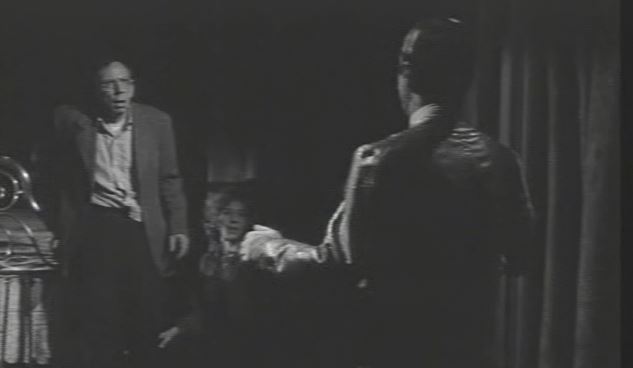
For most of my life, my telephone was listed under the name Norman Bates. It stared as a joke on PacBell... When I first moved out of my parents house at 18, I had a roommate - a guy I worked with at the movie theater. The apartment building was a converted motel on the very edge of Walnut Creek, CA - and looked a little like the Bates Motel. A year later when I moved into my own place in Concord, I got my own phone - and thought I try to pull one over on PacBell by claiming my name was Norman Bates and that I was in college studying Hotel & Motel Management. I figured they’d reject it - but they did *zero* credit checks back then. They were the only game in town, so if you didn’t pay your phone bill... well, you didn’t have a phone. There were no other phone companies to go to, no cellular, nothing. So when the new phone book came out, I was like Navin Johnson flipping through to see if my name was listed... well, Norman’s was! Every time I moved, I expected PacBell to figure it out and yank my phone. They never did. When I moved to Los Angeles, I was sure the game was over... but they asked me if I had graduated college and asked if I was working in the Hotel & Motel industry. I said “Yes” and kept Norman Bates as my phone listing... Until a couple of years ago when I moved a couple of blocks down the street into a building that was wired by Sprint - and *they* caught me. So, if you forget my number, you can’t just ask information for Norman Bates anymore.
Most people identify Hitchcock with PSYCHO - even though it is nothing like any of his other films. I think it’s probably the combination of Hitchcock becoming very famous from his popular TV show... and PSYCHO being his biggest hit ever (which really says something - his first US film, REBECCA, won Best Picture Oscar back in 1940). At the time, low budget horror films made by people like William Castle were popular, and Hitchcock thought it would be fun to make one. The plan was to make it cheap, using the crew from his TV show between seasons and the backlot at Universal. I believe he also used his own money - and kept the budget under $1 million. The film was based on a best seller by Robert Bloch (who, along with Richard Matheson, is one of the great horror novelists) and I believe they spent $100k for the rights (10% of the budget!). Screenplay by Joseph Stefano, who created THE OUTER LIMITS TV show.
Hitchcock loved to experiment in movies. He understood the medium like nobody before or after him, but wasn’t satisfied to just make a movie using that knowledge... instead, he was always pushing. Finding new ways to do things. Attempting things that had never been done before (wait until we get to ROPE). Though TOPAZ is a failed experiment, the idea of telling 4 short stories with some of the same characters which add up to a larger story is something that would be later used in PULP FICTION. The novel PSYCHO does some things that work fine in a novel, don’t work at all in a movie. The solution to the main problem may have been solved by Hitchcock or Stefano or both working together - but it’s a very successful experiment in strange storytelling.

** SPOILERS **
PSYCHO switches protagonists a couple of times. That’s easy to do in a novel, but in a movie the audience *becomes* the protagonist for 2 hours, so swapping characters usually just loses audience identification completely. Hollywood is littered with movies that tried this and failed, and landfills are filled with screenplays that tried it and failed. So lets take a look at how they cracked it in PSYCHO....
Nutshell: PSYCHO opens with location and date and time - almost documentary style. The film is shot in black and white in a time when most films were shot in color. The B&W was an artistic choice - to make it look more “real”. Marion Crane (Janet Leigh) and Sam Loomis (John Gavin) are in a cheap hotel, post sex. She’s in white bra and white slip. They are not married - but sleeping together. This was 1960 - when you couldn’t do things like that on film. Sam is divorced and broke - living in the back room of his dead father’s hardware store... can’t afford to get married. Marion is too old to still be single. They need to find some money so they can live happily ever after, but this is the real world.
One of the things I love about old movies is that they often had to find ways to talk about sex, without alarming the censors. This lead to clever dialogue. Here we get Marion talking about licking Sam’s stamps... and can’t help but think about other things. It’s like a discussion of oral sex!
After the “nooner”, Marion returns to the Real Estate office where she works. A wealthy old client completely hits on her - nothing subtle about it - while brandishing a few bundles of hundreds he’s using to buy a house for his 19 year-old daughter. She’s getting married, his wedding gift is a house, he’s paying *cash*. Marion’s boss tells her to take the money to the bank right away - he doesn’t want that kind of money in the office safe. Marion takes the money... home with her.
Marion, black bra and black slip (bad girl) packs suitcases at her apartment... finally packing the big bundles of money in her purse. She gets in her car and drives to Sam’s place... but gets tired and stops at the Bates Motel for the night. With this much money, she can pay off Sam’s debts and they can live happily ever after. Though she’s stealing, we completely understand it, and the horn-dog rich guy kinda deserves to get ripped off. Why should his spoiled 19 year-old daughter get a free house, when Marion and Sam are working hard just to live on the edge of poverty?
At the Bates Motel Hitchcock and Stefano find the key to the protagonist switch experiment. In the novel, Norman is a fat, nasty, hick. In the film, Norman (Tony Perkins) is a fragile young man with too many responsibilities, trapped in a life he doesn’t deserve. We feel sorry for Norman. After Marion checks in, Norman invites her to dinner up at the house... but Marion overhears Norman’s mother yelling at him - verbally abusing him - belittling him - for inviting a strange woman to the house. Marion is eves-dropping, and knows she shouldn’t be listening to a private conversation... but does anyway.
Later, Norman brings sandwiches and milk down from the house, and has dinner with Marion in his parlor behind the office. Here is where the baton is passed from one protagonist to the next, and it’s a brilliant scene. Norman and Marion talk about being trapped in their lives - and we find out that poor Norman has been stuck in this motel his entire life - taking care of his mother. He has no life outside the motel. His mother is demanding and abusive... and a little crazy, but he can’t just abandon her. He can’t afford to send her to a private sanitarium, and the State run facilities are, well, looney bins - he can’t send his mother to someplace like that. Norman is trapped in his life... and we feel sorry for him. We wish he could find some way out of this trap.
At the end of this scene, we don’t leave with Marion... we leave with *Norman*. Norman has become our new protagonist. Before she leaves, Marion hints that she’s going to drive back home and return the money - probably resolving *her* plot problem. But Norman still has a problem - his abusive mother - and we’re gonna stick around and see how he escapes *his* trap.
Just as Marion eves-dropped on Norman, Norman pulls back a painting, uncovering a peephole in the wall, and spies on Marion as she undresses for a shower. But just as she gets down to bra and slip, Norman turns away. Covers the peephole with the painting. There’s something almost innocent about this - he’s a lonely, virgin man... he will spy on a girl in her bra, but seeing her naked is taking it too far. Strange as this seems, when he turns away and replaces the painting, we kind of admire his restraint. And we couldn’t have that admiration unless he was peeping in the first place. It’s like Marion wanting to return he stolen money.
And everything would be happily ever after except for Norman’s mom....
Because she’s afraid that a woman like Marion might lure her son away... and then she’d have no one to take care of her (and no one to verbally abuse). So, she does what any mother in the same position would do... she brutally kills Marion. Now, poor Norman must clean up the mess - blood all over room #1s bathroom, a dead naked woman, her car, her belongings. Norman must get rid of all of it before anyone discovers what his mother has done and puts her in the looney bin.
Title sequence by the great Saul Bass:
Of course, I have my own books focusing on Hitchcock...
HITCHCOCK: MASTERING SUSPENSE
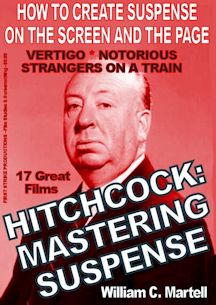
Alfred Hitchcock, who directed 52 movies, was known as the “Master Of Suspense”; but what exactly is suspense and how can *we* master it? How does suspense work? How can *we* create “Hitchcockian” suspense scenes in our screenplays, novels, stories and films?
This book uses seventeen of Hitchcock’s films to show the difference between suspense and surprise, how to use “focus objects” to create suspense, the 20 iconic suspense scenes and situations, how plot twists work, using secrets for suspense, how to use Dread (the cousin of suspense) in horror stories, and dozens of other amazing storytelling lessons. From classics like “Strangers On A Train” and “The Birds” and “Vertigo” and “To Catch A Thief” to older films from the British period like “The 39 Steps” and “The Man Who Knew Too Much” to his hits from the silent era like “The Lodger” (about Jack The Ripper), we’ll look at all of the techniques to create suspense!
Films Included: NOTORIOUS, SABOTAGE, STRANGERS ON A TRAIN, THE 39 STEPS, REBECCA, TO CATCH A THIEF, FRENZY, FOREIGN CORRESPONDENT, THE LODGER, THE BIRDS, TORN CURTAIN, SABOTEUR, VERTIGO, THE MAN WHO KNEW TOO MUCH (1934), THE MAN WHO KNEW TOO MUCH (1955), SUSPICION, and NUMBER SEVENTEEN. 17 Great Films!
Only 125,000 words!
Price: $5.99
Click here for more info!
OTHER COUNTRIES:
UK Folks Click Here.
German Folks Click Here.
French Folks Click Here.
Espania Folks Click Here.
Canadian Folks Click Here.
And....
HITCHCOCK: EXPERIMENTS IN TERROR

USA Readers click here for more info!
HITCHCOCK DID IT FIRST!
We all know that Alfred Hitchcock was the Master Of Suspense, but did you know he was the most *experimental* filmmaker in history?
Contained Thrillers like “Buried”? Serial Protagonists like “Place Beyond The Pines”? Multiple Connecting Stories like “Pulp Fiction”? Same Story Multiple Times like “Run, Lola, Run”? This book focuses on 18 of Hitchcock’s 52 films with wild cinema and story experiments which paved the way for modern films. Almost one hundred different experiments that you may think are recent cinema or story inventions... but some date back to Hitchcock’s *silent* films! We’ll examine these experiments and how they work. Great for film makers, screenwriters, film fans, producers and directors.
Films Examined: “Rear Window”, “Psycho”, “Family Plot”, “Topaz”, “Rope”, “The Wrong Man”, “Easy Virtue”, “Lifeboat”, “Bon Voyage”, “Aventure Malgache”, “Elstree Calling”, “Dial M for Murder”, “Stage Fright”, “Champagne”, “Spellbound”, “I Confess”, and “The Trouble with Harry”, with glances at “Vertigo” and several others.
Professional screenwriter William C. Martell takes you into the world of The Master Of Suspense and shows you the daring experiments that changed cinema. Over 77,000 words.
UK Folks Click Here.
German Folks Click Here.
French Folks Click Here.
Espania Folks Click Here.
Canadian Folks Click Here.
- Bill
BUY THE DVD AT AMAZON: