The adventures of a professional screenwriter and sometimes film festival jurist, slogging through the trenches of Hollywood, writing movies that you have never heard of, and getting no respect. Voted #10 - Best Blogs For Screenwriters - Bachelor's Degree
Since the "birthday" of Hitch's THE BIRDS was last week, how about one of the stars remembering the making if the film? Veronica Cartwight is one of my movie crushes, and I first saw her in this movie when I was a kid. As an adult, she's the quirky actress in ALIEN and the 70s INVASION OF THE BODYSNATCHERS and WITCHES OF EASTWICK and GOIN' SOUTH and so many orher movies and TV shows. Always interesting on screen.
- Bill
Of course, I have my own books focusing on Hitchcock...
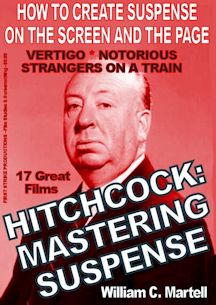
HITCHCOCK: MASTERING SUSPENSE
LEARN SUSPENSE FROM THE MASTER!
Alfred Hitchcock, who directed 52 movies, was known as the “Master Of Suspense”; but what exactly is suspense and how can *we* master it? How does suspense work? How can *we* create “Hitchcockian” suspense scenes in our screenplays, novels, stories and films?
This book uses seventeen of Hitchcock’s films to show the difference between suspense and surprise, how to use “focus objects” to create suspense, the 20 iconic suspense scenes and situations, how plot twists work, using secrets for suspense, how to use Dread (the cousin of suspense) in horror stories, and dozens of other amazing storytelling lessons. From classics like “Strangers On A Train” and “The Birds” and “Vertigo” and “To Catch A Thief” to older films from the British period like “The 39 Steps” and “The Man Who Knew Too Much” to his hits from the silent era like “The Lodger” (about Jack The Ripper), we’ll look at all of the techniques to create suspense!
Films Included: NOTORIOUS, SABOTAGE, STRANGERS ON A TRAIN, THE 39 STEPS, REBECCA, TO CATCH A THIEF, FRENZY, FOREIGN CORRESPONDENT, THE LODGER, THE BIRDS, TORN CURTAIN, SABOTEUR, VERTIGO, THE MAN WHO KNEW TOO MUCH (1934), THE MAN WHO KNEW TOO MUCH (1955), SUSPICION, and NUMBER SEVENTEEN. 17 Great Films!
We all know that Alfred Hitchcock was the Master Of Suspense, but did you know he was the most *experimental* filmmaker in history?
Contained Thrillers like “Buried”? Serial Protagonists like “Place Beyond The Pines”? Multiple Connecting Stories like “Pulp Fiction”? Same Story Multiple Times like “Run, Lola, Run”? This book focuses on 18 of Hitchcock’s 52 films with wild cinema and story experiments which paved the way for modern films. Almost one hundred different experiments that you may think are recent cinema or story inventions... but some date back to Hitchcock’s *silent* films! We’ll examine these experiments and how they work. Great for film makers, screenwriters, film fans, producers and directors.
Films Examined: “Rear Window”, “Psycho”, “Family Plot”, “Topaz”, “Rope”, “The Wrong Man”, “Easy Virtue”, “Lifeboat”, “Bon Voyage”, “Aventure Malgache”, “Elstree Calling”, “Dial M for Murder”, “Stage Fright”, “Champagne”, “Spellbound”, “I Confess”, and “The Trouble with Harry”, with glances at “Vertigo” and several others.
Professional screenwriter William C. Martell takes you into the world of The Master Of Suspense and shows you the daring experiments that changed cinema. Over 77,000 words.
Today is the day in the United States where we honor our fallen soldiers: soldiers and sailors and marines and air force folks and everyone else who have died defending this country. I grew up during an unpopular war (Viet Nam) and the mistake then was to transfer feelings about the war to those people who were fighting it - usually poor kids who had no way to avoid the draft, and were doing their best to serve their country. I think we have all learned from that mistake - no matter what we think about war, the people fighting it who *gave their lives* to serve their country deserve our respect. Defending our freedom is the most important thing someone can do. Those who want to take away or limit our freedom must be fought, both abroad and in this country. All people are created equal, all people have rights to live their lives as they desire as long as that doesn't infringe on the rights of others. When our soldiers fight for those human rights and die, that is the greatest sacrifice. Today we mourn them.
And note: Memorial Day is set aside for those who *gave their lives*, not those who are still alive (that's what Veteran's Day is for). So please, honor our fallen soldiers and sailors and air force and marines today.
These are from of my favorite war movies that show the courage of our men and women in uniform...
THE BIG RED ONE (1980) written & directed by the great Sam Fuller. Unfortunately this is the trailer for the re-release...
GO FOR BROKE (1951)...
\
GARDENS OF STONE (1987) Directed by Francis Ford Coppola.
A clip from STEEL HELMET (1951) directed by Sam Fuller...
FIXED BAYONETTES (1951) also directed by Sam Fuller...
THE BOYS IN COMPANY C (1978) directed by Sidney Furie...
Those are some of my favorites, and if there are any that you haven't seen - check them out. And take some time today to thank and be thankful to those people who have given their lives or gave their lives for this country.
Before we were trying to guess who the singing celebrity was in the Goat costume, we were just trying to guess who the celebrity was on WHAT'S MY LINE - a version of "20 Questions" where a panel of blindfolded semi-celebrities (often chosen for their ability to say funny things off the top of their heads) tried to guess the occupation of a mystery guest. One of the great things about this show was that they often had guests in unusual occuplations, or occupations that were not associated with that sex or race or whatever - which ended up being a lesson in racism and sexism for the TV viewers (I didn't know women were allowed to be airline pilots!). And the audience began to realize that they had a preconcieved notion about who could do what, and (hopefully) began to see that anyone could do anything. Some people might think that shows like this "Didn't age well" - but they often point out that *we* are the ones who have grown up. *We* were the ones who had trouble believing that women could be airline pilots or whetever, and maybe make us think about what we currently have preconcieved notions about. Will people look back on us in 2021 and think we "didn't age well"? Maybe we'd better start taking a look at ourselves *now*?
But instead of a female airline pilot, here we have a mystery guest who is the master of suspense...
And now we return you to 2022...
- Bill
Of course, I have a couple of books about Hitchcock....
HITCHCOCK: MASTERING SUSPENSE
LEARN SUSPENSE FROM THE MASTER!
Alfred Hitchcock, who directed 52 movies, was known as the “Master Of Suspense”; but what exactly is suspense and how can *we* master it? How does suspense work? How can *we* create “Hitchcockian” suspense scenes in our screenplays, novels, stories and films?
This book uses seventeen of Hitchcock’s films to show the difference between suspense and surprise, how to use “focus objects” to create suspense, the 20 iconic suspense scenes and situations, how plot twists work, using secrets for suspense, how to use Dread (the cousin of suspense) in horror stories, and dozens of other amazing storytelling lessons. From classics like “Strangers On A Train” and “The Birds” and “Vertigo” and “To Catch A Thief” to older films from the British period like “The 39 Steps” and “The Man Who Knew Too Much” to his hits from the silent era like “The Lodger” (about Jack The Ripper), we’ll look at all of the techniques to create suspense!
Films Included: NOTORIOUS, SABOTAGE, STRANGERS ON A TRAIN, THE 39 STEPS, REBECCA, TO CATCH A THIEF, FRENZY, FOREIGN CORRESPONDENT, THE LODGER, THE BIRDS, TORN CURTAIN, SABOTEUR, VERTIGO, THE MAN WHO KNEW TOO MUCH (1934), THE MAN WHO KNEW TOO MUCH (1955), SUSPICION, and NUMBER SEVENTEEN. 17 Great Films!
We all know that Alfred Hitchcock was the Master Of Suspense, but did you know he was the most *experimental* filmmaker in history?
Contained Thrillers like “Buried”? Serial Protagonists like “Place Beyond The Pines”? Multiple Connecting Stories like “Pulp Fiction”? Same Story Multiple Times like “Run, Lola, Run”? This book focuses on 18 of Hitchcock’s 53 films with wild cinema and story experiments which paved the way for modern films. Almost one hundred different experiments that you may think are recent cinema or story inventions... but some date back to Hitchcock’s *silent* films! We’ll examine these experiments and how they work. Great for film makers, screenwriters, film fans, producers and directors.
Films Examined: “Rear Window”, “Psycho”, “Family Plot”, “Topaz”, “Rope”, “The Wrong Man”, “Easy Virtue”, “Lifeboat”, “Bon Voyage”, “Aventure Malgache”, “Elstree Calling”, “Dial M for Murder”, “Stage Fright”, “Champagne”, “Spellbound”, “I Confess”, and “The Trouble with Harry”, with glances at “Vertigo” and several others.
Professional screenwriter William C. Martell takes you into the world of The Master Of Suspense and shows you the daring experiments that changed cinema. Over 77,000 words.
Screenwriter John Michael Hayes was born on May 11, 1919 in Worcester, Massachusetts.
Hayes was one of the first screenwriters I noticed. After watching a ton of movies, and realizing that someone had to write them, I started looking at the names of the writers in the credits of some of my favorite movies... and noticed Hayes’ name popping up again and again in Hitchcock films. He scripted REAR WINDOW from a short story I had read by one of my favorite fiction writers, Cornell Woolrich. Because I knew the short story, I also knew what was invented and changed for the movie - a bunch of stuff! Great stuff! Practically the whole movie is new material, since the story is about an invalid man and his male servant and the murder across the courtyard. I realized that for movies, they didn't just take the book and reformat it - they had to completely rethink it for the screen. The short story - "It Had To Be Murder" - takes place almost entirely in the protagonist's mind. He *thinks* he saw a murder across the courtyard. There are no other suspects or characters (except for his male servant), so it's a whole story about what the protagonist think... and that's not a movie! A movie is what we see and hear (that results in what we feel). Hayes also wrote the remake of THE MAN WHO KNEW TOO MUCH and THE TROUBLE WITH HARRY and TO CATCH A THIEF for Hitchcock.
Hayes began as a newspaper reporter - like many other screenwriters. Writing the news meant dealing with crazy deadlines, and being able to spot the story and why it mattered and how to make the readers care... and doing that day after day after day. Much of that applies tro screenwriting as well, but after serving in the Army in WW2, Hayes moved to California and began writing for Radio Dramas like "Sam Spade" and "Inner Sanctum" - both were top shows. His first credit was for the TV series SUSPENSE in 1951 (adaptations of his radio scripts), and his first film credit was Budd Boetticher's RED BALL EXPRESS in 1952 (about Army truck drivers). The following year, 3 films including Anthony Mann's THUNDER BAY starring Jimmy Stewart, TORCH SONG starring Joan Crawford, and WAR ARROW with Maureen O'Hara and Jeff Chandler... which is a lot of star power for his 2nd, 3rd, and 4th films. Since Stewart was in THUNDER BAY, he might have had something to do with hiring Hayes to write REAR WINDOW.
In the middle of those 4 films for Hitch, was A DOG'S LIFE - a story from the point of view of a dog!
In 1957 he adapted the big best seller PEYTON PLACE into a hit movie.
Then high profile adaptations: Thorton Wilder's play THE MATCHMAKER and Terrence Rattigan's SEPERATE TABLES (1958), Samson Raphaelson's BUT NOT FOR ME (1959), John O'Hara's BUTTERFIELD 8 (1960), Hellman's CHILDREN'S HOUR (hey, Sam Spade!)(1961), Enid Bagnold's CHALK GARDEN (1964), Harold Robbins' THE CHARPET BAGGERS and Harold Robbins' WHERE HAS LOVE GONE? (both 1964), HARLOW (1965), Lawrence Durrell's JUDITH (1965), Harold Robbins' NEVADA SMITH (1966), uncredited work on WALKING TALL (1973), and his final credit was IRON WILL in 1994. He died in 2008... at 89 years old.
One of the interesting things about Hitchcock was that he was loyal to his writers. If he got along with a writer and that writer did good work - he just kept working with them. Because Hitch was turning out movies and later had his TV show and other things that took up his time, he needed screenwtriters who he could trust to go off and write the screenplay on their own. Even in the silent films, you will see the same names again and again (Elliot Stannard!).
But in addition to knowing Hayes from REAR WINDOW, I also knew Hayes from his script of Lillian Hellman’s play THE CHILDREN’S HOUR, the version that starred James Garner. I played that role in my High School theater department version. I was talking about CHILDREN’S HOUR on the day Hayes died, because I had just seen a screening of DOUBT - which is pretty much the same story but set in a Catholic school. And I knew Hayes from HARLOW and THE CARPET BAGGERS and NEVADA SMITH... and WALKING TALL. His name popped up on a bunch of films I’d seen.
Hayes career as a radio writer also had some connections with me - I had some of those SAM SPADE shows on tape when I was a kid) and INNER SANCTUM (had a bunch of those on tape, too). After writing 1,500 radio scripts, he started writing movies and became Hitchcock’s main writer... which made him one of the top writers in town. Intreresting that his last produced script was the Disney dog sled movie IRON WILL in 1994 - which I think I saw on opening night!
What were the first screenwriters you noticed?
- Bill
My books on Hitchcock's films...
HITCHCOCK: MASTERING SUSPENSE
LEARN SUSPENSE FROM THE MASTER!
Alfred Hitchcock, who directed 52 movies, was known as the “Master Of Suspense”; but what exactly is suspense and how can *we* master it? How does suspense work? How can *we* create “Hitchcockian” suspense scenes in our screenplays, novels, stories and films?
This book uses seventeen of Hitchcock’s films to show the difference between suspense and surprise, how to use “focus objects” to create suspense, the 20 iconic suspense scenes and situations, how plot twists work, using secrets for suspense, how to use Dread (the cousin of suspense) in horror stories, and dozens of other amazing storytelling lessons. From classics like “Strangers On A Train” and “The Birds” and “Vertigo” and “To Catch A Thief” to older films from the British period like “The 39 Steps” and “The Man Who Knew Too Much” to his hits from the silent era like “The Lodger” (about Jack The Ripper), we’ll look at all of the techniques to create suspense!
Films Included: NOTORIOUS, SABOTAGE, STRANGERS ON A TRAIN, THE 39 STEPS, REBECCA, TO CATCH A THIEF, FRENZY, FOREIGN CORRESPONDENT, THE LODGER, THE BIRDS, TORN CURTAIN, SABOTEUR, VERTIGO, THE MAN WHO KNEW TOO MUCH (1934), THE MAN WHO KNEW TOO MUCH (1955), SUSPICION, and NUMBER SEVENTEEN. 17 Great Films!
We all know that Alfred Hitchcock was the Master Of Suspense, but did you know he was the most *experimental* filmmaker in history?
Contained Thrillers like “Buried”? Serial Protagonists like “Place Beyond The Pines”? Multiple Connecting Stories like “Pulp Fiction”? Same Story Multiple Times like “Run, Lola, Run”? This book focuses on 18 of Hitchcock’s 52 films with wild cinema and story experiments which paved the way for modern films. Almost one hundred different experiments that you may think are recent cinema or story inventions... but some date back to Hitchcock’s *silent* films! We’ll examine these experiments and how they work. Great for film makers, screenwriters, film fans, producers and directors.
Films Examined: “Rear Window”, “Psycho”, “Family Plot”, “Topaz”, “Rope”, “The Wrong Man”, “Easy Virtue”, “Lifeboat”, “Bon Voyage”, “Aventure Malgache”, “Elstree Calling”, “Dial M for Murder”, “Stage Fright”, “Champagne”, “Spellbound”, “I Confess”, and “The Trouble with Harry”, with glances at “Vertigo” and several others.
Professional screenwriter William C. Martell takes you into the world of The Master Of Suspense and shows you the daring experiments that changed cinema. Over 77,000 words.
This is a great new documentary series called HITCH 20 that looks at the 20 TV episodes directed by Hitchcock and here is the last episode of the third season on THE CRYSTAL TRENCH and the importance of locations in story.
CRYSTAL TRENCH extras...
In this episode we look at the relationship between story and location, and how a location can be a character in your story. In an old article in Script Magazine called HITCHCOCK’S CHOCOLATES we sweated the small stuff and looked at the relationship between characters, their tools, and their environment. Using location and props to help tell your story. How do you keep all of these elements organic, and even explore theme through location?
"One of the interesting aspects of "The Secret Agent" is that it takes place in Switzerland," Hitchcock says in HITCHCOCK/TRUFFAUT (1967 Simon And Schuster). "I said to myself, What do they have in Switzerland? They have milk chocolate, they have the Alps, they have village dances, and they have lakes. All of these ingredients were woven into the story. Local topographical features can be used dramatically as well. We used lakes for drowning and the Alps to have our characters fall into crevasses."
IS THIS THE RIGHT PLACE?
Most of us give little thought to our locations, using them only as backgrounds for our stories. They end up little more than theatrical flats - a two dimensional painting of a street our characters act in front of. But location can influence story, and story elements can grow from a location.
A man walking down a dark alley.
A man walking in a park filled with children.
Both scenes show a man walking, but each 'background' will have a different effect on the audience, and on the character's mood and actions. The location changes effects the character and the character effects the direction of the story.
Orson Welles' brilliant THE LADY FROM SHANGHAI (based on a novel by Sherwood King) takes place in San Francisco and uses the location to advance the story. The story of a yacht captain (Welles) who becomes involved with a beautiful woman (Rita Hayworth) and her evil husband (Everett Sloan) in a strange fake murder for life insurance scheme is like a check list of San Francisco landmarks. From Chinatown to Sausalito to Steinhart Aquarium to Playland At The Beach amusement park.
In LADY FROM SHANGHAI locations are not just background to the story, they help shape it. When the scheme goes wrong and Welles is hunted through the city by the police - no one to turn to - he hides in a Chinatown theater. Surrounded by people speaking a strange language, laughing at jokes he doesn't understand, the character is out-numbered and alone simultaneously. The choice of environment strengthens the emotions in the scene.
My DEAD RUN script is a fast paced thriller about a conspiracy to keep a murdered political candidate alive through CGI computer animation. The logical location for this story was someplace where the computer industry has deep roots. Silicon Valley was the obvious choice, but I went with the second city on my list: Seattle, Washington.
What do we find in Seattle? The Space Needle, the logging industry, gourmet coffee shops, grunge-rockers, the monorail, Puget Sound, trolley cars, and Ballard Locks Park all made my list.
Then I decided what scenes would gain the most from each of my locations. The sunny Ballard Locks Park seemed like a perfect place for a sniper attack, my end action scene would be on the Space Needle, and I could use the monorail in a chase scene. My candidate would be involved in logging and environmental issues. Everything on my location list helped to shape the final script. The plot helped me choose the city, but each individual setting influenced the way scenes played. I used the location not just as a background, but to help tell the story.
It's important to make sure your story matches the location, that the story grows naturally from the location and vice versa. You want to find the most effective setting for your story. If you are writing a script about a pair of doomed lovers, can you think of a better location than a sinking ship? The minute Jack and Rose meet each other on the Titanic, the clock is ticking. We know their relationship will be over as soon as that ship sinks. Doomed lovers, doomed location. The location is an organic part of the story.
In THE CRYSTAL TRENCH that glacier *is* a character in the story, as is the mountain the men are climbing. How could this story work in a desert? In a city? On a farm? The story is all about the glacier!
TWO TOOLS FOR SISTER SARAH
"In Hitchcock’s THE MAN WHO KNEW TOO MUCH, James Stewart plays a doctor, and behaves like one throughout the whole picture," Francios Truffaut says in HITCHCOCK/TRUFFAUT. "His line of work is deliberately blended into the action. For instance, before telling Doris Day that their child has been kidnapped, he makes her take a sedative." Stewart's character prepares the sedative calmly, professionally. He's using the tools and methods familiar to him to solve the immediate problem.
Characters will always use familiar tools, given the choice. Tools are an extension of occupation, and occupation is an extension of character and theme. A plumber with a slide rule or a nun with a machine gun seems strange. A character s choice of tools gives us insight into his or her personality and background. They are more than just props.
In Robert Benton's KRAMER VS. KRAMER Dustin Hoffman's wife runs off to find herself, leaving him to take care of his young son. The first morning without Mom, Hoffman has to prepare breakfast. Hoffman is used to grabbing a cup of coffee on the way out the door... that's the extent of his breakfast knowledge.
His son wants french toast. So Hoffman grabs the tools he is familiar with to make the french toast. Instead of using a bowl and a whisk, he uses a coffee cup and a spoon. Breaks the eggs into the cup, beats the eggs with the spoon, then tries to dip the bread in the egg batter. His attempt to make french toast is a complete failure. He will have to learn how to use new tools as a single dad.
In my NIGHT HUNTER film, Don "The Dragon" Wilson plays the last of the vampire hunters, drifting from town to town on the trail of blood suckers. I envisioned him as a man without friends, without family, without a home. Homeless.
In the script when all of his vampire killing tools are taken away from him by the police, he is forced to find new equipment. Would he go into a store and buy it? Not in character. He's homeless, he dumpster dives. He turns discarded items found in the trash into lethal killing tools. Tools that fit his character. One hundred percent organic.
In CRYSTAL TRENCH we not only have the mountain climbing tools, we have that great telescope focused on the side of the mountain that features in scene after scene. The great thing about that telescope is that it’s not only a tool, it’s what I call a “Twitch” in my “Secrets Of Action Screenwriting” book - it’s a physical device that symbolizes an emotional conflict. It’s focused on the dead men, right? So the telescope *becomes* the dead men - a way to have them in a scene when they are actually on the side of the mountain many miles away.
Make a list of your character's "familiar tools", those things they're most comfortable using. These will be the first thing they reach for when they're trying to solve a problem. Tools they know how to use. Tools they know how to use. Tools which help illuminate character through actions.
STOCK COMPANY
In previous episodes of HITCH 20 we’ve talked about Hitchcock’s “stock company” of actors, and I look at Hitch’s loyalty to cast and crew members in HITCHCOCK: MASTERING SUSPENSE. Though many of the HITCH 20 episodes feature John Williams (the actor, not the composer) these past two episodes have featured THE AVENGERS’ Patrick Macnee. In ARTHUR he was the town constable, and here he’s the glacier expert - two very different characters!
This brings the third season of HITCH 20 to a close...
Of course, I have my own books on Hitchcock...
HITCHCOCK: MASTERING SUSPENSE
LEARN SUSPENSE FROM THE MASTER!
Alfred Hitchcock, who directed 52 movies, was known as the “Master Of Suspense”; but what exactly is suspense and how can *we* master it? How does suspense work? How can *we* create “Hitchcockian” suspense scenes in our screenplays, novels, stories and films?
This book uses seventeen of Hitchcock’s films to show the difference between suspense and surprise, how to use “focus objects” to create suspense, the 20 iconic suspense scenes and situations, how plot twists work, using secrets for suspense, how to use Dread (the cousin of suspense) in horror stories, and dozens of other amazing storytelling lessons. From classics like “Strangers On A Train” and “The Birds” and “Vertigo” and “To Catch A Thief” to older films from the British period like “The 39 Steps” and “The Man Who Knew Too Much” to his hits from the silent era like “The Lodger” (about Jack The Ripper), we’ll look at all of the techniques to create suspense!
Films Included: NOTORIOUS, SABOTAGE, STRANGERS ON A TRAIN, THE 39 STEPS, REBECCA, TO CATCH A THIEF, FRENZY, FOREIGN CORRESPONDENT, THE LODGER, THE BIRDS, TORN CURTAIN, SABOTEUR, VERTIGO, THE MAN WHO KNEW TOO MUCH (1934), THE MAN WHO KNEW TOO MUCH (1955), SUSPICION, and NUMBER SEVENTEEN. 17 Great Films!
We all know that Alfred Hitchcock was the Master Of Suspense, but did you know he was the most *experimental* filmmaker in history?
Contained Thrillers like “Buried”? Serial Protagonists like “Place Beyond The Pines”? Multiple Connecting Stories like “Pulp Fiction”? Same Story Multiple Times like “Run, Lola, Run”? This book focuses on 18 of Hitchcock’s 53 films with wild cinema and story experiments which paved the way for modern films. Almost one hundred different experiments that you may think are recent cinema or story inventions... but some date back to Hitchcock’s *silent* films! We’ll examine these experiments and how they work. Great for film makers, screenwriters, film fans, producers and directors.
Films Examined: “Rear Window”, “Psycho”, “Family Plot”, “Topaz”, “Rope”, “The Wrong Man”, “Easy Virtue”, “Lifeboat”, “Bon Voyage”, “Aventure Malgache”, “Elstree Calling”, “Dial M for Murder”, “Stage Fright”, “Champagne”, “Spellbound”, “I Confess”, and “The Trouble with Harry”, with glances at “Vertigo” and several others.
Professional screenwriter William C. Martell takes you into the world of The Master Of Suspense and shows you the daring experiments that changed cinema. Over 77,000 words.