Friday, August 30, 2024

Fridays With Hitchcock:
Robert Rodriguez on Spellbound

Fridays With Hitchcock this week features the director of EL MARIACHI Robert Rodriguez on that wacky dream sequence in SPELLBOUND:


And here is that dream sequence:


Bill


Of course, I have a couple of books about Hitchcock...

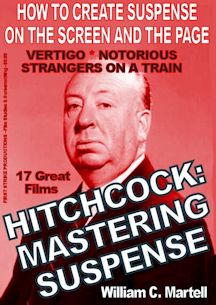
HITCHCOCK: MASTERING SUSPENSE


LEARN SUSPENSE FROM THE MASTER!

Alfred Hitchcock, who directed 52 movies, was known as the “Master Of Suspense”; but what exactly is suspense and how can *we* master it? How does suspense work? How can *we* create “Hitchcockian” suspense scenes in our screenplays, novels, stories and films?

This book uses seventeen of Hitchcock’s films to show the difference between suspense and surprise, how to use “focus objects” to create suspense, the 20 iconic suspense scenes and situations, how plot twists work, using secrets for suspense, how to use Dread (the cousin of suspense) in horror stories, and dozens of other amazing storytelling lessons. From classics like “Strangers On A Train” and “The Birds” and “Vertigo” and “To Catch A Thief” to older films from the British period like “The 39 Steps” and “The Man Who Knew Too Much” to his hits from the silent era like “The Lodger” (about Jack The Ripper), we’ll look at all of the techniques to create suspense!

Films Included: NOTORIOUS, SABOTAGE, STRANGERS ON A TRAIN, THE 39 STEPS, REBECCA, TO CATCH A THIEF, FRENZY, FOREIGN CORRESPONDENT, THE LODGER, THE BIRDS, TORN CURTAIN, SABOTEUR, VERTIGO, THE MAN WHO KNEW TOO MUCH (1934), THE MAN WHO KNEW TOO MUCH (1955), SUSPICION, and NUMBER SEVENTEEN. 17 Great Films!

369 pages packed with information!

Price: $5.99

Click here for more info!

OTHER COUNTRIES:

UK Folks Click Here.

German Folks Click Here.

French Folks Click Here.

Espania Folks Click Here.

Canadian Folks Click Here.

And...


HITCHCOCK: EXPERIMENTS IN TERROR


ON SALE!!! $2 OFF!

Click here for more info!

HITCHCOCK DID IT FIRST!

We all know that Alfred Hitchcock was the Master Of Suspense, but did you know he was the most *experimental* filmmaker in history?

Contained Thrillers like “Buried”? Serial Protagonists like “Place Beyond The Pines”? Multiple Connecting Stories like “Pulp Fiction”? Same Story Multiple Times like “Run, Lola, Run”? This book focuses on 18 of Hitchcock’s 53 films with wild cinema and story experiments which paved the way for modern films. Almost one hundred different experiments that you may think are recent cinema or story inventions... but some date back to Hitchcock’s *silent* films! We’ll examine these experiments and how they work. Great for film makers, screenwriters, film fans, producers and directors.

Films Examined: “Rear Window”, “Psycho”, “Family Plot”, “Topaz”, “Rope”, “The Wrong Man”, “Easy Virtue”, “Lifeboat”, “Bon Voyage”, “Aventure Malgache”, “Elstree Calling”, “Dial M for Murder”, “Stage Fright”, “Champagne”, “Spellbound”, “I Confess”, and “The Trouble with Harry”, with glances at “Vertigo” and several others.

Professional screenwriter William C. Martell takes you into the world of The Master Of Suspense and shows you the daring experiments that changed cinema. Over 77,000 words.

SALE: $3.99

UK Folks Click Here.

German Folks Click Here.

French Folks Click Here.

Espania Folks Click Here.

Canadian Folks Click Here.

- Bill

Wednesday, August 28, 2024

ATLiH: Stunt Trouble

ALL THE LOSERS IN HOLLYWOOD...

One night, sitting in Residuals Bar in Studio City (where the DRAGONHEART script was conceived) and drinking a Guiness, I was telling one of the stories that usually end up on this blog - a story about some poor misguided person in the film biz, and one of my friends said: “Where do you find these people?” I replied, “I bet I know all the losers in Hollywood”.... and they said that should be the title of my autobiography (or this blog). But instead, this blog ened up being called SEX IN A SUBMARINE due to a crazy script note I got from HBO on CRASH DIVE, and ALL THE LOSERS IN HOLLYWOOD was a title without a story... until now.

When looking for regular features for the blog, I thought it would be fun to tell a bunch of those stories of the oddballs I’ve met in the almost 30 years I’ve been in this business. I’m changing all of the names to protect the very very guilty (and avoid meeting lawyers) but the stories you are about to read are true... well, mostly true.

STUNT TROUBLE

For some reason, I know a bunch of stuntmen and special effects guys. My friend Rick’s friend Chuck rolled down the stairs at the end of THE EXORCIST and then, the next day, fell off the top of the Space Needle in PARALLAX VIEW. He’s an interesting guy - he’s worked on almost every Clint Eastwood movie and is still working now... even though he is no longer a young man. I’ll bet I know at least one stuntman on every U.S. movie that hits the big screen... and DVD. For this little story. I’m going to either change the names or leave them out... since these stuntmen want to keep working.

There is this low budget company that began by making low-end direct to video horror films. The company began as a distributor - and that’s really what studios like Paramount and Warner Brothers and Universal are - they distribute films. This company is way way way down the list from those studios. They “buy” a completed low budget film from an indie filmmaker (usually horror), then take it to American Film Market and sell foreign territories for as much as they can get... then release the film on DVD in the USA. They probably began with a boiler room, with out of work actors on the phone selling the movies to mom & pop video stores. Doing a hard sell, because these films have no stars in the cast, and probably no one who can even act in the cast. Plus, they were made on a shoe string and probably look like crap.

The problem these companies have is that they are dependent on the indie producers to make a film they can sell. As you know from my Trilogy Of Terror blog entries, most indie producers don’t have a clue... and end up making horror movies without any horror. I have no idea why they do this. But these really low end distribs have to wade through all of those movies, trying to find a horror film with some horror in it... at least enough to cut together a trailer. Eventually they find some indie filmmakers that have a clue, and they work with those guys - often telling them what sort of horror movie they would buy, so that the indie filmmaker can make that film. But people who have a clue tend to move on to bigger and better distribs... so eventually these low end companies decide it would be much easier to just make the films themselves.

And they start doing “in house” - making their own films.

Now, the creative force behind these films... are salesmen. The guys who sell the films at AFM or have graduated from the boiler room to VP Sales. They are not writers. They are not directors. They are not even producers. They are SALESMEN. They know what sells (boobs, blood) but know absolutely nothing about story or making movies.

They do know that if they are going to make a lot of money on these films, they have to be made for pocket change. So this company makes movies for $100k maximum and pays $1k for the screenplay. They started out paying $2k, but discovered the writer who would take $2k would take $1k. So why not pay the writer less and pocket the difference?

Now, here’s where it gets really good. At the company in this story, after they pay the writer $1k for the script, one of the salesmen does a rewrite. They don’t hire a writer to do the rewrite, because writers don’t know *what sells* the way a salesman does. This company makes over a dozen films a year - and has a deal with Blockbuster video. I have no idea how much Blockbuster pays them per film, but they make them for $100k. SAG signatory (extreme low budget deal) so they can get some names in the cast.

YOU GET WHAT YOU PAY FOR

So one of my stunman friends gets hired to work on a film from this company. The company has decided horror movies are oversaturated, so they’ve decided to make an action flick. Hey, and they are going to spend a little more (because they have to). My friend is a stuntman who wants to become a stunt coordinator (a step up) and they hire him in that position. He reads the script, and it’s not great, but it’s okay.

He goes to the first production meeting and discovers there is very little money in the stunt budget, but a whole lotta action in the script. My friend doesn’t want to be stunt coordinator on a film with very few stunts, how would that look on his resume? He wants to get a bunch of great clips for his reel out of this film, so that he never has to work for a company this low on the totem pole ever again. That means he’s going to have to pull favors.

He realizes the best way to get good clips on *his* reel is to find other stuntmen friends who want good clips on their reels. So he asks all of his buddies what stunts they have always wanted to do... stunts they would do just to have them on their reel (so that other companies will hire them at top dollar to do the same stunts in much better films). My friend goes back to the “producers” with a list of “stunts at cost” and they work them into the script. This is easier than you might think, since action films tend to have the same basic stunts. There are car chases and a high fall and fist fights and things like that.

Now, at this budget, the most impressive “stunt at cost” he can get is a car doing a multiple roll and exploding. My friend knows a stuntman who has always wanted a big car roll on his reel. If you’ve seen THE KINGDOM, you know that a good car roll can be really impressive. The SUV chase and explosion in that film is just amazing. There’s a behind the scenes on HBO that shows how they did it - and *that* is amazing. Back in the 70s when John Wayne was losing popularity, he made a film called McQ where he played a Dirty Harry type cop - and to sell the film, they did a record breaking car roll. The only reason why I own that film on DVD - the car roll.

Now, the car roll stuntman has never done one of these before, so he pulls all of *his* favors - and gets five top stunt guys in Hollywood to help him with his first car roll (and be there to watch... so they might hire him or recommend him later). They buy a car, build a roll cage, do all of the prep stuff. These expenses come out of pocket, now - the stuntguy will be paid for after the stunt. The stuntguy gets a pyrotech friend of his to explode a second car for cost. They will need an ambulance and a water truck on set for this... but the “producers” argue that they can do without both. The producers are thinking they can save money... and pocket it. What’s more, the ambulance and water truck and Fire Marshal don’t show up on film, so why pay for them? If it’s not on screen, it’s not important.

Well, the law says differently, so the producers are forced to comply. The producers will take care of the water truck and ambulance and Fire Marshal... because they are afraid if my friend the stunt coordinator does it, he won’t get the best price.

A week before the film goes into production, one of the two salesmen who own the company does his script rewrite... and now the script is much much worse than when my friend signed on. Now it’s crap. But the two salesmen turned “producers” who own the company think it’s brilliant. They think they know what they are doing, and what is good... and they are wrong.

But my friend thinks that maybe all of the cool stunts will make up for the (now) really bad screenplay....

THE CAR ROLL AND EXPLOSION

The call time is 9am. The stunt guys show up at 9am with the vehicles.... and no one else is there.

No one.

They wait around, and people start trickling in.

The pyro guy wants to run a test - explode the second car with a quarter of the pyro stuff... but there is no fire marshal on set. He asks when the fire marshal is supposed to show, and the Assistant Director says call time was 9am (even though he didn't show until after 10am himself). But he assured the pyro guy that there was a permit to explode stuff.

Well, the pyro guy *knows* the fire marshal who would be assigned to this film, and calls him. Guess what? There was never a permit. No one ever applied for a permit. This makes the pyro guy angry, but he’s already out here and set up... so he talks to the fire marshal. Smooths things over. Finds a way to make it work. The fire marshal will come out on set and they can fill out the paperwork and get a permit when he arrives. He will allow them to do the explosions (if they have a water truck on site) as soon as he arrives. By the way - this is a huge favor the pyro guy is pulling - he's getting a fire marshal to show up and do a permit on site... and it was the guy's day off.

The fire marshal gives them even a bigger break - he allows the pyro guy to do a test before he arrives.

My friend the stunt coordinator realizes that the test may provide an additional angle of the explosion (this is a low budget film - they have *one* camera to film the explosion) and tells the camera crew he needs a camera set up in 30 minutes. The camera crew seems to be working at their own pace, but assures him that the camera will be ready in half an hour.

Fifteen minutes later, my friend checks in with the camera crew, and they don’t seem to be working very fast. Part of this may be that my friend is the stunt coordinator, not the director... but it’s not like the camera crew is doing anything else. Today is a stunt day - it’s all about the stunt. The director, who is somewhere at the location on his cell phone talking to someone about something that has nothing to do with the movie. Seems not to care. I have no idea what they pay the directors on these films, but if the writer’s fee is any indicator, the director is probably making minimum wage. Now. I have this belief that what you are getting paid should have nothing to do with the amount of energy and enthusiasm you give a project. If you decide to do a crappy job because you are being paid crap... you won’t ever be offered a better job. Anyway, neither the director nor the camera guys seemed to give a damn.

This stunt man is going to risk his life by the end of the day, doing a dangerous car roll for peanuts, and the camera guys and director don’t care.

Half an hour later, the car is ready to explode... the camera is not ready to shoot. Now, my friend thinks the test explosion is pretty important on a low budget film... so he begs the pryo guy to give them another half hour to get the camera set up. Then he tells the camera crew that they have a half hour to get the camera set up and pointed at the car that is going to explode. If they aren’t ready in half an hour, they will explode the car anyway.

A half hour later, the camera is still not ready, and the pyro guy says he's going to do his test. The test is cool... and not on film.

When the camera finally is ready, the stunt guy gets ready to do his car roll. All of his buddies - big time stunt guys - are there to see the big event... and maybe pull him from the wreckage if things go wrong. They give him last minute advice on how to do the car roll, things to watch out for, things to remember... Then they all shake his hand. He’s about to do something very dangerous... roll a car over several times *on purpose*. Stuntmen are crazy.

The stuntguy asks when the ambulance is going to show, the Assistant Director says, “I don't know, but we're behind time, so just do it.”

The stuntguy thinks that is a very bad idea - they are *miles* from the nearest town out in the middle of nowhere. He asks how far the nearest hospital is - and the AD doesn't know. Folks, in case you don't know - the rules say they need to know where the nearest hospital is, and have directions on how to get there, even if all they are shooting is a *dialogue scene*. Usually the map to the hospital, along with all of the emergency numbers, is on the back of the call sheet. If a film is shooting a dialogue scene and someone gets hurt, has a heart attack, whatever, they need to know where the nearest hospital is.

This is a day where they are doing dangerous stunts *and* explosions and the Assistant Director has no idea where the nearest hospital is... not even the phone number!

Well, the stuntguy blows his top. The AD gets on the phone to one of the two salesmen turned film producers who run this company and explains that the stuntguy refuses to do the stunt unless they have an ambulance. The “producer” asks if an ambulance is really required? Maybe he can talk the stuntguy into doing the car roll without it, put him on the phone.

The stuntguy controls his temper as he explains how dangerous this stunt is. They have the car with the roll-cage, they have all of the safety equipment, they have a stunt team... it would be a shame to lose the stunt because they don’t have an ambulance. The “producer” tells the AD it's up to him to get an ambulance out there - free or dirt cheap.

Well, while the AD is calling ambulance companies, the fire marshal shows up - so they can blow up the second car. The fire marshal sees the water truck, and, for some reason, decides to tap the tank with his knuckles... it's empty. See, filling it with water would cost extra - somewhere between $20 and $50 - so they didn't do that. Well, the fire marshal blows up - what kind of morons are these guys? He's not going to let them do *anything* - even bullet hits - unless they get the water truck filled with water. The first AD calls HQ again, and the “producer” decides it's too much trouble to send a PA to fill the water truck, plus pay for an ambulance, etc.

So, they change the scene. They just want the car to drive up and down the dirt road, and they'll do everything else in post. They’ll superimpose some fake looking fireball on the car, and instead of the car roll, well... it just comes to a stop.

The stunt guys are all pissed off. The pyro guy is pissed off. The fire marshal is threatening an investigation.

Everyone has wasted their time, wasted their efforts, wasted their credibility... they’ve pulled all kinds of favors... for nothing. For want of a single horse a mighty empire fell... All of the cool stunts they would have had in their low budget movie for *free*? Not there.

This is why so many low budget film makers remain low budget film makers. They think it’s more important to save $20 than to make a better film. Who the hell would even *rent* a water truck and then not put water in it? These guys are low budget losers... the kind of people you never want to work for. They don't care, and they don't want to improve their work. The most important thing - the basic requirement - you have to care. You have to love what you do. You need to constantly be trying to do something better - to improve yourself and your work. Even if you are making a low budget horror flick, you need to try to make the *best* low budget horror film possible. If you don't have the money, use your imagination.

My friend and all of his stuntmen friends are never going to work for these low budget loser again, and have spread the word. No one will ever do them a favor again... no more free stunts, they'll have to pay full price. But the crappy film without stunts? On the shelves at Blockbuster.

Only in Hollywood, baby!

- Bill

Wednesday, August 21, 2024

Scene Of The Week: Gun Crazy (bank robbery)

I read a blog entry on another blog with the 20 Greatest Long Takes In Movies and was surprised that they left this one out. Many of those long takes in movies are kind of stunts - they usually just set the scene or show scenery instead of tell the story. The opening from TOUCH OF EVIL and the whole damned film of ROPE are the exceptions. But how many long takes are not just showing the story - but the concept of the unbroken take is what creates emotions in the audience?

This scene from GUN CRAZY is all one take... and because we are *trapped* in that take with no edits to help us escape, the suspense escalates. We can not cut to inside the bank. We can not cut to some other place. We are stuck *here*, in *this shot*, dealing with all of the problems *in this shot* and can not escape! It's a great scene, and there's an interesting rif on it in SPRING BREAKERS where we see the robbery through the window of the getaway car. But the *economy* of this scene really adds to the tension...


GUN CRAZY is a great film, a low budget film, and I talk about it a little in the Film Noir Class, and here's my review...

Gun Crazy - the DVD
GUN CRAZY is an adult story. Not Hollywood fluff. It’s dark. It’s sexy. Probably the thing that impressed me the most when I first saw it were Peggy Cummins’ *very* tight black trousers. Women in 1940s movies always wore skirts and dresses. If they did wear pants they were non-sexual - often mannish. But here we have pants so tight it’s almost as if she’s naked.

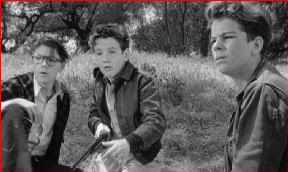
The three boys look at the bobcat
The story is about a boy (eventually played by John Dall) who has a gun fetish. In the opening scene he steals a gun from a shop window, admires it while the alarm blares, then takes off running... tripping on the wet street. The gun goes sliding across the wet street until it hits a man’s boot... tilt up... a *Police*man’s boot. Next scene - the boy in court explaining to the judge how much he just loves guns. He doesn’t feel whole unless he has a gun in his hands. We’ll leave that up to Uncle Sigmund... but that’s what drives the film - this guy needs a gun to feel like a man. At the trial we meet his two best friends - one is the policeman’s son, the other wears glasses so you know he’ll grow up to be a writer - and they tell the judge that our hero isn’t a killer, on a camping trip he couldn’t shoot a wildcat that was hanging around their campsite (great flashback). He couldn’t bring himself to shoot at it. Wow, same problem as Jon Voight in DELIVERANCE! Boy is sentenced to reform school, from there he goes into the army, then he comes home.

Now we have adult John Dall and his two pals - one is now a cop and the other is a writer for the town newspaper. The carnival is in town, so that’s where they go.
Peggy Cummins - trousers so tight there's a visible panty line
The great thing about this film are the set pieces. In the old studio days, it was a scene so juicy the studio would pay for a new set to be built. You don’t need a new set for a set piece, you just need a big juicy scene... and even though GUN CRAZY was a low budget film, probably shot on leftover sets that had been used a million times before and real locations that could be got cheap - and in the case of one set piece, probably shot without any set at all - the film is full of amazing set pieces.

sure - shoot at my head
The Carnival - maybe the same one from THE RING (1927) - has a sharp shooter as it’s main attraction. Sexy Peggy Cummins in those skin-tight pants. She shoots balloons from around her assistant, shoots a cigarette out of her mouth, and all of the other carny tricks you usually see with a knife thrower. The Barker, an aging pretty boy, announces that for a mere $50 you can test your shooting skills against the master... and possibly win $500. Kind of the same deal as THE RING, just with guns instead of fists. John Dall’s buddies put up the money, and we get a great set piece as Dall and Cummins try to out shoot each other... and fall in lust in the process. Because Dall is an amazing shot, the Barker keeps upping the ante in order to win the bet. Eventually it comes down to this insane trick where a crown that holds a half dozen matches is put on Dall’s head and Cummins *lights the matches* with her bullets. All but one. Then it’s her turn to wear the crown. Dall lights them all. Look, I don’t want even the best sharp shooter in the world to be aiming a gun at my *head* from across the room, let alone firing at me six times. That’s just crazy! Dall ends up with a job at the carnival...
sex and violence - the film was made in the 40s, how old are your grandparents - could this be them after doing it?
Now we have a great scene - not a set piece, but a juicy *dramatic* scene that deals with the romantic triangle between the Barker and Cummins and Dall. One of the interesting things is how they used a metaphor to tell us who was sleeping with who. When Dall first joins the carnival, the Barker asks if he has a car... he says no. Cummins wants him to ride with them, the Barker says there isn’t room in their car... Dall can ride with the clown. If you watch who rides with who in the carnival scenes, you can see Cummins and Dall getting together and the Barker riding alone. Which brings us to the big juicy scene where all of this blows up. Real good. The Barker has a claim on Cummins and tells Dall he’s out of here if he doesn’t honor it. The result of the big blow up is *Cummins and Dall* leaving together (in the same car), which leads us to some relationship stuff where they realize they are broke, and then Cummins’ plan to make money...

By armed robbery.
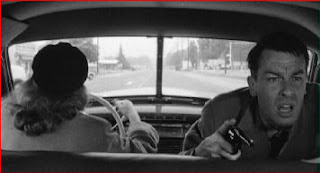
John Dall exits the bank as Peggy tries to sweet talk the cop - all from the back seat of the getaway car Now we get one of the greatest scenes in low budget history - that “backseat bank robbery” above. It’s a single continuous shot - several minutes - taken from the back seat of their car as they drive down the street of a town, find the bank, hope that there is a parking spot, Cummins pulls into a spot near the front of the bank and Dall gets out. After Dall goes into the bank, a cop walks down the sidewalk, stops near the front of the bank! Cummins pulls the car up, gets out, flirts with the cop, and tries to steer him away from the bank. Not happening. This builds suspense. She keeps trying to get the cop out of the way, but he won’t budge. Then the alarm goes off. She hits the cop, just as Dall bolts out of the bank doors with the money. back seat camera They get in the car, Dall driving, and now we get a shoot out and car chase from the back seat of the car. All one shot. The great thing about this is that it was probably dirt cheap - we don’t need the bank interior and extras and setting up lights in the location. It’s *one* camera set up. But it gives you the feeling that you are right there - in the getaway car with them. When the cop fires at the car, he’s firing at *you*. And it’s all one cool shot. This is a *great* scene!
John Dall with a bag full of guns and steaks
The big set piece is the armed robbery that will make them rich. Dall thinks this means they can retire to some exotic location and just be together for the rest of their lives. Cummins thinks only about how much money they will end up with. The target for the armed robbery - the Armour meat packing plant payroll. Well before anyone thought of product placement, we get a *real* company name and a *real* meat packing plant. Again, this was probably due to the low budget. They found a practical location and probably couldn’t afford to change all of the signs.

everyone tells him hes in the wrong area including this armed guardThis is one of those split second timed robberies where all kinds of things can go wrong... and do. It’s a tense scene, then it blows up and becomes a big action scene. The great part about it are the pieces of the set piece. Dall drives up in a truck filled with beef on hooks. He gets some steaks from a butcher and puts them in his bag, then walks to the offices and has to get past a half dozen people who tell him he’s in the wrong area. Dall tells them he has the steaks for the boss’s barbeque. Everyone tells him there’s no refrigeration here - he should take the steaks back to the plant. The deeper he gets into the office, the more he and the steaks are out of place. Eventually he gets to the boss’s floor... where Cummins is working as a secretary, Here it’s Cummins who tells him he’s in the wrong place - as she leads him right into the boss’s office, where they kidnap him and have him fill the steak bag with payroll money. And here’s where we see the beginning of the end - Cummins gets trigger happy and shoots a whole lotta people on the way out. It’s a great big run and gun scene - lots of action to break the tension that has come before.

After that set piece they are on the run, and we get a great sequence where they have their last night out as a couple. They go to the Santa Monica Pier and go on carnival rides - bringing us back to the beginning of their relationship. Then they go to a dance hall, and have a nice, tender, relationship scene... not knowing that the police have traced them to California and are waiting outside. They manage to escape with nothing - they even lose some of the clothes on their backs. Only one place to go...

Back to Dall’s home town. Now we get a great scene with the criminals and Dall’s sister’s family.... trying to act normal when people come over. Dealing with kids playing in the yard when you are harboring a pair of fugitives. And eventually a great scene with Dall and his two childhood friends - the cop and the reporter. A low budget film needs big scenes like this one - juicy drama where childhood friends are on opposite sides of the law... and Dall is kind of in the middle. Cummins is all for just killing them- in fact, she’d kill anyone if it allowed them to escape. She’d kill the kids (and that is in the film). In fact, there’s a great unseen scene where Cummins does *something* to Dall’s sister and her entre family - maybe she just locks them up, maybe she kills them all. We never find out which it is, because we come to the other big amazing set piece...

The one that probably has no set!
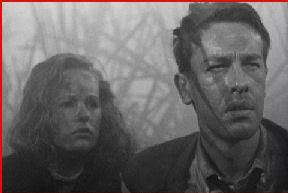
smoke and tuleDall and Cummins end up chased by every cop in the state, and blood hounds, and posses and probably villagers with pitchforks... but since they are chased through a foggy swamp, we just *hear* all of these things. I’m not sure if we see a single dog - though there may be a stock shot of dogs chasing - but we *hear* packs of blood hounds cha!sing them. We hear hundreds of cops searching the foggy swamp for them.

The swamp is... well, it’s 99% fog and 1% a couple of thatches of tule grass.
can you hear all of those cops and dogs?
The big scene where th!ey hide and the cops and dogs search - is just them behind a thatch of tules surrounded by fog. And it works! It’s an amazing scene. Probably shot in some warehouse with a smoke machine. Just goes to show you, *imagination* and *inventiveness* can create production value if you don’t have any cash.

GUN CRAZY still holds up, mostly due to the amazing set pieces and great sequences and fairly obvious sexual overtones... oh, and Cummin’s skin tight trousers.

- Bill

Nothing sexual about this


Nothing sexual about this... - Bill

Wednesday, August 14, 2024

ATLIH: Eyes Bigger Than Their Budget

ALL THE LOSERS IN HOLLYWOOD...

Over a decade ago I got a call out of the blue from a director I had never worked with (and never heard of) who said I came highly recommended as a screenwriter... but never told me who recommended me. We met in a coffee shop across from the DGA. He was this charismatic guy, almost as tall as I am, and was wearing a formal vest - which is unusual for Los Angeles. He was interested in my available scripts. He told me he was in post production on his first indie feature and it was already getting all klnds of great buzz around town and he was sure that a studio would set him up with a big feature deal... but while that was being negociated, he had an investor lined up with $1.2 million to do a genre film, what did I have? I pitched him a couple of stories, he gave me his fancy silvery business card with his e-mail address and I told him I’d send him some synopsis.

Okay, I have to admit that I’m not so much looking at the $1.2 million film as that big feature deal. The $1.2 million deal is less than half of the budget of the films I’m used to working on, but a bird in the hand pays the rent. So I go home, look through the script inventory, select the ones that can be made on this budget... and there are a couple of really good ones that can be made for that, including one of my favorite scripts of mine - DANGEROUS CURVES. It works as a showcase for a male actor, and has a bunch of cool plot twists - kind of a cross between Hitchcock and BLOOD SIMPLE with a hint of strange Roman Polanski. And the personal thing - it’s about an architect whose clients keep wanting him to change his plans in ways that can not work... while his dead wife haunts him and a corrupt cop blackmails him. I’ve always wanted to see this one on screen, and it could be a director’s showcase, too. There were a few other scripts on the list, too, some other really good ones that could be made on his budget - and I included the URL for all of my other available scripts.

Okay, I have to admit, the reason why I sent that URL wasn’t for the $1.2 million project, but for that big studio project. I wanted him to find the script for the studio film on my website, and bring that into the studio when they make his deal.

A week or two goes by, then I get a call from the director - he wants to read a script, could I meet him at that coffee shop across from the DGA on Thursday. And then he tells me what script he wants me to bring... DANGEROUS CURVES? No. One of the others on my list of scripts you can make for $1.2 million? No. This guy wants to read one of my big budget studio scripts. One that I really like. One that got me a few studio meetings and I was kind of saving for later - it’s kind of a dream script. Bur maybe this director is either planning ahead to his big studio deal... or maybe he’s skipping the $1.2 million project because something has happened with his indie film already? What if this is the big deal... and he wants my script?

So I make up a couple of copies and drive over Laurel Canyon to the coffee shop. I hand him the script, ask him how his film is going... and he tells me great, but it’s still in post. I ask if there’s been any studio interest, yet, and he says there is a lot of great buzz, and everyone thinks he’s a genius and the next big thing, and after this film he’ll really be hot. After this film? Well, he has to read the script, first. Of course....


As I’m zooming back over Laurel Canyon, passing the house that rolled down the hill, I wondered what the hell was going on. It seemed like he was thinking this *huge* budget foreign location chase script he was looking at for his $1.2 million budget... and that wasn’t going to work. But, he’d figure that out once he read it, right? And then he’d look at the other scripts and pick one that fits the amount of money he has, right?

Wrong. A few days later he calls to tell me he just loves this script. And he has some ideas on how he might be able to make it for $1.2 million. And I want to scream, but instead I calmly say that I don’t think this film can successfully be made for that budget. I mean, even if there is no star in the film, he’d have to have some sort of great connections - like a facility deal - to pull this off at that budget. Plus, you’d have to scale down the action, which, I guess is possible, but.... He tells me he thinks he has it all figured out, and he wants to meet me to talk about my next draft.

I politely say that maybe he should write up his ideas and e-mail them to me before we meet, so that I can have some time to think about them. He doesn’t seem to want to do any typing, just talking, but he agrees to do this. Over a week later I get his suggestions for “the next draft” and I almost smash my computer monitor in anger. First - he has a facilities deal... here in the USA, in a Southern state, that means completely changing the concept of the script - no longer will it be about a guy in a foreign land on the run with no one to turn to, and language issues... unless it’s maybe a guy from California who can’t understand thick Southern accents. And the action scenes get mostly cut out completely - so it’s a chase film with almost no chase. There were a couple of scenes where the hero found places to hide - kind of like the THREE DAYS OF THE CONDOR scenes with Faye Dunnaway - and he wants to make that the main part of the story. So instead of a chase film, it’s a hide film... which is a completely different movie. Basically this big script gets hacked down to nothing - and loses everything that was cool about it. And the “machine that drives the story” - the MacGuffin - doesn’t work if this story takes place in the American South at all. I’d have to come up with something else that drives the story.

Okay, bird in the hand that pays the rent, right?

Wrong. I e-mal him back and say that I really don’t think this script can possible work at this budget. He still wants to meet and talk about these changes and “the next draft”.

I meet him at that Coffee Bean across from the DGA and he’s talking a mile a minute about how this could be a great film with all of these changes and will guarantee his big studio deal. This guy is a great talker... and almost convinces me. I wish I had that gift - that charisma and ability to make complete nonsense sound great. But I’m good on the page, not that good in the room. My scripts can get places that I can’t. The other side of this is that when people do all of this big talk, I can usually see through it. I can smell the BS through the charm. So I wait until he’s done and say that I still don’t think this script can be done on this budget without completely ruining it. I ask him what he likes about the script, and after he mentions a few things, I note that those things will either not exist in “the next draft” or will be changed so much they may not be as interesting. Of course, he says there’s no way to know until after I finish that “next draft” and he reads it. He tells me to go home and think about it, this could be a great film.

I drive past that tumbled down house on Laurel Canyon... It was once a multi-million dollar view home, then the slides tumbled it down the hill until it came to rest on the edge of Laurel Canyon - a broken mess. Imagine being the owner of that home. You have this great house, everyone loves it and wishes it was theirs, then one day it rolls down the hill and turns into a bunch of junk waiting to be demolished and hauled away. And everyone who drives over Laurel Canyon gets to see what’s left of your luxury home and snicker. Oh, how the mighty have fallen! Fallen right down the hill and smashing on the side of the road.

Did I want my script to be that house?

I looked over the notes again when I got home, and decided that it couldn’t be made on $1.2 million without trashing it. But what made this director pass up scripts that *could* be made on his budget - and *good scripts*, not trash - and select something that didn’t have a chance at surviving the budget rewrite surgery? Couldn’t he look down the line and see how his notes would change the script? Why didn’t he want to make a script that could actually be made for his budget? What is the motivation there? Is it that I said it couldn’t be done, so he had to do it?

I e-mailed the director, saying I didn’t think this script would work in the cut down version - that many of the things *he* liked about the script would be removed, so it wouldn’t even be the same script. So if he wants to do *this* script, maybe he should consider doing it when he gets his big deal, rather than try to make it fit his budget and kill it in the process. And I re-sent the list of loglines for the scripts that *could* be made on his $1.2 budget. I figured this was the end of it - no more bird in the hand, and I’d have to find some other deal somewhere. But instead, he requested another script. Not DANGEROUS CURVES, but one that has almost been made at least 3 times. I sent him the script - instead of meeting him at the coffee shop - and thought this might all still work out, right?

A couple of weeks he e-mailed me notes on the script. Everything that was “wrong” with the script. I read over the notes, and instantly wanted to e-mail the director with the rebuttal. You know, we all want to do that. In this case, it would have been easy, because everything on his list of problems was not a problem at all. Most of the “problems” were things that seemed due to skimming the script - I could have just listed the page numbers of where these things were set up, but he seemed to have missed them. This script had almost been made three times - and all of those people read the set ups and didn’t find any problems. Oh, sure, they had notes - but all of the past notes had made sense or been practical issues. I think he was *looking* for reasons to dislike this script, because...

The end of his e-mail of what was wrong with this script that could actually be made for $1.2 million was that he still thought the big script could be successfully trimmed down, and I should reconsider doing that “next draft”. He *still* didn’t want to make the one he could afford to make, he wanted to make the one he couldn’t.

And he’s not the only one. Every year or two some big talk director or big talk producer - and they always seem to be new - looks over the list of scripts they can afford and would rather do the script that they could never afford to make on their budget. And chop out everything that they like about it so that they can afford to make it on the money they have - which turns it into crap. There’s no way this can work. I know it. A director or producer who does a movie a year knows that biting off more than you can chew usually results in a movie that is one big problem after another to shoot - all compromises and doesn’t work when you cut it all together. Hey, maybe some freakin’ genius director at the top of his game might be able to make this work on that budget, but that’s a lot of stars aligning in ways they have never aligned before. That’s a big chance to take with someone else’s $1.2 million. Why not take the script that’s a slam-dunk at $1.2 and use the easy schedule to spend more time being creative? Give the films some style? Use a dolly and crane? Design some amazing shots? Why would you want the script that will be living hell just to get on screen at $1.2 with master shots and a couple of close ups?

What makes these people pick the script they can’t pull off? Are they trying to set themselves up for failure? Do they want the project to crash and burn before it ever happens? Are they trying to prove something (and if so, to who)? Was their first film a miracle and they’re hoping that lightening strikes twice? Why set out to do something that can’t be done?

Right now I have two producers reading scripts they can’t afford on their budgets. If either one wants to me chop it down to what he can afford - ruining it in the process - I’m just going to say no. I have enough *really good* scripts that can work on these guy’s budgets - why would I want to ruin a script that won’t? That doesn’t make any sense at all.

I sent him an e-mail asking what he was planning on paying me for this "next rewrite", and you already know the punchline.

No money up front, but I would be "well paid" once the $1.2 came through... and, of course, top of the list when he got his big budget studio film.

I told him that I accepted cash, not promises of cash... but if he wanted to choose any of the scripts that he could actually afford to do, I was willing to give him a free option. And I was willing to make any reasonable changes that I believed would make it a better film.

I never heard back from the director with that indie film who wanted to turn my big chase thriller into a small hide film, so I decided to look him up on IMDB. They demolished what was left of that house that was on the side of Laurel Canyon and took away the debris a couple of months later - now it’s hard to even remember that it was there. A year later I had 2 films released on the same day - both ended up in the top 10 DVD rentals in the USA - neither of those deals had even been made when I was meeting this director at the Coffee Bean across from the DGA. So, I wonder what he’s been up to? I wonder what his big studio film is?

Well, according to IMDB he has that one indie film... and nothing else in the works at all. And according to IMDB his indie film has yet to be released... Anywhere. There are no consumer reviews - no one has seen it at a festival and posted a review or anything.

Now, IMDB is not always accurate - so maybe it was released somewhere, and maybe it played festivals somewhere and maybe people liked the film... but this big talking director seems to have nothing going right now (and I read deals in the trades, and haven’t seen his name). My guess is that he had a window to do something for $1.2 before his film was finished... and that window has closed. That’s kind of a business tip, by the way - the time when you want to seal a deal is *before* your film is released. You may think your film might become a huge hit and studios will be fighting over you... but what if it flops? Lots of films everyone thought were going to be hits just didn’t click with the audience for some reason. Though you can predict which films have a better chance of becoming hits, there’s no “hit formula” where you can be sure a film will work. So you want to make a deal while there is still hope that your film is a hit. If it *is* a hit, you’ll get other offers. Hey, you may have to make that $1.2 million film before you make the studio’s $120 million film, but if you’re hot, the studio will still want you. But if your film flops? Well, if you have that $1.2 million film already in production or preproduction, it’s like a second chance at the big studio project! Not to mention - income.

Heck, that’s why I was willing to sell a script to a guy with less that half the budget I’m used to - income (my bills must be paid whether it’s *the* project or not) and as a writer you never know if this is going to be the combination of director and cast and perfect timing that makes this film the next SAW - some low budget genre film that gets picked up for theatrical release and ends up becoming a huge hit. I can’t plan on any of the scripts I have circling at studios to ever land.

If this guy had just taken the *good* script he could afford to make at the time, he’d have *two* films on his IMDB listing... and probably would have been released by a major label (Sony, LionsGate, etc)... and if I liked the way it came out I’d try to get it shown at some film fest that I’ll be speaking at... and try to get coverage in one of the magazines that I write for or have written for in the past. Basically, by promoting a good film version of my script I also promote the director, production company, cast members. And who knows? Maybe that $1.2 million film could have been the new SAW? We will never know.

If I had a limited amount of money, I would want the *best script* I could find which could easily be made on that budget... then I would pull out all of the stops to design interesting shots and do some great casting and make it the best film version of that best script.

And then sign a deal on the next project while this one was in post.

- Bill

PS: Right after this post first ran, I had a producer call me up and say how much he loved it, and how he knew all kinds of losers whose eyes were bigger than their budgets, and that he was looking for a screenplay that he could make on a budget. I sent him a list of loglines... and he requested one that he could not afford to do on his budget! It was a freakin' epic screenplay that took place on a ship in the ocean! And had a bunch of water scenes that would require a huge tank! So these people seem unable to see themselves in a mirror! Time vampires.

- Bill in 2020.

Wednesday, August 07, 2024

ATLiH: DINNER WITH A DIRECTOR

ALL THE LOSERS IN HOLLYWOOD...

One night, sitting in Residuals Bar in Studio City (where the DRAGONHEART script was conceived) and drinking a Guiness, I was telling one of the stories that usually end up on this blog - a story about some poor misguided person in the film biz, and one of my friends said: “Where do you find these people?” I replied, “I bet I know all the losers in Hollywood”.... and they said that should be the title of my autobiography (or this blog). But instead, this blog ened up being called SEX IN A SUBMARINE due to a crazy script note I got from HBO on CRASH DIVE, and ALL THE LOSERS IN HOLLYWOOD was a title without a story... until now.

When looking for regular features for the blog, I thought it would be fun to tell a bunch of those stories of the oddballs I’ve met in the almost 30 years I’ve been in this business. I’m changing all of the names to protect the very very guilty (and avoid meeting lawyers) but the stories you are about to read are true... well, mostly true.

DINNER WITH A DIRECTOR


There are a bunch of people in the business that I have dinner with once or twice a year. A business dinner, but also a “What have you been up to?” dinner. In every single business they say “This is a business of relationships” and in screenwriting that means maintaining relationships with people you don’t really know, but have dinner or lunch or maybe drinks with once or twice a year. Instead of dressing in your screenwriter uniform of black dress shirt and jeans, you put on slacks and whatever else the restaurant’s dress code requires and get a free meal. What you are hoping for is: they say they are looking for a screenplay about dancing donkeys... and you have just finished a screenplay about dancing donkeys. Score!

But that never happens, and instead you have dinner with someone you hardly know and are afraid to ask about their spouse or their kid for fear they’re in the middle of a painful divorce or their kid is in rehab or jail. One good thing if you are a screenwriter, due to some weird pecking order thing that puts screenwriters below the people who bring the donuts to set, usually they pick up the check. Be warned: if you order big, they will want to split the tab; if you order small, they will pick up the check. It’s the same rule as if you go to a movie premiere where they will have food and drinks afterwards. If you don’t eat first, there will be one plate of hors d’oeuvres for 300 people, if you *do* eat first, there will be a five course meal.

So when this director (who I’ll call Robert, even though his real name is...) set up our semi annual dinner - which he always pays for - I went to meet him. This director has a colorful backstory - right out of film school he accidentally got hired to direct a commercial. He was last choice and they called him instead of the other guys by mistake - the list was upside down. That lead to other commercials, and then the stuff between the commercials - TV shows. He directed a bunch of kids shows with kid actors that you may have heard of but probably didn’t watch. After that, Robert did some hour long syndicated work - but never more than one episode on any show. I have no idea why they never brought him back. But he learned how to shoot fast - some hour long syndicated shows do an hour in a week, and that means you can shoot a feature film in two weeks... and that means you get hired to make low budget films. So even though he moved up from syndicated shows to network shows (again only doing one episode on a show before moving on) he eventually ran out of shows to direct and did some low budget movies. Two week wonders.

After making several movies for other producers, Robert began producing his own films. He made deals with distributors and they would fund his two week wonder genre flicks, mostly horror, but he made some action flicks and erotic thrillers and a monster movie or two.


Over the years, even though he had dinner with me a couple of times a year, he never once bought a script from me or hired me to write something for him. He seemed to favor first time screenwriters, and at first I thought it was because he could pay them less than he would have to pay me... but later I began to believe it was a control issue. I talked to one of the writers after a concrete carpet premiere and Robert could have afforded me for what he paid the new writer. His budgets were high enough to afford mid range stars and a full union shoot for two weeks. He didn’t need to hire first time screenwriters.

Oh, and these new writer’s scripts weren’t very good. Not just my opinion, the reviews for the films tended to mention the poor screenplays - filled with awful dialogue and contrived stories and sometimes laugh outloud horror scenes. One film had a woman Epilady herself to death and another character tear their foot open and bleed to death using one of those foot callous sanders. If there was a late night infomercial about it, it was used as a murder weapon in one of his films! As the bad reviews kept coming in, I kept wondering why he paid for my dinner a couple of times a year but never asked me to write a screenplay.

So, here we are having dinner in one of those trendy restaurants that I’m too cheap to eat in unless someone else is paying, and it’s been a while between gigs for me and I wish he would hire me for the next two week wonder - my script would be much better than his first time writers screenplays - so I’m casually mentioning a couple of horror scripts I have sitting around, and...

A TV Star came up to the table. This guy was one of the stand outs in a hit ensemble show that ran for six or seven years, on the cover of TV Guide and a household name... and then just sort of vanished. He had done a bunch of pilots (as the star) and none of them got picked up and then people just stopped calling him, I guess. But this guy was a star, you would know his name. “Excuse me for interrupting, Robert, my wife and I were having dinner (he gestures to the other side of the restaurant) and I saw you over here and I thought I would stop by and say hello.”

Robert didn’t introduce me, I’m a writer - you don’t earn any points for having dinner with a writer. So I just watched the conversation unfold while using the time to eat instead of talk (the worst part about these business dinner things is that you don’t want to accidentally spit food at someone or talk with food between your teeth... so you tend not to eat very much. I have had business lunches where I went to get lunch afterwards). After the pleasantries, the TV Star gave one of his million dollar smiles and told Robert that everybody loved his latest pilot but he had a couple of months before it would go to series if the network picked it up and he was looking for something to kill time, like one of Robert’s movies.

Robert matched the TV Star’s smile, “Amazing! Another pilot? I guess I missed reading about it in the trades. What network?”

“One of the new cable channels. Hasn’t launched, yet. But I have a couple of months, and I loved working with you when you directed that episode of our show...”

“Are you starring in this show, or is it an ensemble?”

“The thing is, I only have these two months that are free. Every time my wife and I go into Blockbuster, there’s another one of your movies on the shelves...”

“What are you doing in Blockbuster? You don't have an assistant? An intern to do that stuff for you?” Robert was just needling him, and the TV Star was beginning to squirm.

“If you are making another one of your films in the next couple of months...”

“As a matter of fact, we’re about to go into pre-production on the next one. A werewolf movie set in an abandoned desert gas station. I found the gas station while driving around with the wife and kids and a werewolf just fit the location. Found this new kid to write the script, and it’s amazing. The kid had only written one script before - he came here to be an actor - and I found him in an acting workshop I was guest lecturing at. But this kid, second script and he just knocked it out of the park. There’s a scene where they spray the werewolf with that Nair depilatory stuff that is out of this world. Never seen anything like that in a werewolf movie before! Sure, it was my idea. I mean, the kid's green, couldn't come up with an idea like that if he tried. I'm guiding him on this. But this kid is an amazing writer. ”

“I have never played a werewolf before, that sounds interesting.”

“We’ve already cast the lead, Sorry.”

“Well, are there any interesting supporting roles? I could do a cameo, be one of the names on the box, helps the film’s sales...”

“You’d take a minor role like that? With this big pilot that may go to series?”

“Well, I need something in the next two months. If the role is something interesting...”

“Sounds like it has to be in these two months between pilot and series. And we are shooting in three months. So I don’t think it’s going to work out with your schedule.”

“Well, the pilot may not get picked up...”

“Like all of the others? It sounds like you really need a gig?”

“Well....”

“You aren’t here with your wife having dinner. I’ve been watching you go from table to table for the past half hour. What happens in two months? You lose your medical insurance? You miss a mortgage payment? The orthodontist repossess your kid’s braces? ”

The TV Star took a deep breath to calm himself, “I need the job, Robert. I still have some marque value. My show is playing in syndication all over the country. A hundred percent of the major markets. This can help both of us. Just give me four days. Enough to keep my SAG health & welfare benefits. I need the job.”

“Sorry, got nothing for you. But amazing to see you again.” Robert focused on his food as if the TV Star was no longer standing at the table.

The TV Star gave me that million dollar smile and said, “Sorry for interrupting your meal,” before walking away... he had exhausted every connection he had in Mantilini’s, Robert was his last chance. I felt terrible for him. I was between gigs and one of the reasons I was here was to maybe sell Robert a script for his next crappy horror film. And of course he was picking up the tab for the meal that I had actually gotten a chance to eat this time. This is a brutal business and you never know where your next job is coming from, and there are times when you think there may not be a next job. That it was all some sort of fluke and Hollywood (collectively) has realize that your career was a mistake and now it is over. I wasn’t even near that point, I had a film made the year before and did a couple of assignments that will probable never get made, but I had gotten paid. But this TV Star seemed on the edge of panic that his career was over and the next time we would see him he would be our waiter at Mantilini’s. You may think that sounds crazy, but one of the entertainment magazines used to have a blind item section filled with stars from previous decades who had been spotted waiting tables and working in upscale retail stores on Rodeo Drive because their careers abruptly ended. That sort of thing was a career ender for a star.

Robert looked up from his meal to watch him leave the restaurant, and smiled, “What a loser. You can smell it on him. Loser. Puts on his best clothes and comes here begging for work. Table to table and no one will hire him. No one. Why? Do you know how many pilots he did? All of them crap.”

“He’s still well known and a good actor, why not give him a role in the werewolf film?”

“Why would I want that guy in my movie? He’s a loser. In that downward spiral of all losers. You could smell it, right?”

“Only his cologne.”

“How much was he wearing? Amazing! If I gave him a role, even a small role, in one of my films he would bring down the rest of the cast. His negative energy would spread. That’s what happens, you put one loser in your film and everyone becomes losers. I can’t afford that to happen. That guy’s career is over, and he’s just starting to realize it. Before he was on that TV show, he was doing telemarketing... and that’s where he will be in two months. On the phone begging you to switch to this cable company instead of the one you have. That’s a commission job, so you have to beg if you want to pay the bills. I don’t need some beggar bringing down one of my films.”

“But four days? Why not give him some small role? Leave him off the video box if you think that’s a problem? You have to cast somebody, right?”

“Not a loser. Not a beggar. Not that guy.” Robert tossed his napkin onto his plate, which was at least half full of food. “You know who that guy reminds me of? Barbara Payton. You know that story?”

“She was in ‘Trapped’ with Lloyd Bridges and ‘Kiss Tomorrow Goodbye’ with Cagney.”

“One of those amazing great Hollywood stories. Fame and misfortune. You should write that story!”

“I leave the biopics to Karaszewski & Alexander. I just write genre stuff: action and thrillers and horror.”


“Payton was one of the hottest starlets in town. She was up for the Marilyn Monroe part in ‘Asphalt Jungle’. After ‘Kiss Tomorrow Goodbye’ Cagney got her signed at Warner Brothers for five thousand a week. A week. Amazing! Bam, she got the female lead opposite Gary Cooper in ‘Dallas’ and the female lead opposite Gregory Peck in ‘Only The Valiant’. This was all in the same year! 1950. Same year she got engaged to pretty boy movie star Franchot Tone, and began an affair with movie star Tom Neal. She was amazing. Everybody wanted her on screen and between the sheets. Tom Neal was a drinker and a bit of a hothead, and punched out Franchot, leaving the guy in a coma for a day. Really messing up the pretty boy. Neal and Payton both ended up with that loser smell and people stopped hiring both of them. Within a couple of years this beauty queen who was the hottest actress in Hollywood was a toothless hooker on Sunset Boulevard, being arrested again and again for prostitution. She had movies still playing in theaters while she was on her knees blowing guys!”

“And she was dead before she hit forty. Now, mostly forgotten... except as a cautionary example.”

Robert gave me his most serious look. “You see that guy as a TV Star who needs a break, and want to help him. I see that guy as a loser who is on his way down and may drag my werewolf movie with him. I can’t afford that. Screw him. Screw him.”

“He’s just trying to keep it going, like all of us.”

“People like him will drag you down. My advice, Bill, avoid the losers. This town is full of them. Full of them.”

We finished our dinner and walked out to the valet stand, waiting for our cars, and shook hands and... I decided never to have dinner with Robert again. I made that decision before I read that story about what happened to the TV Star in the papers a couple of weeks later. It was a big story, and kind of shocking. I always wonder what Robert thought when he read it. If he had any regrets about the way he had treated the TV Star that night in the restaurant.

Turns out I didn’t need to sell a script for Robert to make into a terrible horror film like that werewolf movie he made. I sold a script soon after that night and it actually got made. Not well made, but it was shot on 35mm film and had a couple of names in the cast bigger than the names in Robert’s werewolf at a gas station movie. But the TV Star, you ask, what happened to him? Did he end up blowing guys on Sunset Boulevard? No. Something even more shocking. You probably know what happened. It was in the trades.

That pilot that the TV Star was the lead in didn’t make it at the new cable network, in fact, the new cable network didn’t make it, either. But the pilot got shopped around and ended up getting picked up by a big broadcast network. Between that show and the one that followed, that TV Star has been the star of a hit TV show for the past dozen years. Just got signed to a production deal at NBC/Universal where he gets to make his own shows. And Robert? Still making crappy little horror movies with ever shrinking budgets and probably complaining about the smell of losers all around him...

And in Hollywood, no one can hear you scream.

Guess who the loser was in this story?

- Bill

Wednesday, July 24, 2024

Flashback: Set Crashing

My buddy Van Tassell and I hung out a couple of years ago after seeing the movie FORBIDDEN POWER at a film festival in Las Vegas. I think Van is my oldest friend - I've known him since I was 18, and when I go home for the holidays we grab beers and see movies.

Whenever anyone filmed a movie in the San Francisco Bay Area, Van and I snuck on the set. Growing up in the East Bay Area - halfway between Oakland and Stockton - San Francisco always seemed like some far off place you only went to on special school field trips or when you went to the zoo on your birthday. Actually, we usually went to the Oakland Zoo on my birthday. I saw San Francisco more in movies than in real life.

So when I started making my own movies on 8mm and Super-8mm, my buddy Van Tassell and I began driving into the city and sneaking onto movie sets... to watch the pros at work.

Van installs carpets for a living (any out of work film guys could always find a job tearing up jute padding and carrying heavy rolls of carpet for Van) and his carpet tool pouch looks EXACTLY like a film grip's tool pouch. This was part of the plan to sneak onto movie sets - look like someone who belongs. So we would dress like grips, filling the tool pouch with film tools.

I subscribed to Weekly Variety, and they printed the films in production. Whenever anything was shooting in San Francisco (a popular location) we'd take a few days off from our day jobs to crash the set. To find out where they were filming I'd call the city permit office and pretend to be somebody from a newspaper covering the film or a caterer who forgot where to send the food truck. They'd tell me where the permit was issued for, but usually it was a vague answer like "They're shooting in the Marina District today" - maybe they didn't believe my story?

So Van and I would pile in his red Bronco - it was used as a picture vehicle in Paul's movie WEAPONS OF DEATH.... the hero's truck - and just drive around the Marina District until we spotted two dozen huge trucks. Then we'd just follow the cables to the set. The key was to be cool and blend in. We looked like grips, but we also had to ACT like grips. A couple of times someone would actually ask us to do something, and we always did it. I actually carried a 9-K light from the truck to where they were shooting on one set.


Van and I became pros at blending in, and we crashed a bunch of sets. Mel Brooks filmed HIGH ANXIETY in San Francisco, and we were there. Don Siegel shot TELEFON and ESCAPE FROM ALCATRAZ and we were there. But the best story is when they shot the James Bond movie VIEW TO A KILL. We didn't know it would become the worst James Bond movie ever - we just knew that James Bond was shooting in San Francisco, so Van and I decided to go out and watch. Dressed as grips.

The day Van and I crashed the set they were doing this huge effects scene - burning down City Hall. They had rigged all of these gas explosions on the building. They had Roger Moore's stunt double on a fire truck. They'd hired a bunch of extras to run in panic and some stunt men who would actually catch on fire. It was going to be very expensive, and they could only do it once. Boy did we pick the right day to crash the set!

So, we're doing our best to look like grips - helping ourselves to doughnuts on the craft services table - when we notice these two guys hop the rope and sneak onto the set. Well, that creates a danger to us. If they start checking to see who belongs on the set and who doesn't, we'll be kicked off before they start filming. Van and I come to a dead stop in the doughnut line, causing REAL grips to complain.

These two sneak-ins are wearing warm-up suits and look WAY out of place. They're also laughing - probably a little drunk. Then they see the food and start to come over!

Oh man. They're walking right towards us. Laughing so loud, people are starting to notice them. A couple of big Security Guards hear the laughter, turn and see the two sneak-ins, and move to intercept them... Coming right at us!

Two big Security Guards.
Walking towards Van and me.
We both freeze for a minute, then one of the REAL grips tells us to stop hogging the doughnuts. So we try to move away from the craft services table, but that means moving TOWARDS the two sneak-ins... and those two big Security Guards.

Shit! No choice!
Van and I play it really cool and move away from the table, pretending to be REALLY interested in the sprinkles on our doughnuts. The two sneak-ins brush past us on the way to the food. One of the Security Guards says, "Hey! You two!" Van and I try NOT to look at them, but both of us are wondering if they're talking to us or the sneak-ins. What if the Guards know everyone on the crew and know we don't belong? Can they arrest you for crashing a set?

They two big Security Guards are coming right at us. One puts his hand on my shoulder. Busted!!!

"Excuse me," he says as he moves me aside to get to the sneak- ins. Van and I watch the sneak-ins get rousted by the two big Security Guards. They are told to leave the area... but they hang around on the sidelines.

Close call. Van and I eat our doughnuts and watch the extras get instructions on how to run in panic when City Hall explodes behind them. The extras are told they can't screw up the shot, because they are only going to do it once. Van and I watch as the FX guys turn on their remote controls and they get the Roger Moore stunt guy on top of the fire truck. "This is gonna be cool," Van whispers to me.

Everyone takes their places as they get ready to blow up City Hall. Lights blast on. The director whispers to the AD who yells: ACTION! They start filming. The extras walk down the street calmly. BLAM! City Hall explodes into flames! The fire truck races into the shot...

And the two sneak-ins in warm ups hop the rope, run RIGHT IN FRONT OF THE CAMERA and yell "City Hall's on fire! City Hall's on fire!" Then they run away, like the rest of the extras... blending into the crowd.

Van and I have been on a dozen film sets and have always stayed in the background. Always played it cool. Always tried to blend in. We can say to friends, "Yeah, we were on the set of that James Bond movie. We watched them burn down city hall." But those two sneak-ins?

If you look closely, they're actually IN THE MOVIE!

- Bill

Wednesday, June 19, 2024

Elitism & Experience

From the beginning of 2011...

A few weeks ago John August had a post on his blog that got a rise out of me.

John wondered if the blog had become too advanced for a beginning writer, so he decided to read through his mail to see if he was too “inside baseball”... and printed a note from a writer that asked all kinds of stupid questions and then made fun of the writer. Ridiculed the dude. I posted in the comments section that I thought that even though many of the guy's questions could have been answered by spending some time searching John's site – at least the guy was asking questions, right? Yes, he probably should have searched the site first. Yes, he probably should have done a better job of Googling. But John could have guided him instead of made fun of him.

And on Done Deal Pro I said basically the same thing: Lots of new writers don't know where to begin, they Google “How do I write a screenplay” and find a website and don't know the first thing about screenwriting so they don't know what to search for – they don't even know what a screenplay consists of. They don't know what to Google.


In one of my favorite films IN A LONELY PLACE, a screenwriter played by Humphrey Bogart says that people don't know screenwriters exist – they think actors just make up their lines... and when they become stars, they do. And that's where a lot of new writers are – what's on the page? Everything? If you just have a great idea – can you sell that? If you need an agent, can you tell me where to find one? On Done Deal Pro we regularly see new writers ask these questions and many more. And people on DDP ridicule them and make fun of how naive they are... but they also answer the questions and point them to places where they can read real screenplays and explain how the whole agent thing works. My theory is help them... then make fun of them.

Here's the thing – to me all of these questions sound silly. They sound like things people should just be able to figure out on their own, right? Things they could just find online, right? But when they land at someplace like John's site or DDP – they *have* looked online and ended up there asking questions. Things that we see as obvious. But that's because we forgot when we were them. Now that we know stuff, we think everyone else does!

Plus, there's that pecking order thing – I did a blog entry on that, and I think it's going to come up in this one, too. Nobody knows everything, and all of us are still learning and have things that we need to learn. Now, we can look at those who know less than us and make fun of them, or we can give them the information they need and send them in the right direction.

Or both.

The thing about writers is that many of us are smart asses and are just waiting for someone to say something that's a set up for our joke. I know I am. Yes, this makes me a partial asshole, but I also answer the questions so I figure I kind of earn my assholiness. But, if you just trash the person without helping them, you're building up some negative karma and eventually you will be the person who doesn't know something and someone will make fun of you. All of us are stupid about something.

AM I AN ELITIST?


One of the interesting things in life is how various different things happen at the same time... and all seem to add up to something larger. These random things are connected – which is just plain weird. Plate of shrimp. If I were crazy, I would imagine a giant conspiracy out to get me. But instead, it's just life.

Before the John August blog post, two other things happened back-to-back that connect to the concept of know-it-alls and know-nothings and screenwriting.

There's a message board I frequent that is filled with new writers – and many of them suffer from being overly artsie. This is a common thing. Many new writers think that Hollywood makes all of those remakes and sequels and comic books movies because there is a shortage of quality original screenplays... and *they* have the ability to write those brilliant screenplays!

In fact, when they compare the kind of crap Hollywood makes to what they are capable of, it's obvious that they are geniuses and the people who work in Hollywood now are all morons. Many of these folks believe that film is art, and Hollywood would make nothing but art movies if they had enough great artsie screenplays. Every film would be TREE OF LIFE, if they had a couple hundred similar (genius) (artistic) screenplays.

This is not true.

Hollywood makes movies that will attract a mass audience. That mass audience is more interested in being entertained than seeing some great piece of art... check out the grosses for this year's Oscar winner... and TREE OF LIFE while you're at it. There was a recent article on how the general public no longer goes to see the Best Picture Winner – they don't care about it and don't relate to it anymore. The “Oscar bounce” is gone! They've worked all week long and this film is their escape from all of the crap of real life – they may want to laugh so hard they pass out. What makes them laugh that hard may be the bathroom scene from DUMB & DUMBER.


That makes that bathroom scene from DUMB & DUMBER great screenwriting. I know that makes some of you think I'm crazy or a massive hack – but do you know how hard it is to find something that makes 60 million people around the world laugh? That is the art of screenwriting – making 60 million people around the world feel something. Some emotion. That may be fear from a horror movie or love from a romance or excitement from an action film – but finding that universal thing... and 110 minutes of those universal things – is so difficult that Hollywood pays great money if you can do that. They pay lots of money if you can entertain lots of people. The fewer people you entertain, the less money you get. Kind of trickle down.

Now, that doesn't mean that art films are bad, or TREE OF LIFE is bad, or PRECIOUS or A SERIOUS MAN or HURT LOCKER are bad... just that they may be really tough screenplays to get anyone to read, let alone buy and produce.

Well, on this message board full of artsie new writers a few people posted some stuff that was completely naive... and someone posted a well thought out reasoned response explaining why their theory of how Hollywood worked was incorrect and something an outsider might believe. Here's the amazing thing – this guy who posted has been nominated for awards, wrote a great critically acclaimed film which you have all seen, that got him a gig writing a couple of big Hollywood films you have also seen, and recently wrote critically acclaimed film that I really love and own on DVD. Dude is a great writer. He was lurking. He de-lurked to help this writer...

And got crapped on.
And argued with.

Nobody knew who he was. They thought he was just some other idiot hack like me who was defending Hollywood films. They trashed whatever he said. Now, I knew who he was from another board, but none of these jokers even tried to figure out who he was... or just respect what he said. The guy was using logic and reason and the people fighting him were defending their position without ever acutally *thinking*. They were too busy arguing with him.

For me, the amusing thing about this was that this guy *was* a legitimate artist as a screenwriter. And he was explaining that *in his experience* commerce was still a major issue and you will have to find the way to sell your screenplay. To businessmen. Who want to make money.


Okay, everyone on this board knows who I am – I do not lurk. I jump in to the discussion, with a different side than the famous writer. Based on my actual experience in the business – I used some real examples both from my stuff and some other well known and easy to Google examples. And my experiences lead me to very similar conclusions as the other writer. Because that's kind of the way things are. From the outside you might think "If only Hollywood had 200 TREE OF LIFE scripts they would make 200 films like TREE OF LIFE." From the inside, you know that a film like TREE OF LIFE is hell to get off the ground... and no one in Hollywood really wants a screenplay like that. In fact, TREE OF LIFE was not made by Hollywood!

If you were to take a hundred professional writers, we would all have similar experiences with slight differences. If you take 100 people who have gone to the DMV and taken a driving test, the main points will all be the same but there may be some individual differences due to that handful of variables there are. So I jump in and basically agree with the other writer – and so do the handful of other pros on the boards...

THEM AND US


And now we have an interesting dichotomy – those who earn a living writing screenplays vs. those who do not. Those with experience in the business and those who do not have experience in the business. The working writers are saying “this is the way it really works” and the new writers are saying “no – it doesn't work that way”. When I say, “Hey, I've been doing this for a while, that really is the way it works.” And the professionals are branded “elitists” for saying that “our way” is the one that works and “their way” doesn't work.

This confused me.

I thought elitists were all about having power over others and excluding them... when the reason we were there giving this advice was to *include* these folks – to show them the secret way into the business. To help them. “You know that wall? There's a doorway through it over here!” But it seems that knowing what you are talking about, having actual experience, is a big negative thing.

Who knew?

The issue becomes facts vs. opinions – and that's crazy. But this seems to be something that isn't just on screenwriting messageboards, the whole country seems to think that a fact is the same as an opinion. That they are equal. If 99% of scientists think the world is round and 1% think it's flat – those 1% are “equal” to the 99%. Crazy! That 1% are the lunatic fringe. In science as in anything else there are always a couple of nutjobs... but the *majority* of people who know what they are talking about agree with each other... and 1% is *not* equal to 99%. Those are *not* two equally valid viewpoints – because at the end of the day the majority rules.

Except, when you are in that 1% you'd much rather believe that it's equally valid to believe the Earth is flat and the space program is a conspiracy and they put something in our milk as children to make us see that curve on the horizon...

And that's *science* - when you're discussing screenwriting and there's an art component and as many different definitions of “good movie” as there are people? More difficult to even agree on what is a “fact”!

But add to this – screenwriting is strange in that it is both art and commerce wrapped into one. Sure – there are arthouse indie films, but even those get some form of distribution because someone thinks they will make money. They are more of a niche thing – and aimed at being popular with that niche. If you plan on *selling* a screenplay then it is a commercial endeavor – not just for you but for who you sell the screenplay to... and for the screenplay itself. There are so many elements of the *craft* of writing that tie into the commercial aspects that you can't really talk art and craft without at least touching on the commercial part. And, on a messageboard filled with artsie types, bringing up the money part brands you a sell out.

On another board there is an intelligent, articulate, artsie screenwriter guy who makes great arguments in favor of seeing screenwriting as an art. I often argue with him, but I also encourage him to keep making his case - because he isn't one of those just fighting for his point - he also *thinks* and *considers the other side* and argues using facts rather than opinions. I like this guy. We need this guy in the business. The funny thing about my art vs. commerce arguments is that if you drop me in a room full of artists I argue on the commerce side... but if you drop me in a room full of mercanaries I fight for art. Screenwriting is both.


The problem is – two people can write screenplays of equal artistic quality, but if one is about a farm boy in Ohio who dreams of moving to New York and getting a job as a street poet, and the other is about a farm boy on Tatooine who dreams of being a Jedi Knight and starfighter pilot and rescuing a hot Princess from an evil Black Knight... well, you can guess which screenplay is going to have an easier chance of selling.

There are commercial considerations involved with every screenplay that is bought – and that becomes part of the conversation on the experienced screenwriter side. It's not elitism, it's another danged lesson that most of learned the hard way – and we're trying to help others. Though everyone learns at their own rate, the biggest problem with many of these debates is that some people DO NOT WANT TO LEARN. Not just the commercial stuff (I mean, who really wants to learn that? I fought it) but much of the story stuff that's important. The artsie folks don't want there to be any elements that they can be judged by – so the concept of one script being better *even artistically* than another is some form of elitism.

Huh?

The real problem with this whole “Elitist” thing is that it makes people with experience and actual knowledge, and brands them with a negative for *trying to help*. That does not make them want to stick around on some messageboard and continue helping when they really should be writing. It also demonizes education and intelligence and experience – which seems crazy to me. It guarantees that those folks on messageboards will stay exactly where they are – because the *do not want to learn*. Knowledge is a negative - ignorance is bliss - stupidity is art.

They often seem to think they know everything – which I don't think this famous writer or myself or any of the other working pros who these folks argued against believe about themselves. I believe there are tons of things that I don't know – and a large part of my life and my website and my blog are trying to figure out how things work and share that knowledge... but mostly trying to figure it out because there are things I don't know.

Do you think you know everything?

WINO THEORY


I think for most of us, the more we know the more we realize we don't know... and need to learn. Writing screenplays is incredibly complicated, and requires that you get a bunch of different ingredients in the proper mix.

The problem on some messageboards (and with some executives) is they think that one 110 pages of typing is the same as another 110 pages of typing. That writing the pages is the hard part. And there are plenty of screenplays that get so damaged in development that their 110 pages of writing *is* equal to just about any other 110 pages of typing. But those scripts die a quick death – and if they are made into films due to some mistake, the films die a quick death.

The key is to write something that people think about a decade later... because it will be good (art!) *and* because a decade later you'll want them to call you and hire you for some project. If they read your 110 pages of typing and instantly forget it, you have a problem. Though scripts can be developed into crap, you don't want them to start out that way. My belief (hope) is that even when a script gets mangled there's enough good stuff left to hint that there was a great version they bought. Though, I have no idea what that good stuff might be in the filmed version of CROOKED.

Of course, even if they screw up your screenplay on the way to the screen, your actual screenplay still exists as a sample - and I get all kinds of calls years later based on someone reading a screenplay before it got ruined. I have also used those screenplays as samples. In fact, I have some people interested in hiring me now based on a screenplay they read in the past... which they remembered.


You see - art is involved in screenwriting. Even in popular screenwriting. It's not just "write a 110 page action script", it's writing a 110 page action script that is better than the other hundreds of scripts they have read and will turn out an okay movie once it goes through the meatgrinder. If anything, a popular commercial film really needs to be *artistic* and great more than the art film - since if the art film ever gets made it is most likely to be written and directed and produced by the same person (no meatgrinder). The martial arts star lead isn't going to rewrite all of his lines... so that the actions end up being the thing that carries the story and theme and emotional conflict.

There are great commercial scripts and stinkers. Some screenplays are better than others. Some writers have learned more than others - and that is reflected in the quality of their writing. Doesn't mean those other writers can't learn as much and write scripts of equal quality eventually. Just means *at this point in time* the more experienced writer is, well, more experienced. They've done it many more times and learned more.

I think one of the issues with those who think all 110 pages are equal is what I call the WINO THEORY. I once dated a woman who worked in the wine biz, and know some people in the biz (one guy who gets paid to drink!) and a sommelier – and wrote a script called ROUGH FINISH that was James Bond as a wine taster.

Wine ends up being a lot like screenwriting.

The average person can drink two different glasses of wine and think one tastes good and the other does not – but that's about it. If you give that average person two different glasses of *good* wine, they may not be able to tell which is better. Both are equal to them.


But “educate their palates” and teach them a little about wine, and they can easily tell a cabernet from a merlot from a zinfandel from a pinot noir. They may prefer one over the other. They also know what a cabernet is supposed to taste like (basically) and whether it tastes strange or even has been cut with some other grape. At this stage they can also probably tell you whether the wine was fermented in oak or steel or even redwood or acacia or pine.

The next step might be to refine their palates so that they can tell which region the grapes were grown in – each soil leaves a mark. And maybe even make a good guess at the year due to the amount of tanic acid in the wine. Now they can take a dozen “good” glasses of wine and tell you more about each one – and maybe even taste minor defects in some wine that the average drinker never knew were there. They “have better taste”.

And with each increase in education, with each piece of knowledge, they can taste little details that the average drinker may not even know exist.

My character in ROUGH FINISH was a “private palate” who would break into a winery and taste the wine “before its time” to help investors and wine connoisseurs know which Bordeauxs to buy. He tastes something in the wine that only a handful of people in the world would even notice – and becomes the man who knows too much. Fun idea for a chase action script – but it's based on the (real) idea that an expert wine taster would be able to denote things no one else could... is that Elitism or Experience and Education?

My theory is that the new screenwriter might think the difficult part is getting to FADE OUT – and that *is* difficult. But a hundred thousand people a year get to FADE OUT... and the more you know, the more you can see what is just a bit off on one script and right on the money in another – and the more you know how to write that better screenplay.

You don't just give every character a unique voice and vocabulary and world view and attitude... you realize that all of those different elements are connected in some way to theme... and theme is connected to universal truths that connect to the audience. It just gets more and more complicated! And I don't think you ever reach some point where you know it all. There is always something to learn.

But if you think just writing 110 pages is all there is to it, you have failed.

If you think you don't need to learn anything more, you have failed.

If you think that the 1% who believe the Earth is flat are just as correct as the 99% who believe it is round, you aren't thinking and are not trying to learn and better yourself.

If you think someone who has learned more than you know at this point in time and is trying to help you is an elitist, you have failed.

And, if you know more than someone else – help them. Costs you nothing.

I've found that most established screenwriters want to help new writers – they empathize. They were that new writer at one time, and want to help you avoid all of the pitfalls they stumbled through. So, on a messageboard or in person or whatever – thank them for the help and don't fight them until they just give up on *everybody* and leave. I think it's all about learning - and continuing to learn. Any writer who is giving you advice - even if you don't like what they are saying - is trying to help you. they don't have to do that. They don't get paid to do that. They have many other things they can do that either pay more or are more enjoyable.

Experience and knowledge are not elitism.

If people are trying to *help you* - that's the opposite of elitism.

And DAYS OF HEAVEN is one of my favorite movies... along with AIRPLANE!

- Bill

eXTReMe Tracker