The adventures of a professional screenwriter and sometimes film festival jurist, slogging through the trenches of Hollywood, writing movies that you have never heard of, and getting no respect. Voted #10 - Best Blogs For Screenwriters - Bachelor's Degree
Showing posts with label scene of the week. Show all posts
Showing posts with label scene of the week. Show all posts
There's a new documentary about Brian DePalma (does it surprise anyone that he's one of my favorite directors?) that purports that DePalma does not copy Hitchcock, he just speaks the same language. The language of cinema. That DePalma has made all kinds of movies - from comedies to horror to thrillers to dramas - and even though he's obviously a fan of Hitchcock, much of what critics see as Hitchcock in many of his films is just speaking the visual language of film. Of course you shoot it that way - you don't want to look illiterate, do you? You want to clearly communicate to the audience, right? Last week we looked at a clip from JAWS with techniques that were lifted from Hitchcock, but few people diminish Spielberg's talent for speaking the language of film, why do they always go after DePalma? Before we look at our scene from CARRIE, here's a look at DePalma's low budget horror flick SISTERS...
And now the CARRIE entry...
After last week’s very long take that was locked down in the back seat of the getaway car in GUN CRAZY, I thought it would be fun to look at kind of the opposite - a scene where the camera moves but the protagonist stays in the same spot... and this underappreciated shot from Brian DePalma’s CARRIE (1976). This was the first version of Stephen King’s first best seller to hit the screen, and so far the best. There was a TV version and a sequel/remake (RAGE) and now we are getting a remake by the talented Kimberly Peirce who directed one of my favorite indies BOYS DON’T CRY. I think she’s a great match for the material, and her version will end up different than DePalma’s because she has a different point of view...
But the DePalma film made him a star director (it was his *tenth* feature film!) And also made many cast members into stars. It was John Travolta’s *second* film (after THE DEVIL’S RAIN) and Piper Laurie’s return to the big screen after a *15 year* absence after her Oscar nominated performance as the love interest in THE HUSTLER opposite Paul Newman, and Amy Irving’s first movie, and P.J. Soles’ (ROCK AND ROLL HIGH SCHOOL, HALLOWEEN) first movie, and William Katt’s first movie, and Nancy Allen’s first movie, and Betty Buckley’s first movie, and Edie McClurg’s first movie. What’s interesting about all of these young actors is that they were cast in CARRIE after auditioning for another film... called STAR WARS. DePalma sat in on Lucas’ auditions and picked people for *his* film... yes, that means John Travolta and William Katt might have played Luke Skywalker!
Usually when we think of *Exposition* we think of Basil Exposition from the AUSTIN POWERS movies (or his cousin Prompter Exposition who always asks those leading questions so that someone can spend a couple of minutes of screen time talking on-and-on about what has happened and why it happened and any other story information the audience needs to know. “As a scientist, I’m sure you know that...” Boring stuff that often brings the story to a halt *and* ends up silly. Part of a screenwriter’s job is to find ways to hide exposition so that the audience has no idea they are getting the information. In the Dialogue Blue Book I look at some techniques like using conflict in the scene to disguise the exposition, but Lawrence D. Cohen’s screenplay for CARRIE uses *actions* to give us the necessary exposition. Instead of that verbal exposition dump, we get an intense emotional scene packed with information... and all in one shot!
This shot *begins* at Tommy (William Katt) and Carrie (Sissy Spacek)’s prom table after they have just decided to go ahead and vote for themselves as Prom King & Queen even though they don’t have a chance in hell of winning. That’s when Norma (P.J. Soles) picks up the ballots from the table, and we follow her as she picks up other ballots from other tables. We see how the ballots are collected from all of the kids at the prom, and then we see Norma kiss her boyfriend and drop the ballots on the floor behind him, telling him to kick them behind the wall, then she grabs *fake* ballots from his coat as she pulls away from him. We see how they switch the ballots so that Carrie and Tommy will end up winning. All of this information we get visually, through the actions of the characters. No one has to tell us that they are switching the ballots...
And so far no one has told us *why* they are switching the ballots. This builds mystery.
Then we follow Norma to the faculty table where the ballots will be counted, and then she knocks on the window under the stage where Chris (Nancy Allen) and Billy Nolan (John Travolta) are hiding... and Chris is holding on to a rope. This hands off the scene, and Nancy goes on as we hold on Chris and Billy for a moment. Chris pulls slightly on the rope, and we *follow the rope*... to the back of the stage where Sue Snell (Amy Irving) sneaks in and hides behind the stage. Sue feels the rope moving, and we follow the rope up to the rafters over the stage... and that bucket of pig’s blood directly over the King & Queen’s chairs on the stage, and then look past the bucket of blood - back to where the shot began - at Carrie and Tommy sitting at their table as their names are announced as King & Queen... and they head toward the stage.
We now know *why* the ballots were switched, and we also know what is about to happen. This creates tension and dread and suspense...
Carrie White, who begins this story in blood when she has her first period in the gym shower, and was doused over the head and face by a glass of water by her mother at the dinner table; now will be drenched with pig’s blood on prom night... and they’re all going to laugh at her. This creates emotions in the viewer - Carrie has gone from bullied weird girl in a sack dress to Cinderella prom queen... and now that her life seems to have turned around we don’t want anything bad to happen to her.
More exposition told visually. No one *tells us* what the plan to ridicule Carrie at the prom is, or how it will work. Instead we *see* the exposition. As the audience traces that rope to the bucket of blood, their terror builds. They wish they could find some way to stop the inevitable. Instead of some dry verbal exposition, we get an emotional experience.
I was looking for the earlier clip - a single amazing shot that shows the whole ballot-box stuffing scheme at the prom as Carrie and Tommy actually begin to have a relationship in the background, but that clip is nowhere to be found on YouTube. When I was looking for this shot on line, all of the clips available either began at the end of the shot or somewhere in the middle. It seemed as if no one realized this was all one single long take. The clip labeled “Full Prom Scene” started at the end of the shot! Another clip that was all about the camera work, managed to start in the *middle* of the shot! It’s as if no one noticed this was all one long take - they were too busy experiencing the story unfold. Finally I found a clip on YouTube that *linked* a clip of the actual entire prom scene, and I was able to start at the beginning of this shot (but had no way to end the clip). Here’s that clip of the whole prom - and it begins with a long slow take reminiscent of the ballroom shot from Hitchcock’s YOUNG AND INNOCENT. The purpose of the long takes is to slow down the pacing to create contrast and shock/excitement after the pig’s blood when the action and horror kick in. The same way we use long sentences to slow the tempo down and short sentences to quicken the pacing.
And in the next series of shots, Sue Snell will trace the rope to the rafters, realize what is going to happen, and try like hell to stop it. She becomes our surrogate in the scene. Her success would be our success, her failure becomes our failure. Here’s that scene:
Exposition doesn't need to be someone talking on-and-on to give us that dump of information, we can give the information to the audience visually... and make it emotional and exciting!
If you've read Secrets Of Action Screenwriting you know that one of my favorite writing tools is *Magnification*, which I learned in Dan Arnold’s acting class in High School. The basic idea is to make something normal sized and make it much bigger. Stakes and conflict and emotions are all raised. Something average becomes something larger than life... large enough to fill that big screen. This works with concepts, emotions, and understanding the emotions of your characters.
This scene also deals with *Tension* - which is unresolved conflict. To create tension you must have a conflict... and the conflict needs to be ongoing and active and not solved. Once you resolve the conflict, you remove the tension. If you allow the audience to forget the conflict, you remove the tension. On Fridays when I do the Hitchcock entries, there are a couple on tension and suspense and “poking the tiger” to keep the audience aware that there is an existing conflict. If you don’t poke the tiger the conflict dissipates and you lose all of the tension.
So here is a scene that uses both elements, and it’s one of my favorite scenes. From GOODFELLAS (1990) written by Nicholas Pileggi, based on his true crime book. Directed by Martin Scorsese, and it’s like his 15th feature film. He’s one of my favorite directors, never really had a hit like his fellow “Hollywood Brats” but is always doing great work. Ages ago, when I was fresh out of high school, I sent him a letter asking if he’d read one of my screenplays... and he said yes! I sent some crappy early screenplay and got a great letter back from the head of his production company telling me to stick with it, etc. The polite brush off - but the guy never had to be polite in the first place. That script was ANYONE CAN LOSE and a friend asked me about it a couple of days ago - it’s one of those scripts with some great scenes but the story doesn’t work well. People remember it and wonder if I ever figured out how to fix it. Nope. But, back to GOODFELLAS...
Henry Hill is a small time crook way out on the fringe of organized crime, who wants to move up. So he looks to make some new friends who are equally ambitious and see if they can team up to move up the mob ladder... and become the new generation of organized crime. Now here’s the thing - this is kind of like a job interview, and the people you are interviewing you may be armed and may have just killed someone five minutes ago.
So let’s use our magnification tool. Remember those times in your past you were hanging out with someone who you wanted to impress... and *didn’t* want to offend? Might have been a job interview or a first date or meeting your romantic partner’s best friend or some other situation where you were hanging out with someone important and didn’t want to screw it up. Now, because we are all human, we have probably all screwed up in this situation at least once. I am socially inept and have some for of social tourettes that kicks in when I'm with people I need to impress - so that I always say the completely wrong thing. I get nervous and probably try too hard and end up saying something stupid. Because of that, I work hard *not* to do that when I meet people or hang out with people that I want to impress, which makes me even more nervous... But you’ve probably blown it a couple of times, right? Now we’re going to take that anxiety and that mistake and *Magnify* it. We’re going to raise the stakes and emotions and turn that first meeting into a life or death situation. You are hanging out with a guy who kills people. You don’t want to say the wrong thing in this situation, you don’t want to accidentally offend him...
Funny how?
Great scene, and see how they keep “poking the tiger” to keep that tension alive?
This is a great example of how to take a “throw away scene” and make it so entertaining that we’re talking about it 25 years later... but it also helps us identify with Henry (Ray Liotta) and is the perfect introduction to Tommy (Joe Pesci).
While we’re on Joe Pesci - he won an Oscar for this performance, and his speech was: "This is an honor and privilege, thank you," because he didn’t think he was going to win and had no planned acceptance speech. Pesci as been in a bunch of great films, and is always great in lesser films. Would you believe his first time on screen was in HEY LET’S TWIST (1961) because he was a Rock & Roll guitar player for the featured band The Starliters... and even recorded a Rock & Roll solo album as a singer: “Little Joe Sure Can Sing”! He was a childhood friend of Frankie Valli, and was instrumental in the formation of The Four Seasons (he’s even a character in JERSEY BOYS!). So the whole Rock & Roll career, then a new career as an actor that leads to an Oscar win and another nomination plus a bunch of memorable films.
( Joe Pesci plays guitar in a band on The Lucy Show (1966) - Carol Burnett co-stars.)
Magnification and Tension work hand-in-hand in this scene, but they can work separately as well in scenes. Tension is a great scene tool, and when I get around to doing the Scenes Blue Book there will be a whole chapter on tension techniques.
The comments section is open for discussion of the scene.
This week’s scene is one of my favorites, and it does a great job of introducing the protagonist... using *visual* exposition rather than the often clumsy verbal kind. I use it as one of several examples of protagonist introductions in THE SECRETS OF ACTION SCREENWRITING, and because that book works for all genres let’s snag that scene for discussion here.
Though the "Hot Dog" scene in "Dirty Harry" (1971) isn't the first time we see the character (it’s his third scene), it is a good example of how to pack lots of information in a single scene. Harry is sitting at the counter in a blue collar diner eating a hot dog when he spots a car idling in front of a bank across the street. Harry tells the diner owner to call the police, then unholsters his 44 Magnum and stops the bank robbery single handed, destroying anything which gets in his way. Finally he threatens the downed bank robber, and gives his signature lines from the film: “Did he fire six shots or only five?" Well, to tell you the truth, in all this excitement I kind of lost track myself. But being as this is a .44 Magnum, the most powerful handgun in the world, and would blow your head clean off, you've got to ask yourself one question: Do I feel lucky? Well, do ya, punk?"
A great scene, huh?
So let's take a look at that scene and then tear it apart to see how it works:
One simple little scene - what do we learn about Harry from this scene?
1) He's a blue collar guy. When Harry says he’ll have the usual, the fry cook asks “Usual dinner or usual lunch?” Harry asks what does it matter... and the fry cook makes him a hot dog. Not only is Harry a regular here - he’s a regular here twice a day sometimes. San Francisco has all kinds of great restaurants, he’s more comfortable eating a hot dog at some neighborhood joint. We’ll look at the scene that follows this one in a moment for more of Harry’s blue collar side... and a simple thing that helps us identify with this Bad Ass Hero.
2) He's incredibly observant and smart. He sees the smoke from the tail pipe of the car parked in front of the bank, and figures out that there is a robbery in progress. Harry is kind of like Sherlock Holmes - he sees all of the small details that others miss. Everyone else sees a busy city street - Harry sees the car idling in front of the bank. We’ll look at the actual introduction scene to Harry in a moment, which has more Sherlock Holmes elements.
3) He carries a non-regulation gun. A HUGE gun. A gun that isn't designed to wound, but to kill. That was one of the “selling points” of this film - that huge gun. It’s the most powerful handgun in the world. It’s a *hand cannon*. There’s a chapter of SECRETS OF ACTION called “Weapons For Weirdos” about how a character’s choice of weapon can give us character information and create a way for us to identify the character. If everyone uses the same (regulation) gun, they become bland. We want our characters - even the henchmen - to stand out. Have a “personality”. If giving Henchman #2 a cross bow helps turn a minor character into someone more memorable, go for it! That same theory applies to your protagonist. Don’t give them a bland weapon (or wardrobe or whatever) when you can give them a distinctive one.
4) He faces the robbers alone. He is fearless. He tells the fry cook to call the police department and tell them there is a 211 in progress. But the moment he hears the alarm go off, he gets off his stool, eating the last of his hot dog, and pulls his gun and starts shooting. There are two bad guys, one of him - and he’s still chewing on his lunch - and he just strolls out and engages them in a shoot out.
5) He doesn't wait for back up. He's a lone wolf, not a team player. He could have easily just waited for the police cars to come after the fry cook called in the 211. It’s his lunch hour, right? But that isn’t Harry. Harry isn’t really part of the police department, he’s his own man. In the second scene with Harry, he’s reporting to the Chief Of Police (John Larch) and the Mayor (John Vernon) and he’s paired with toady team player Lt. Bressler (Harry Gardino) to bring out Harry’s independence. Where Bressler is doing everything possible to kiss the Mayor’s ass, Harry is holding his disdain in check. He’s a guy who does his job but hates office politics. He is not a team member, nor is he a show off. He’s *independent* and *interdependent*, which matches the cowboy character Eastwood played in many films.
6) He continues eating his lunch as he brings down the robbers. This is just another normal occasion for Harry. He’s calm while everyone else (robbers included) are running and screaming. Cars flip over! Shotguns are fired at him! At one point he looks down at his leg and sees red drops, and you can see him wondering: ketchup or blood? He is not afraid or hurt or affected. He is a bad ass. Everyone else has their adrenaline pumping like crazy, Harry is just trying to finish his lunch. While shooting bad guys.
7) Nothing gets in his way on his quest for "justice". He trashes the entire block while catching the criminals. Talk about collateral damage! There’s a great shot where Harry walks through the wreckage, past the flipped car and blasting fire hydrant, through the “rain”, passing a civilian car where people are screaming, directly to the injured suspect with the shotgun. Harry is a juggernaut. All of this destruction isn’t even on his radar, only the perp. This is an important character trait, because Harry will cause all kinds of destruction in his wake later in the story that will get him almost thrown off the force.
8) He doesn't give the wounded robber the Miranda-Escobito warning... He threatens to KILL him. No kid gloves, here. This guy treats criminals like scum. Here’s where he gets his signature line, and informs us that the gun will blow the bad guy’s head clean off.
9) For being such a bad ass, he has a sense of playfulness. Though the “Six shots or only five” line is a threat, it’s a *clever* threat. Harry isn’t some on-the-nose tough cop, he’s the kind of cop who is going to say things like “When a naked man is chasing a woman with a butcher knife and a hard on, I figure he isn’t out collecting for the Red Cross” to explain why he shot a suspect. Harry always has some amusing way of saying things - and the target of his wise cracks tend to be authority figures like the Mayor. This is a great way to balance out a character who is mostly seen in violent action.
10) Harry is always in control. After he threatens the wounded bank robber, who gives up and lets Harry take his shot gun rather that have his head blown clean off by that 44 Magnum, the robber says: “I’ve got to know.” Did Harry fire 6 shots or only 5? Was Harry’s threat just a bluff? Remember, Harry has that Sherlock Holmes element - of course he knows how many shots he fired in all of this excitement. But instead of Harry saying it was all just a bluff and his gun is empty, he walks up to the robber and aims the HUGE gun point blank at his face and pulls the trigger. Click. Harry smiles and walks away. Remember that actions not only speak louder than words, they are more visceral - and can be more clever. Of all of the ways Harry could have shown the bank robber that his gun was empty and this was a bluff, *this* method packs the most punch. Look for the small ways you can make an impact in your scene. The *beats* in the scene are important, and need to be just as creative and interesting as the scene itself. It’s not just the scene idea, but all of the little ideas within the scene.
We learn many other details, and also get audience identification with Harry: This interrupts his lunch. Not even a sit-down lunch, but a lousy hot dog. Anyone who has ever had their lunch interrupted by work knows how Harry feels. I know that seems like a minor point of identification, but Harry is what I call a Bad Ass Protagonist, kind of a superhero without the tights. Though I go into much more detail in the book, the problem with protagonists like this is that they are more characters we wish we could be than characters we can identify with - so anything you can do to give us a point of identification helps. Being interrupted at lunch by work may seem minor, but it’s something. The writer was *thinking*.
This is a “fun” scene. At no time do you think it’s any form of exposition. You probably weren’t aware that you were learning anything at all about this character. It was a big shoot out and the protag’s signature line. A fire hydrant gets hit! A car flips over! And Harry’s reaction is *irritated* that his lunch has been interrupted! This is an *entertaining* scene, and we never realize that it is really and *information* scene. You never want the audience to realize you are establishing something that will pay off later or giving them critical plot information - you want them to be in the moment, enjoying the story. Storytelling is basically giving the audience information, but we don’t want them to be aware that they are getting that information - we want them to be wrapped up in the story.
THE NEXT SCENE: After this shoot out, the red drops on Harry’s pants end up being blood rather that ketchup, and he goes to the emergency room. The doctor, Steve, grew up in the same neighborhood as Harry - establishing that Harry is a San Francisco native... and once had a childhood. (One of my favorite lines of dialogue is from ESCAPE FROM ALCATRAZ when Eastwood is asked how his childhood was and answers “Short”.) We also find out some personal information - the doctor tells Harry that if he has discomfort after being stitched up to have his wife... then stops cold and apologizes to Harry. And Harry has a flash of pain. The shotgun blast didn’t even register, but the mention of his wife does. This creates some character mystery which will be solved later in the story. Always great to withhold some information about your characters to keep the audience wondering (and involved) for a few scenes. This works especially well with Bad Ass Heroes because they tend to be mysterious. But when the doctor gets ready to cut off Harry’s trousers to remove the shotgun pellets, we get some character gold. Harry *painfully* removes the trousers, “For $29.50, let it hurt.” This guy lives on a budget, and that reinforces the blue collar aspects of his character and helps to create some identification with a character completely unlike us.
INTRO SCENE: The very first shot is the Scorpio Killer’s sniper rifle aiming right at the viewer! Then we see, through his sniper scope, a woman at a rooftop pool taking off her robe and diving in. Swimming laps. She’s beautiful, sexy, and the killer admires her through his sniper scope. Then fires - killing her - blood staining the water.
A door opens and Dirty Harry walks up to the rooftop pool. He’s silhouetted in the evening light - this is THE MAN. He studies the crime scene for a moment - and what we have is kind of a locked room mystery. Who could have gotten onto the rooftop to kill her? Who had access? Why didn’t she notice? Did she know the killer? But Harry is like Sherlock Holmes - he looks around at the other rooftops.
Harry walks down the streets until he comes to a skyscraper in the business district. On the rooftop, he walks around the perimeter - the city far below. Cars look like ants. You can’t even see people from this height. This is great, because we get a bird’s eye view of the city - and Harry is on top of it. There’s something subliminal about showing Harry looking over the city, not lost on Christopher Nolan. Harry walks around the top of the building until he comes to the side overlooking the rooftop swimming pool - way in the distance. We get a great telephoto shot of them removing the woman’s body that gives us a sense of how far away it is - just a blue rectangle from here. Harry searches the roof, finds a shell casing, uses his pencil to pick it up to preserve finger prints... then sees the paper flapping on an antenna and moves to read it. The Scorpio Killer’s note.
All of these actions in this opening scene have set the duel between Harry and the Scorpio Killer and shown how both are worthy adversaries. Harry has been established not just as a guy who uses the most powerful handgun in the world, but as a true detective like Sherlock Holmes. He can spot the clues where others can’t. A couple of minutes in and we have set up the entire story... and set up many elements of both protagonist and antagonist.
And in the Hot Dog Scene we learn at least ten very important things about Harry from this one brief scene. By the time Harry gets a new partner and is set out after the Scorpio Killer, we know exactly how he will react in every scene, because it was all set up in this character introduction scene. What we don't get in this scene – that Harry was married and his wife died after being hit by a drunk driver, but do we really need to know that to understand the character and their actions when the plot kicks in?
THE GODFATHER was released on March 15, 1972 - so I probably should have run this two months ago...
Mario Puzo and Francis Ford Coppola’s THE GODFATHER has no shortage of great scenes, and this week we’re going to look at one of my favorites - Michael’s First Kill.
Irony and Contrast are two connected elements that make for a great scene. If a bad man has to do a bad thing, it’s not interesting. If a good man has to do a bad thing, *that’s* a scene! If a good man has to do something just plain evil for a good reason - that’s the stuff that makes a film memorable.
In THE GODFATHER we have three brothers vying for their father's love in order to inherit the family business - a Mafia crime family:
1) First born Sonny is strong, aggressive, combative... and won't take no for and answer. He's quick with his fists - again, we have traits that come to mind when we think of running a crime family.
2) Middle child Fredo loves drinking and gambling and women and will lie through his teeth to get what he wants. These are all traits that might be of value if he were running the criminal organization.
3) Then we come to Michael - he's studious, quiet, honorable, patriotic and could be the poster boy for traditional American family values. If you were to make a checklist of things that don't fit our image of mobster, you'd have Michael. He's completely at odds with the other characters in the film - he's NOT a criminal type at all. He's the least likely brother to be chosen to run the family... which why he is perfect for this scene.
With Michael as the protagonist of this scene (and the film) we have a story that is constantly interesting because it has built in conflict - Michael is NOT as tough as Sonny was, he is not as duplicitous as Fredo... How can he possibly survive as head of the family? The original reason why he's eventually chosen by his father is that he is the kind of "straight-arrow" non-criminal type who can lead the family out of criminal enterprises into legitimate business. But that choice hasn’t been made yet...
Michael (Al Pacino) has returned from WW2 a hero, has a girlfriend from outside the mob world Kay (Diane Keaton) and is on course to become a legit business man. But problems begin when Sollozzo (the great Al Lettieri) wants the Corleones to finance his heroin business, and the Don (Marlon Brando) refuses to become involved in the drug trade. Sollozzo causes some very violent problems like having Don Corleone shot while buying oranges. Now *someone* needs to get revenge and stop the assault on the family once and for all. Should they send violent Sonny (James Caan) or liar Fredo (John Cazale) - people who could easily pull the trigger? Problem there is that Sollozzo and his pet cop McClusky (Sterling Hayden) *know* they can’t trust those two. But the straight arrow law abiding Michael? He’s the good son, the one even the villains can trust.
Which makes him the perfect assassin... and also the most dramatic choice. Can Michael do it? Can a good man do a bad thing? Will he break down?
These questions create lots of suspense in the scene. But the scene is *filled* with suspense. Some of that comes from the good man doing the bad thing, but there are great moments - when he can’t find the gun behind the flush tank, and then that pause at the bathroom door where he wonders if he can do this. Then, we get a whole damned conversation with Sollozzo. As the conversation goes on, we wonder if Michael will ever pull the gun and do it. Time is running out. What if they finish dinner and Sollozzo and McClusky are still alive?
Because there are no subtitles for the conversation in Sicilian (it’s kind of a silent moment with talking) here’s what they say:
SOLLOZZO: "I'm sorry..."
MICHAEL: "Leave it alone." ( or ) "Forget about it."
SOLLOZZO: "What happened to your father was business. I have much respect for your father. But your father, his thinking is old-fashioned. You must understand why I had to do that."
MICHAEL: "I understand those things..."
[Waiter brings McCluskey's veal, then exits.]
SOLLOZZO: "Now let's work through where we go from here."
MICHAEL: "How do you say... ?" [Then Michael returns to speaking English.]
[After Michael returns from the bathroom]
SOLLOZZO: "Everything all right? I respect myself, understand, and cannot allow another man to hold me back. What happened was unavoidable. I had the unspoken support of the other Family dons. If your father were in better health, without his eldest son running things, no disrespect intended, we wouldn't have this nonsense. We will stop fighting until your father is well and can resume bargaining. No vengeance will be taken. We will have peace, but your Family should interfere no longer."
The great thing about a great movie is that everything gets tied together in a single scene: this is a *plot scene*, it's also a violent scene (and this is a gangster flick), and a character scene, and a story scene. It serves many purposes in the film, and is the thing that pushes Michael to the head of the family (also, Sonny gets machine gunned to pieces, so he’s kind of out of the running). It’s a fantastic scene from two fantastic movies (there is no GODFATHER 3 in my book), and there’s a good chance we’ll look at another film from one of the films later in the series. By the way, in the First 10 Pages Blue Book expansion that I’m working on, I have articles on *both* films’ opening 10 minutes. These are great films with great beginnings... plus great scenes like this one.
As usual, scene discussion in the comments section
The scene of the week is a nice bit of threatening dialogue from THE THIRD MAN, and a reunion between two old friends Holly (Joeseph Cotton) and Harry (Orson Welles)... after one of their funerals. The great thing about this conversation is how charming and fun Harry makes his threats and his justifications for criminal activities. He's a bad guy you just want to hang out with.
The British Film Institute selected THE THIRD MAN as the Best British Film Ever Made - and it's hard to argue with that. It does a million things right, it has one iconic scene after another, some amazing lines (this scene doesn't have the film's best lines!) and is a great thriller with a huge action-chase set piece at the end which has been lifted in dozens of other films. If you haven't seen it - check it out. Actually filmed in the rubble of Post WW2 Vienna!
This is one of my favorite films - and I can watch it again and again. The characters, scenes, and story are all great. The story has a really messy and messed up romance - can you fall in love with your dead best friend's girlfriend and not have it be just a little awkward? I also love the humor in the film - like all great thrillers it straddles absurdity. The yappy little dog. Saved by a speech on cowboy literature. The misplaced slide in the slide show. It's a great example of how to balance a film.
Comments section is open for discussion of the scene.
One of my favorite films is John Millius's THE WIND AND THE LION, and here's a great scene with Brian Keith as Teddy Roosevelt on a hunting trip in Yosemite talking about a grizzly bear he's just killed...
The bear is part of the character's story thread - and shows up in several later scenes as it is stuffed and posed and eventually Teddy has his picture taken with it. Each scene with Teddy has some small bit about the bear - or maybe a large bit. He jumps up on his desk at one point to show the pose he wants for the stuffed bear.
The great thing about this "bear subplot" is that it allows the character to talk obliquely about elements of the main plot (a kidnaping in Morocco that may start a war) without being obvious or on the nose. In some ways, the dead grizzly is a "code" or a symbol that allows him to speak about the political situation without ever talking politics. I have a script tip about "symbolic dialogue" - when a character talks about one thing but is actually talking about something else.
This is a great technique to use if having your character talk about the plot situation would result in dull or obvious dialogue. Let them talk about something else... and let it have a second meaning about the plot situation.
Many people think that after the dark films of the 70s, STAR WARS came along and changed everything with its rousing story of adventure. But adventure was already a major component of 70s films, with John Huston’s epic adventure THE MAN WHO WOULD BE KING and this fun swashbuckler which were released a couple of years before STAR WARS and written and directed by one of Lucas’ friends, John Milius. There are sword fights and romance and cliff hangers and fantastic stunts and it all takes place in a world far away and many years ago.
It is a great film for 12 year olds of all ages - filled with larger than life characters and all kinds of romance and adventure.
John Milius is one of my favorite directors, and when I met him this was the film I mentioned loving - even though many of his other films are also among my favorites. I start every day listening to the Basil Poledouris theme to CONAN THE BARBARIAN, and I thought PUBLIC ENEMIES paled big time in comparison to DILLINGER. They remade CONAN and RED DAWN and neither worked. His movies were usually about two strong people in combat - and the respect the combatants had for each other and the honor of a good fight. In RED DAWN the Cuban villain allows the Wolverines to remove their wounded in one scene - even though he could easily kill them and end his problems. But he is a man of honor - even though he is the villain. Even though Milius and I have completely different political beliefs, he never demonizes the other side. Though he may not agree with the opposing government’s goals (or maybe even the hero’s government’s goals - governments are usually corrupt), the warriors on the battlefield are not evil guys. His antagonists are not two dimensional mustache twirlers, they are real people.
The great thing about having two strong forces locked in battle is that you get to explore each character... and there’s no shortage of action.
Here we have a story loosely based on an actual historical event - the kidnaping of an American in the middle east and the quest to get them back unharmed. In real life it was 64 year old American citizen Ion Perdicaris and his son, kidnaped by Berber warrior Mulai Ahmed er Raisuli and his horsemen from his villa in Morocco to secure a ransom and political power from the Sultan... and President Teddy Roosevelt famously said: “Perdicaris alive or Raisuli dead!” and moved in the Marines. As a romance between a dashing Berber warrior and some 64 year old dude probably wasn’t going to play in 1975, Milius changed the 64 year old man into an attractive young woman with her two children and has the story seen through the eyes of the boy. Not accurate history, but it’s an adventure film not a documentary. Most of the other characters and even some of the dialogue remains true.
The film is a true epic - big action, big emotions, big romance, big stars and an amazing Jerry Goldsmith score. It’s like LAWRENCE OF ARABIA meets RAIDERS OF THE LOST ARK. Sean Connery plays the Raisuli as a handsome sheik on horseback, a young Candice Bergan played Eden Perdicaris, and Brian Keith steals the show playing Teddy Rooselvelt. The film is filled with great sword fighting scenes and some of the most amazing horse stunts you will ever see - lots of horses *indoors* on stairways and rooftop chases!
When the film came out I was a teenager and movies still opened on Wednesdays and only opened in major cities... played there for a month or two, then opened in the suburbs (which used to be called “Roadshow”). So, to see the movie on opening day, my friend Dave and I drove all the way to San Francisco and saw a matinee. Not packed. But afterwards, we pretended to sword fight all the way back to the car. I saw the film one more time in San Francisco, then once when it played “roadshow” in Concord. This was one of those movies that got me excited about making movies when I grew up. I wanted to do big, exciting, swashbucklers like this!
The film was not a big hit, nor was it a flop. It did okay. What I always find strange is how people will find fault with some movie... and then ignore the same problem in some movie they like. The two big things critics disliked about this film were Sean Connery’s Middle Eastern accent (which sounded Scottish) and that they changed the kidnaped dude to a kidnaped chick. Has Connery ever had an accent in a movie that wasn’t Scottish? Did we ever care? And how many movies based on some true event stay completely true to what happened? They all dramatize things! Were there major complaints about SHAKESPEARE IN LOVE bending the facts? No - it was a movie! I think the critics thought it was *fun* when movies had been gritty and serious for the past few years. The year WIND came out was the same year ONE FLEW OVER THE CUCKOO’S NEST and DOG DAY AFTERNOON and SHAMPOO came out. Nobody could see STAR WARS in the crystal ball. WIND AND THE LION wasn’t one of the top ten films that year, though a film Milius did some uncredited writing on called JAWS was #1. THE WIND AND THE LION is one of those films that people fall in love with. I still love the film and watch the DVD probably once a year.
Milius Interview:
If WIND AND THE LION pops up on TCM, check it out. It might make you feel like a 12 year old again, and you might sword fight with a broom... and break something.
I love the Goldsmith score, but also love the cinematography and direction. Just in that Grizzly clip, there are some images so beautiful they could be paintings. Millius is one of those directors who is kind of forgotten now, but made some amazing films... and needs to be rediscovered by a new generation.
The amazing thing about JAWS is that it is so well made it stands up now... and is better than most current films. In fact, compare JAWS to JURASSIC PARK (same director) and JAWS still wins. Better characters and situations and more suspense. The novel JAWS is kind of a pulpy beach read - a big chunk of it focuses on the affair between Mrs. Brody and hunky young Matt Hooper. All of that was removed for the film, and some great scenes were added. In fact, what always impresses me about JAWS is how many great scenes and memorable scenes are in the film. Just for fun, why not write a list of the great or memorable scenes you can remember. Doesn’t matter how long it has been since you have seen the movie, in fact - the longer it has been the better! If you haven’t seen the film since 1975, those scenes you can remember now made an impression.
Got your list? Well, I know which two scenes are on the top, and we’ll be looking at one of those later in the series, but now let’s look at one that is probably further down your list... A memorable scenes.
This scene happens about 13 minutes into the film... you read that right! The movie begins with the teens on the beach, skinny dipping, shark attacking the girl. Great way to start a film! The audience knows there is a shark out there. Next we have a scene that introduces Martin Brody and his wife and kids - he’s new on the job. He was an NYPD cop, who came to Amity... and is not thrilled by the water. He’s also over protective of his kids - he warns them the swing set isn’t safe.
Next scene we have our missing girl, and the guy she was with is showing Brody where she disappeared... and then they find what is left of her. Shocking! The town’s medical examiner confirms it as “Shark Attack”. Brody asks where they keep the “Beach Closed” signs... and finds out they don’t have any.
So Brody heads down to the store to buy sign making supplies. Now, here’s the great thing - the bike shop guy wants Brody to deal with the kids at the Kung Fu class, because they keep kung fuing his fence and even his bikes. The small town problems he *thought* he was going to deal with! He gets to the store, and more small town problems are discussed as he buys the paint and brushes and signs. He tells his deputy to take the stuff back to the police station and have the *secretary* make the signs, she has better penmanship. This becomes an issue!
Then Brody gets cornered by the Mayor and City Council Members on a ferry - and is pressured to change the cause of death to “boating accident” and pressured to keep the beaches open. The Mayor gives that great little speech about how when someone yells “Barracuda!” no one cares, but when someone yells “Shark!” it creates a panic. Brody *knows* this was a shark attack, but bends under the pressure. It’s him on that ferry against a handful of others - his bosses - who press him to do what he knows is the wrong thing.
Which brings us to this scene, about 13 minutes into the film. See how fast paced this film is? But it doesn’t seem that way - we get a good introduction to Brody and his family, a feel for small town life, introduce Body’s deputy and secretary, a look at small town politics... all while dealing with the shark attack. These aren’t a bunch of quick-cut MTV scenes, these scenes are concise and do many things at once. Packed with information, and emotion...
And then we have our day at the beach...
This scene is all about Brody *knowing* that he was pressured to do the wrong thing. He’s on edge - watching the people in the water. We get to know some minor characters - the Kitner Boy and his Mom, the Boy and his Dog, the Woman on the raft... and Bad Hat Harry (Bryan Singer’s production company!). All of these people will be players in the scene.
This scene has two great Hitchcock techniques - the “Hitchcock Wipes” where a passing person bridges the cuts so that it all flows as if it is one piece of film. This technique was used in “Rope” and “Frenzy”. In JAWS each wipe takes us closer and closer to Brody - focusing on how intently he is watching the people in the water... worried about a shark attack. The other technique is the “Dolly/Zoom” from “Vertigo”, where the camera dollys at the exact same rate as the lens zooms to that we get an expansion or compression of the background.
One of my favorite bits is when the guy *blocks Brody’s line of sight to the water* in order to talk about red curbs or whatever mundane thing. This creates suspense and frustration for Brody’s character - and that perfectly transfers to the audience. Conflict is the key to everything, and here we have another person with a small problem getting in Brody’s way when there is a much bigger problem. The great payoff with this is the screaming girl and her boyfriend. This heightens the tension. Even though it’s a fake out, we *know* that something is going to happen for real.
Now we “make it personal” with his kids getting into the water. He’s concerned, but hold back - tries to act cool. His kids swim way out there... towards the Kitner Boy.
Now it’s Bad Hat Harry who blocks his line of sight. The conflict has *escalated* because Brody’s kids are out there... in potential danger.
Escalating the tension and building dread is the Boy unable to find his Dog. That stick he was throwing is floating in the water... but no Dog fetching it. Something is wrong.
Did you see that? One of the great things about the shark eating the Kitner Boy is that it happens *in the background* of the shot of Brody’s kids and their friends swimming. Instead of making it obvious, the shot puts it in the background so that we aren’t quite sure what we saw. That’s more ominous than if they made it obvious. The folks on the beach aren’t sure what they are seeing, as well. That’s when we get the great “Dolly/Zoom” and Brody - knowing this is all his fault for being spineless - runs to the edge of the water and yells for everyone to get out of the water.
Here’s where we get more wonderful conflict. The parents race *into the water* to grab their kids! Into danger! Now Brody is trying to get the parents back to the shore (unsuccessfully) as well as get the kids to swim to shore. Absolute panic! Once everyone is on shore and heading away from the water, one person is walking *toward* the water - Mrs. Kitner. The scene ends just over 18 minutes into the film... with the bloody raft brushing up against the shore.
That’s not even one of the top two scenes you wrote down, which were probably “We’re gonna need a bigger boat!” and Quint relating his experience on the USS Indianapolis during WW2.
What does that look like on the page?
               EXT. AMITY BEACH - DAY

               A plump jelly-bowl of a woman plunges into the ocean. There's
               enough there to satisfy the most gluttonous shark. Buoyant,
               joyful, she splashes away in abandon. From her, we pan off
               to reveal other cheerful bathers enjoying that last
               uncluttered weekend before the season starts in earnest.

               ANGLE ON THE WATERLINE

               A Man and his dog are romping at the water's edge. The Man
               is throwing a stick out into the surf, the dog, a happy
               retriever, is bounding into the waves after it.

               TWO YOUNG PEOPLE ON THE BEACH

               A Girl and her Boyfriend leave their blanket and run for the
               water, playing tag, chasing each other, having a wonderful
               time.

               ANGLE ON BIRTHDAY PARTY ON THE SAND - MARTIN AND ELLEN BRODY

               He is sitting stiffly in a beach chair, scanning the beach
               with careful, cautious looks, eyeballing everything that's
               going on.

               Around their particular blanket and umbrella are a number of
               adults and their kids, the youngsters gathered to celebrate
               Michael's birthday. Ellen is dishing out ice cream and cake
               from a cooler chest to the raucous 10-year-olds. Michael's
               hand is still bandaged.

                                     MAX TAFT
                              (an adult)
                         Looks like another big season. Gets
                         worse every year.

                                     MRS. TAFT
                         And none of them from the Island.
                         Just a lot of bother.

               Brody (and we) hear a shrill scream from the water. He
               stretches to look past the group, to see what's happening
               out there.

               BRODY'S POINT OF VIEW - THE WATER

               The young lady is disappearing under the water, pulled under
               the waves by some force. She is shrieking. She pops right up
               again riding the shoulders of her boyfriend, who pulled her
               under. She's laughing hysterically. Brody is unamused.

               THE ADULTS

                                     BRODY
                              (to Taft)
                         What?

                                     TAFT
                         Present company excepted, but off-
                         islanders are a pain in the butt.
                         Pardon my French.

               Ellen captures Sean, and holds him playfully, an example.

                                     ELLEN
                         What about this kid? What if he were
                         born here. That make him an islander?

                                     TAFT
                         Just 'cause a cat has kittens in an
                         oven, it don't make them muffins.

                                     SEAN
                         I'm not a muffin! I'm a boy!

               Brody rumples his hair and sets him off to play.

               ANGLE ON ANOTHER SMALL BOY, PLAYING ALONE

               It's Alex Kintner, and his mother, nearby, reading a novel.

               Alex is towing a funny rubber raft, and headed for the water.

                                     MRS. KINTNER
                         Alex! Alex Kintner! Where do you
                         think you're going?

                                     ALEX
                         Water. Just once more, please?

                                     MRS. KINTNER
                         Let me see your fingers --

               He holds out his hands.

                                     MRS. KINTNER
                         They're beginning to prune. 10 minutes
                         more.

               Alex starts for the ocean. Behind him, Michael and his gang
               are also heading for the inviting waves. Brody is watching
               them go, his spine rigid with tension.

               MAN AND HIS DOG

               As Alex and the boys hit the water, we see the man throwing
               his stick into the waves, his dog swimming strongly after
               it.

               BRODY'S POINT OF VIEW

               Out beyond the kids and the dog, the Fat Lady is bobbing
               around, out way too far, isolated from the other swimmers.

               UNDERWATER VIEW - EXT. - DAY

               A fish's-eye view of the bathers: lots of little kicking
               legs, rafts with tasty arms dangling in the blue, slowing
               circling, favoring one raft (little Alex's). The Kintner
               boy's legs and arms are kicking and paddling, producing
               bizarre underwater vibrations of more than passing interest.
               Dog goes by, dog-paddling along.

               ON THE BEACH

               Brody is half-rising, looking out over the water. The Fat
               Lady is not where he remembered her. He scans the water
               anxiously.

                                     ELLEN
                         Do you want the boys to come in?
                         Honey, if you're worried...

               A Black Object swims across the water. It's the dog, breasting
               against the surf.

               ANGLE ON THE WATER - BRODY'S POINT OF VIEW

               It's the Fat Lady, floating, relaxing. A black object swims
               up to her. It's not the dog. It rears up out of the water.

               It's a man in a black bathing cap. They exchange distant
               pleasantries, he strokes away.

               ANOTHER ANGLE - WATER

               Alex Kintner, paddling around, making boat sounds, tooting,
               going "vroom, vroom."

               ANGLE ON THE BOY AND GIRL

               They kiss, embrace, kiss again. Strong stuff. They sink
               beneath the waves, knotted in an embrace.

               ANGLE ON MICHAEL BRODY AND HIS FRIENDS

               He's trying to salvage a soggy piece of birthday cake, holding
               it above the water, paddling with his other hand. The bandage
               has come part way loose, and his cut is trailing in the water.

               BRODY AND ELLEN ON THE BEACH

               Ellen is rubbing suntan oil on his back, and he is allowing
               himself to relax part way. His eyes still nervously scan the
               beach in a constant surveillance. Mr. Keisel is coming out
               of the water, toweling off vigorously, exclaiming to himself.

                                     BRODY
                              (to Keisel)
                         How's the water?

                                     KEISEL
                         Too cold. I'm going in again Labor
                         Day. Hope we get this weather next
                         weekend.

                                     ELLEN
                         You're very tight, y'know?
                              (digs in)
                         Right there.

                                     BRODY
                         Ow.
                              (he sees something)
                         He's gotta be more careful in the
                         water...

               ANGLE ON THE GANG PLAYING IN THE WATER

               Michael has just been drenched. He splashes back. A big
               waterfight ensues, the boys splashing and chopping at the
               water, shouting battle cries and karate whoops. Alex is
               paddling around near them, but not involved with them.

               ALONG THE WATERLINE ON THE BEACH

               The Man with the Dog is whistling into the ocean, looking
               for his dog.

                                     DOG MAN
                         Buster! Hey, Buster! Here boy!
                              (whistles)
                         He continues to ad lib calling his
                         dog, but there's no answer, no dog
                         in the water.

               THE WATERFRONT

               A huge splash explodes in the water near the gang, an eruption
               of foam and spray that stops everyone cold for a moment.
               They stop to see who was responsible.

                                     A KID (MATHEW)
                         Hey, no fair splashing in the eyes!

               Before anyone can answer, another kid (P.J.) renews the
               battle, whooping a karate cry, and slashing at the water
               with his hand like a little kung-fu warrior, advancing through
               the waves.

               CLOSE ON MATHEW, SPLASHING BACK

               He hits the water, which sprays up suspiciously pink. He
               stares at it, surprised.

               CLOSE ON P.J.

               His hands are dripping deep pink, the red matting his hair,
               running into his eyes. He looks down. The boys are surrounded
               with a deep pink slick, their little bodies ringed by a
               spreading stain of blood.

               ANGLE ON SHORE, A TOURIST AND HIS WIFE

               He's pointing frantically out to sea.

                                     TOURIST
                         Something in the water. Right there!
                         Didn't anyone see it?

                                     WOMAN
                         There's blood in the water.

               ANGLE ON BRODY

               He leaps to his feet, nearly knocking Ellen over, and starts
               for the water.

                                     ELLEN
                         What is it...?

               Brody is pelting towards the water. He kicks sand over an
               annoyed Mrs. Kintner, who looks up, just in time to hear
               Brody's bellow.

                                     BRODY
                         Michael! Sean! Out of the water.
                         Everybody out of the water! Michael!
                         Get out!

               His urgency communicates itself to the others. Ellen snatches
               Sean up from where he's been playing in the sand. Other
               parents are calling their kids, hysteria mounting. People
               rush into the water, dragging their children and families
               bodily out of the ocean. The first kids coming out of the
               surf are frantically trying to wash the sticky blood off
               their bodies. The sight of the red sends the beach into a
               full panic.

               CLOSE ON BRODY

               He rushes into the water, up to his ankles, and suddenly
               stops, unable to move into deeper water. He is urging Michael
               out, holding his hands out to his son, who is slogging through
               the surf towards his dad. He stands there immobilized by the
               water, nervously helping people out of it onto the beach.

               ANGLE ON MICHAEL

               As he emerges from the water, Alex Kintner's raft washes in
               behind him, ripped in half, the water pink, the foam spreading
               the stain onto the sand as the wave breaks.

               ANGLE ON MRS. KINTNER

               Her voice rising into panic and hysteria with each unanswered
               cry.

                                     MRS. KINTNER
                         Alex! Alex? Alex...!
I read a blog entry on another blog with the 20 Greatest Long Takes In Movies and was surprised that they left this one out. Many of those long takes in movies are kind of stunts - they usually just set the scene or show scenery instead of tell the story. The opening from TOUCH OF EVIL and the whole damned film of ROPE are the exceptions. But how many long takes are not just showing the story - but the concept of the unbroken take is what creates emotions in the audience?
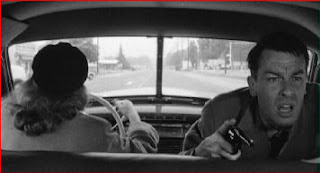
This scene from GUN CRAZY is all one take... and because we are *trapped* in that take with no edits to help us escape, the suspense escalates. We can not cut to inside the bank. We can not cut to some other place. We are stuck *here*, in *this shot*, dealing with all of the problems *in this shot* and can not escape! It's a great scene, and there's an interesting rif on it in SPRING BREAKERS where we see the robbery through the window of the getaway car. But the *economy* of this scene really adds to the tension...
GUN CRAZY is a great film, a low budget film, and I talk about it a little in the Film Noir Class, and here's my review...
GUN CRAZY is an adult story. Not Hollywood fluff. It’s dark. It’s sexy. Probably the thing that impressed me the most when I first saw it were Peggy Cummins’ *very* tight black trousers. Women in 1940s movies always wore skirts and dresses. If they did wear pants they were non-sexual - often mannish. But here we have pants so tight it’s almost as if she’s naked.
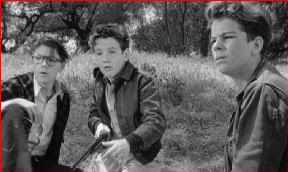
The story is about a boy (eventually played by John Dall) who has a gun fetish. In the opening scene he steals a gun from a shop window, admires it while the alarm blares, then takes off running... tripping on the wet street. The gun goes sliding across the wet street until it hits a man’s boot... tilt up... a *Police*man’s boot. Next scene - the boy in court explaining to the judge how much he just loves guns. He doesn’t feel whole unless he has a gun in his hands. We’ll leave that up to Uncle Sigmund... but that’s what drives the film - this guy needs a gun to feel like a man. At the trial we meet his two best friends - one is the policeman’s son, the other wears glasses so you know he’ll grow up to be a writer - and they tell the judge that our hero isn’t a killer, on a camping trip he couldn’t shoot a wildcat that was hanging around their campsite (great flashback). He couldn’t bring himself to shoot at it. Wow, same problem as Jon Voight in DELIVERANCE! Boy is sentenced to reform school, from there he goes into the army, then he comes home.
Now we have adult John Dall and his two pals - one is now a cop and the other is a writer for the town newspaper. The carnival is in town, so that’s where they go. The great thing about this film are the set pieces. In the old studio days, it was a scene so juicy the studio would pay for a new set to be built. You don’t need a new set for a set piece, you just need a big juicy scene... and even though GUN CRAZY was a low budget film, probably shot on leftover sets that had been used a million times before and real locations that could be got cheap - and in the case of one set piece, probably shot without any set at all - the film is full of amazing set pieces.
The Carnival - maybe the same one from THE RING (1927) - has a sharp shooter as it’s main attraction. Sexy Peggy Cummins in those skin-tight pants. She shoots balloons from around her assistant, shoots a cigarette out of her mouth, and all of the other carny tricks you usually see with a knife thrower. The Barker, an aging pretty boy, announces that for a mere $50 you can test your shooting skills against the master... and possibly win $500. Kind of the same deal as THE RING, just with guns instead of fists. John Dall’s buddies put up the money, and we get a great set piece as Dall and Cummins try to out shoot each other... and fall in lust in the process. Because Dall is an amazing shot, the Barker keeps upping the ante in order to win the bet. Eventually it comes down to this insane trick where a crown that holds a half dozen matches is put on Dall’s head and Cummins *lights the matches* with her bullets. All but one. Then it’s her turn to wear the crown. Dall lights them all. Look, I don’t want even the best sharp shooter in the world to be aiming a gun at my *head* from across the room, let alone firing at me six times. That’s just crazy! Dall ends up with a job at the carnival... Now we have a great scene - not a set piece, but a juicy *dramatic* scene that deals with the romantic triangle between the Barker and Cummins and Dall. One of the interesting things is how they used a metaphor to tell us who was sleeping with who. When Dall first joins the carnival, the Barker asks if he has a car... he says no. Cummins wants him to ride with them, the Barker says there isn’t room in their car... Dall can ride with the clown. If you watch who rides with who in the carnival scenes, you can see Cummins and Dall getting together and the Barker riding alone. Which brings us to the big juicy scene where all of this blows up. Real good. The Barker has a claim on Cummins and tells Dall he’s out of here if he doesn’t honor it. The result of the big blow up is *Cummins and Dall* leaving together (in the same car), which leads us to some relationship stuff where they realize they are broke, and then Cummins’ plan to make money...
By armed robbery.
Now we get one of the greatest scenes in low budget history - that “backseat bank robbery” above. It’s a single continuous shot - several minutes - taken from the back seat of their car as they drive down the street of a town, find the bank, hope that there is a parking spot, Cummins pulls into a spot near the front of the bank and Dall gets out. After Dall goes into the bank, a cop walks down the sidewalk, stops near the front of the bank! Cummins pulls the car up, gets out, flirts with the cop, and tries to steer him away from the bank. Not happening. This builds suspense. She keeps trying to get the cop out of the way, but he won’t budge. Then the alarm goes off. She hits the cop, just as Dall bolts out of the bank doors with the money.
They get in the car, Dall driving, and now we get a shoot out and car chase from the back seat of the car. All one shot. The great thing about this is that it was probably dirt cheap - we don’t need the bank interior and extras and setting up lights in the location. It’s *one* camera set up. But it gives you the feeling that you are right there - in the getaway car with them. When the cop fires at the car, he’s firing at *you*. And it’s all one cool shot. This is a *great* scene!
The big set piece is the armed robbery that will make them rich. Dall thinks this means they can retire to some exotic location and just be together for the rest of their lives. Cummins thinks only about how much money they will end up with. The target for the armed robbery - the Armour meat packing plant payroll. Well before anyone thought of product placement, we get a *real* company name and a *real* meat packing plant. Again, this was probably due to the low budget. They found a practical location and probably couldn’t afford to change all of the signs.
This is one of those split second timed robberies where all kinds of things can go wrong... and do. It’s a tense scene, then it blows up and becomes a big action scene. The great part about it are the pieces of the set piece. Dall drives up in a truck filled with beef on hooks. He gets some steaks from a butcher and puts them in his bag, then walks to the offices and has to get past a half dozen people who tell him he’s in the wrong area. Dall tells them he has the steaks for the boss’s barbeque. Everyone tells him there’s no refrigeration here - he should take the steaks back to the plant. The deeper he gets into the office, the more he and the steaks are out of place. Eventually he gets to the boss’s floor... where Cummins is working as a secretary, Here it’s Cummins who tells him he’s in the wrong place - as she leads him right into the boss’s office, where they kidnap him and have him fill the steak bag with payroll money. And here’s where we see the beginning of the end - Cummins gets trigger happy and shoots a whole lotta people on the way out. It’s a great big run and gun scene - lots of action to break the tension that has come before.
After that set piece they are on the run, and we get a great sequence where they have their last night out as a couple. They go to the Santa Monica Pier and go on carnival rides - bringing us back to the beginning of their relationship. Then they go to a dance hall, and have a nice, tender, relationship scene... not knowing that the police have traced them to California and are waiting outside. They manage to escape with nothing - they even lose some of the clothes on their backs. Only one place to go...
Back to Dall’s home town. Now we get a great scene with the criminals and Dall’s sister’s family.... trying to act normal when people come over. Dealing with kids playing in the yard when you are harboring a pair of fugitives. And eventually a great scene with Dall and his two childhood friends - the cop and the reporter. A low budget film needs big scenes like this one - juicy drama where childhood friends are on opposite sides of the law... and Dall is kind of in the middle. Cummins is all for just killing them- in fact, she’d kill anyone if it allowed them to escape. She’d kill the kids (and that is in the film). In fact, there’s a great unseen scene where Cummins does *something* to Dall’s sister and her entre family - maybe she just locks them up, maybe she kills them all. We never find out which it is, because we come to the other big amazing set piece...
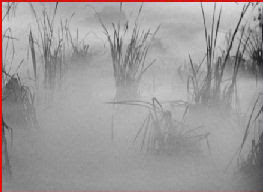
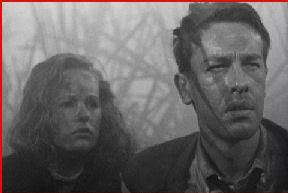
The one that probably has no set! Dall and Cummins end up chased by every cop in the state, and blood hounds, and posses and probably villagers with pitchforks... but since they are chased through a foggy swamp, we just *hear* all of these things. I’m not sure if we see a single dog - though there may be a stock shot of dogs chasing - but we *hear* packs of blood hounds cha!sing them. We hear hundreds of cops searching the foggy swamp for them.
The swamp is... well, it’s 99% fog and 1% a couple of thatches of tule grass. The big scene where th!ey hide and the cops and dogs search - is just them behind a thatch of tules surrounded by fog. And it works! It’s an amazing scene. Probably shot in some warehouse with a smoke machine. Just goes to show you, *imagination* and *inventiveness* can create production value if you don’t have any cash.
GUN CRAZY still holds up, mostly due to the amazing set pieces and great sequences and fairly obvious sexual overtones... oh, and Cummin’s skin tight trousers.