Showing posts with label bill's favorite films. Show all posts

Tuesday, July 21, 2026

Trailer Tuesday: The Wind And The Lion (1975)

My birthday was yesterday, so...

One of my favorite movies, and probably one you have never heard of... now on BluRay thanks to the wonderful people at Warner Archive.

Directed by: John Millius.
Written by: John Millius.
Starring: Sean Connery, Candice Bergen, Brian Keith, Geoffrey Lewis, John Huston, the great Vladek Sheybal.
Director Of Photography: Billy Williams.
Music By: the great Jerry Goldsmith, one of my favorite of his 254 scores.


Many people think that after the dark films of the 70s, STAR WARS came along and changed everything with its rousing story of adventure. But adventure was already a major component of 70s films, with John Huston’s epic adventure THE MAN WHO WOULD BE KING and this fun swashbuckler released a couple of years before STAR WARS and written and directed by one of Lucas’ friends, John Milius. There are sword fights and romance and cliff hangers and fantastic stunts and it all takes place in a world far away and many years ago.

It is a great film for 12 year olds of all ages - filled with larger than life characters and all kinds of romance and adventure. And *knowing* that it's a boy's adventure story it often takes the point if view of a 12 year old boy in the story.


John Milius is one of my favorite directors, and when I met him a few years ago this was the film I mentioned loving - even though many of his other films are also among my favorites. I start every day listening to the Basil Poledouris theme to CONAN THE BARBARIAN, and I thought PUBLIC ENEMIES paled big time in comparison to DILLINGER. They have tried remaking CONAN and RED DAWN without success and I believe part of that is because they missed Milius' point. His movies were usually about two strong people in combat - and the *respect* the combatants had for each other and the honor of a good fight. In the original RED DAWN the Cuban villain allows the Wolverines to remove their wounded in one scene - even though he could easily kill them and end his problems. But he is a man of honor - even though he is the villain. In the remake we have evil Korean villains who have no trace of humanity or honor. Just *eeeeevil*! Even though Milius and I have completely different political beliefs, he never demonizes the other side in his films. Though he may not agree with the opposing government’s goals (or maybe even the hero’s government’s goals - governments are usually corrupt), the warriors on the battlefield are not evil guys. His antagonists are not two dimensional mustache twirlers, they are real people.

The great thing about having two strong forces locked in battle is that you get to explore each character... plus there’s no shortage of action. This is something today's film makers (and production execs with stupid notes) should consider. Hitchcock said "The better the villain, the better the picture", and "better" includes being more fleshed out and dimensional. If a giant asteroid smashes earth, we don't *feel anything* about the asteroid... it's just a rock. We can't hate the asteroid... it's just a rock. The problem with the Korean villains in the RED DAWN remake is that they were just rocks... no trace of humanity that could pull out our emotions.


With THE WIND AND THE LION we have a story loosely based on an actual historical event - the kidnaping of two Americans in the middle east and the quest to get them back unharmed. In real life it was 64 year old American citizen Ion Perdicaris and his son, kidnaped by Berber warrior Mulai Ahmed er Raisuli and his horsemen from his villa in Morocco to secure a ransom and political power from the Sultan... and President Teddy Roosevelt famously said: “Perdicaris alive or Raisuli dead!” and moved in the Marines. As a romance between a dashing Berber warrior and some 64 year old dude probably wasn’t going to play in 1975, Milius changed the 64 year old man into an attractive young woman with her *two* children and as I said earlier, has the story seen through the eyes of the boy. Not accurate history, but it’s an adventure film not a documentary. Most of the other characters and even some of the dialogue remains true.

The film is a true epic - big action, big emotions, big romance, big stars and an amazing Jerry Goldsmith score. It’s like LAWRENCE OF ARABIA meets RAIDERS OF THE LOST ARK. Sean Connery plays the Raisuli as a handsome sheik on horseback, a young Candice Bergan played Eden Perdicaris, and Brian Keith steals the show playing Teddy Roosevelt. The film is filled with great sword fighting scenes and some of the most amazing horse stunts you will ever see - lots of horses *indoors* on stairways and rooftop chases!

What is interesting is that our kidnaper is the *love interest* and the male lead in this story. The main conflict is between the Raisuli and Teddy Rosevelt... who never share a single scene. This telegram (from the film) sums up their conflict: “To Theodore Roosevelt - you are like the Wind and I like the Lion. You form the Tempest. The sand stings my eyes and the Ground is parched. I roar in defiance but you do not hear. But between us there is a difference. I, like the lion, must remain in my place. While you like the wind will never know yours. - Mulay Hamid El Raisuli, Lord of the Riff, Sultan to the Berbers, Last of the Barbary Pirates.” Roosevelt sends his Marines to track down the Raisuli, and rescue Mrs. Pedecaris and her children.


Since Roosevelt and the Raisuli never share a scene, the story finds some excellent other forms of conflict. Mrs. Pedecaris is a prim and proper woman who is used to servants and elegant accommodations and manners... who is kidnaped and forced to take an extended camping trip in the desert where there is no indoor plumbing and no indoors. She wears many layers of clothing to preserve modesty, but these things aren’t exactly camping and horse riding attire. The Raisuli doesn’t help his side by chopping off the head of a thief in one scene... and forcing Mrs. Pedecaris to find a way to change clothes in front of his band of Barbary Pirates. So we have Pedecaris against the Raisuli, constantly battling each other (and falling in love along the way... this *is* a movie).

But we also have the politics. The Raisuli’s reason for kidnaping Mrs. Pedecaris is to force the Sultan and his uncle the Bashaw (Vladek Sheybal, who tangled with Connery in FROM RUSSIA WITH LOVE) into removing the foreign influences from the country. The place is *filled* with Americans and English and Germans and everybody else trying to make deals for the country’s resources, and sell European goods (like weapons) to the Sultan. The country has become corrupt, and the Raisuli believes they will be conquered through commerce by the west. The Germans end up the main negative influence in this story, probably because of those spiked helmets. But does this remind you of any other political situation? Wait, there’s more... because the USA sends in the Marines (lead by Steven Kanaly) to protect their interests and rescue Mrs. Pedecaris... which seems a bit like Viet Nam. Now, one of my other favorite Milius films BIG WEDNESDAY is *about* Viet Nam... and in that film he has one of the three leads make the decision to serve his country with honor while the other two don’t go to war. So Milius doesn’t seem to be on the anti war side of Viet Nam. But there are still traces of a meddling United States becoming involved with a foreign conflict that is such a rat’s nest that there’s no way we can understand it, let alone do anything to solve it. The real conflict is between the Sultan & Bashaw and the Raisuli... and the Raisuli is the Bashaw’s *brother*! (Wait, does that make the sultan Raisuli’s son? Maybe, never brought up.) There is nothing America can do to resolve the internal politics of this country.


Teddy Roosevelt is portrayed as a President who must do *something* after an American is kidnaped. He sends his Ambassador (the great Geoffrey Lewis) to try negotiation with the Sultan, hoping the Sultan will grant the Raisuli a section of the kingdom that will be free from foreign influences... but the Sultan is fickle and would rather play with his German machinegun. Many of the scenes concern Roosevelt’s love of nature, the building of the national parks system, and the Grizzly Bear he has shot on a hunting trip and wants to have stuffed and mounted... not as an inferior to humans, but as a fierce animal (kind of the king of the American jungle). John Huston plays his *slippery* Secretary Of State John Hay, who tries to manipulate the President... without success. The politics on both sides are convoluted and confusing... only the individuals like Roosevelt and the Raisuli have honor.

This film has a rousing score by Jerry Goldsmith which I bought on vinyl probably the day I first saw the film (there was a Soundtracks Only store in San Francisco) and I have it to this day (and a CD without as many scratches). If you don't know who Goldsmith was, he was probably the greatest modern film composer... and I prefer him over John Williams. He also scored CHINATOWN and THE BLUE MAX and THE OMEN and... well, lots of great scores! The film was shot by Billy Williams who was nominated a few times for Best Cinematography Oscar but only won once for GANDHI. Stunts by Terry Leonard, who also did the stunt coordination on RAIDERS OF THE LOST ARK and APOCALYPSE NOW and RED DAWN and most recently on AMAZING SPIDERMAN 2.


When the film came out I was a teenager and movies still opened on Wednesdays and only opened in major cities... played there for a month or two, then opened in the suburbs (which used to be called “Roadshow”). So, to see the movie on opening day, my friend Dave and I drove all the way to San Francisco and saw the very first matinee. Not packed. But afterwards, we pretended to sword fight all the way back to the car. I saw the film one more time in San Francisco, then once when it played “roadshow” in Concord. This was one of those movies that got me excited about making movies when I grew up. I wanted to do big, exciting, swashbucklers like this!

The film was not a big hit, nor was it a flop. It did okay. What I always find strange is how people will find fault with some movie... and then ignore the same problem in some movie they like. The two big things critics disliked about this film were Sean Connery’s Middle Eastern accent (which sounded Scottish) and that they changed the kidnaped dude to a kidnaped chick. Has Connery ever had an accent in a movie that wasn’t Scottish? Did we ever care? And how many movies based on some true event stay completely true to what happened? They all dramatize things! Were there major complaints about SHAKESPEARE IN LOVE bending the facts? No - it was a movie! I think the critics thought it was *fun* when movies had been gritty and serious for the past few years. The year WIND came out was the same year ONE FLEW OVER THE CUCKOO’S NEST and DOG DAY AFTERNOON and SHAMPOO came out. Nobody could see STAR WARS in the crystal ball. WIND AND THE LION wasn’t one of the top ten films that year, though a film Milius did some uncredited writing on called JAWS was #1.

THE WIND AND THE LION is one of those films that people fall in love with. I still love the film and watch the DVD probably once a year... and now it's out on BluRay!

Milius Interview:


Check out THE WIND AND THE LION on BluRay. It might make you feel like a 12 year old again, and you might sword fight with a broom... and break something.

One of my favorite films.

- Bill

Tuesday, April 14, 2026

Trailer Tuesday: Gun Crazy (1950)

Gun Crazy (1950)

Directed by: Joseph H. Lewis.
Written by: MacKinley Kantor and Dalton Trumbo (Millard Kaufman as Trumbo's "front").
Starring: Peggy Cummins, John Dall, Rusty Tamblyn
.


I probably first saw this film at the UC Theater in Berkeley a couple of decades ago, and was blown away by it. First, like most noir, it’s an adult story. Not Hollywood fluff. It’s dark. It’s sexy. Probably the thing that impressed me the most when I first saw it were Peggy Cummins’ *very* tight black trousers. Women in 1940s movies always wore skirts and dresses. If they did wear pants they were non-sexual - often mannish. But here we have pants so tight it’s almost as if she’s naked.

SPOILERS!
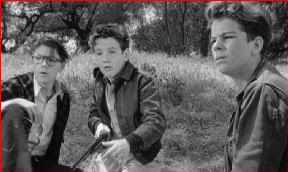
The three boys look at the bobcat
The story is about a boy (eventually played by John Dall) who has a gun fetish. In the opening scene he steals a gun from a shop window, admires it while the alarm blares, then takes off running... tripping on the wet street. The gun goes sliding across the wet street until it hits a man’s boot... tilt up... a *Police*man’s boot. Next scene - the boy in court explaining to the judge how much he just loves guns. He doesn’t feel whole unless he has a gun in his hands. We’ll leave that up to Uncle Sigmund... but that’s what drives the film - this guy needs a gun to feel like a man. At the trial we meet his two best friends - one is the policeman’s son, the other wears glasses so you know he’ll grow up to be a writer - and they tell the judge that our hero isn’t a killer, on a camping trip he couldn’t shoot a wildcat that was hanging around their campsite (great flashback). He couldn’t bring himself to shoot at it. Wow, same problem as Jon Voight in DELIVERANCE! Boy is sentenced to reform school, from there he goes into the army, then he comes home.

Now we have adult John Dall and his two pals - one is now a cop and the other is a writer for the town newspaper. The carnival is in town, so that’s where they go.
Peggy Cummins - trousers so tight there's a visible panty line
The great thing about this film are the set pieces. In case you missed that Script Tip, a set pieces is a big scene. In the old studio days, it was a scene so juicy the studio would pay for a new set to be built. You don’t need a new set for a set piece, you just need a big juicy scene... and even though GUN CRAZY was a low budget film, probably shot on leftover sets that had been used a million times before and real loactions that could be got cheap - and in the case of one set piece, probably shot without any set at all - the film is full of amazing set pieces.

sure - shoot at my head
The Carnival - maybe the same one from THE RING (1927) - has a sharp shooter as it’s main attraction. Sexy Peggy Cummins in those skin-tight pants. She shoots balloons from around her assistant, shoots a cigarette out of her mouth, and all of the other carny tricks you usually see with a knife thrower. The Barker, an aging pretty boy, announces that for a mere $50 you can test your shooting skills against the master... and possibly win $500. Kind of the same deal as THE RING, just with guns instead of fists. John Dall’s buddies put up the money, and we get a great set piece as Dall and Cummins try to out shoot each other... and fall in lust in the process. Because Dall is an amazing shot, the Barker keeps upping the ante in order to win the bet. Eventually it comes down to this insane trick where a crown that holds a half dozen matches is put on Dall’s head and Cummins *lights the matches* with her bullets. All but one. Then it’s her turn to wear the crown. Dall lights them all. Look, I don’t want even the best sharp shooter in the world to be aiming a gun at my *head* from across the room, let alone firing at me six times. That’s just crazy! Dall ends up with a job at the carnival...
sex and violence - the film was made in the 40s, how old are your grandparents - could this be them after doing it?
Now we have a great scene - not a set piece, but a juicy *dramatic* scene that deals with the romantic triangle between the Barker and Cummins and Dall. One of the interesting things is how they used a metaphor to tell us who was sleeping with who. When Dall first joins the carnival, the Barker asks if he has a car... he says no. Cummins wants him to ride with them, the Barker says there isn’t room in their car... Dall can ride with the clown. If you watch who rides with who in the carnival scenes, you can see Cummins and Dall getting together and the Barker riding alone. Which brings us to the big juicy scene where all of this blows up. Real good. The Barker has a claim on Cummins and tells Dall he’s out of here if he doesn’t honor it. The result of the big blow up is *Cummins and Dall* leaving together (in the same car), which leads us to some relationship stuff where they realize they are broke, and then Cummins’ plan to make money...

By armed robbery.
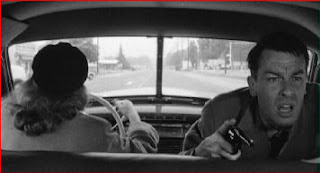
John Dall exits the bank as Peggy tries to sweet talk the cop - all from the back seat of the getaway carNow we get one of the greatest set pieces in low budget history - the “backseat bank robbery”. It’s a single continuous shot - several minutes - taken from the back seat of their car as they drive down the street of a town, find the bank, hope that there is a parking spot, Cummins pulls into a spot near the front of the bank and Dall gets out. After Dall goes into the bank, a cop walks down the sidewalk, stops near the front of the bank! Cummins pulls the car up, gets out, flirts with the cop, and tries to steer him away from the bank. Not happening. This builds suspense. She keeps trying to get the cop out of the way, but he won’t budge. Then the alarm goes off. She hits the cop, just as Dall bolts out of the bank doors with the money.back seat cameraThey get in the car, Dall driving, and now we get a shoot out and car chase from the back seat of the car. All one shot. The great thing about this is that it was probably dirt cheap - we don’t need the bank interior and extras and setting up lights in the location. It’s *one* camera set up. But it gives you the feeling that you are right there - in the getaway car with them. When the cop fires at the car, he’s firing at *you*. And it’s all one cool shot.
John Dall with a bag full of guns and steaks
The big set piece is the armed robbery that will make them rich. Dall thinks this means they can retire to some exotic location and just be together for the rest of their lives. Cummins thinks only about how much money they will end up with. The target for the armed robbery - the Armour meat packing plant payroll. Well before anyone thought of product placement, we get a *real* company name and a *real* meat packing plant. Again, this was probably due to the low budget. They found a practical location and probably couldn’t afford to change all of the signs.

This is one of those split second timed robberies where all kinds of things can go wrong... and do. It’s a tense scene, then it blows up and becomes a big action scene. The great part about it are the pieces of the set piece...

All of the details make the scene real... and build suspense!


everyone tells him hes in the wrong area including this armed guard

Dall drives up in a truck filled with beef on hooks. He gets some steaks from a butcher and puts them in his bag, then walks to the offices and has to get past a half dozen people who tell him he’s in the wrong area. Dall tells them he has the steaks for the boss’s barbeque. Everyone tells him there’s no refrigeration here - he should take the steaks back to the plant. The deeper he gets into the office, the more he and the steaks are out of place. Eventually he gets to the boss’s floor... where Cummins is working as a secretary, Here it’s Cummins who tells him he’s in the wrong place - as she leads him right into the boss’s office, where they kidnap him and have him fill the steak bag with payroll money. And here’s where we see the beginning of the end - Cummins gets trigger happy and shoots a whole lotta people on the way out. It’s a great big run and gun scene - lots of action to break the tension that has come before.

After that set piece they are on the run, and we get a great sequence where they have their last night out as a couple. They go to the Santa Monica Pier and go on carnival rides - bringing us back to the beginning of their relationship. Then they go to a dance hall, and have a nice, tender, relationship scene... not knowing that the police have traced them to California and are waiting outside. They manage to escape with nothing - they even lose some of the clothes on their backs. Only one place to go...

Back to Dall’s home town. Now we get a great scene with the criminals and Dall’s sister’s family.... trying to act normal when people come over. Dealing with kids playing in the yard when you are harboring a pair of fugitives. And eventually a great scene with Dall and his two childhood friends - the cop and the reporter. A low budget film needs big scenes like this one - juicy drama where childhood friends are on opposite sides of the law... and Dall is kind of in the middle. Cummins is all for just killing them- in fact, she’d kill anyone if it allowed them to escape. She’d kill the kids (and that is in the film). In fact, there’s a great unseen scene where Cummins does *something* to Dall’s sister and her entire family - maybe she just locks them up, maybe she kills them all. We never find out which it is, because we come to the other big amazing set piece...

The one that probably has no set!
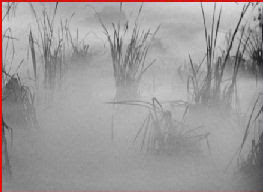
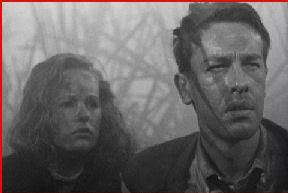
smoke and tuleDall and Cummins end up chased by every cop in the state, and blood hounds, and posses and probably villagers with pitchforks... but since they are chased through a foggy swamp, we just *hear* all of these things. I’m not sure if we see a single dog - though there may be a stock shot of dogs chasing - but we *hear* packs of blood hounds chasing them. We hear hundreds of cops searching the foggy swamp for them.

The swamp is... well, it’s 99% fog and 1% a couple of thatches of tule grass.
can you hear all of those cops and dogs?
The big scene where they hide and the cops and dogs search - is just them behind a thatch of tules surrounded by fog. And it works! It’s an amazing scene. Probably shot in some warehouse with a smoke machine. Just goes to show you, *imagination* and *inventiveness* can create production value if you don’t have any cash.

GUN CRAZY still holds up, mostly due to the amazing set pieces and great sequences and fairly obvious sexual overtones... oh, and Cummin’s skin tight trousers.

- Bill

Nothing sexual about this...

Nothing sexual about this Gun Crazy - the DVD

Tuesday, March 17, 2026

Trailer Tuesday: THE IPCRESS FILE (1965)

RIP Len Deighton
One of my favorite films.

Director: Sidney J. Furie (BOYS IN COMPANY C)
Writers: James Doran, Bill Canaway.
Starring: Michael Caine, Sue Lloyd, Guy Doleman, Nigel Green.
Produced by: Harry Saltzman.
Cinematographer: Otto Heller (BAFTA (British Oscars) nominee for ALFIE, winner for this film... and the lighting is amazing.)
Music by: John Barry (the James Bond movies) - and it’s a great score!

Sort of the “anti-Bond”, but made by the producers of the Connery films. Harry Palmer is The Spy Who Does Paperwork in this predecessor to THREE DAYS OF THE CONDOR. There is a form for everything - a form to get a gun, a form to fill out if you fire the gun... and if you manage to hit someone? No end to the amount of paperwork! This is the *government* - it’s all about filling out forms! Forms for stake outs, forms to requisition a car, forms for *not* discovering any information. Harry hates paperwork, but he’s a genius at sifting through it for clues - to find an enemy agent with no known address, he checks for parking tickets... because like Turner in CONDOR, Harry Palmer is brains rather than brawn. The other anti-Bond element here is that Harry is not great at fighting and when he shoots a gun he tends to screw up.

Oh, and this is a paranoid thriller, which we will talk about later.


There are so many great things about this film that I will never get to all of them, but you have young Michael Caine in his first starring role and amazing camera work by Otto Heller and a great John Barry score and a clever script and... well, let’s start at the beginning.

TEASER


The film opens with what you would call a “teaser” in television. A car driving down the streets of London with two men in the backseat: one is reading “New Scientist Magazine” and the other keeps looking behind the car and ahead of the car and generally building up the audience’s paranoia that something is going to happen. The car makes it to a train station where the paranoid man, Agent Taylor (Charles Rea), accompanies the scientist Radcliff (Aubrey Richards) to the train and his train compartment. A porter follows with the luggage. In the train station Agent Taylor is on high alert, looking for danger.

Once Radcliff is secure in his compartment, Agent Taylor goes back to the car... where he spots Radlciff’s camera, grabs it, and races to the train. When he opens the train compartment door, the man reading “New Scientist Magazine” lowers the magazine from his face, exposing that he is *not* Radcliff. What? This is a great reveal, because the imposter is wearing the same clothes and same hat as Radcliff. If you are going to show that the scientist has been switched, you want to find a way to do it that has maximum impact. We think the man reading “New Scientist Magazine” in the train compartment is Radcliff right up until the moment his face is revealed.

Next shot is the train leaving the station and the camera turns slowly to reveal Agent Taylor dead on the side of the tracks.

Okay, that’s a great way to begin a movie!

IDENTITY

Now that we have our problem, we need to introduce our protagonist, and we get a swell scene behind the titles: Harry Palmer (Michael Caine) wakes up in the morning and prepares for a day of work. It is a simple scene which tells us EVERYTHING we need to know about this character. He has to find his glasses before he can see the alarm clock. Everything is a blur! He grinds his own gourmet coffee beans, and uses a complicated coffee maker (kind of an in-film advert, since one of the producers owned the company that made the gourmet coffee making machine). Harry looks out his flat window while drinking his coffee. Later, he finds a woman's necklace in his bed... while searching for his misplaced gun. There’s a bit of a zoom shot to the gun - and guns get close ups in this film, which is unusual. And then Harry leaves his apartment, late for work. One of the reason why I think this is a predecessor for CONDOR is that Harry is an ordinary guy in a job that starts out boring in the story (Harry is doing stake out duty on someone) and then suddenly becomes dangerous. Can he handle that? He’s not just the spy who does paperwork, he’s an *underdog* spy!

Introduction To Harry:


The interesting thing about the Deighton novels are that they are told first person and we never learn the character’s name... he is a spy and has a dozen aliases. An element of the novels is the loss of identity - when you use so many different names, who are you really? And the film does a great job of illustrating this through story and situations. Never knowing the name worked on the page, but they needed something to call him on screen, so - legend has it - the producer asked Caine for the most boring first name he could imagine, and Caine responded “Harry” to Harry Saltzman. And he didn’t get fired!

IPCRESS makes the job of spying mundane: a bunch of stakes outs and surveillance jobs followed by paperwork, so that when it explodes with action it seems much bigger due to the contrast. Caine plays Harry as a problem child who probably needed a good spanking many years ago, but now knows exactly how far he can push authority before it pushes back.

His boss, Colonel Ross (Doleman), hates him and has him transferred to Major Dalby’s department where he has to fill out stacks of paperwork as they try to find the kidnapped scientist who has been put up for auction by an espionage agent for hire code-name, BlueJay (Frank Gatliff) an Albanian who sells secrets... and people. Dalby (Nigel Green) “doesn’t have the sense of humor that Ross has” (which was none at all) and cracks the whip on Harry again and again. Harry finds a friend in team member Carswell (Gordon Jackson) and a love interest in team member Jean (Lloyd) - who may be a spy for Ross’s department... but she thinks that Harry is a spy for Ross’s department. Neither trusts each other - though they sleep together. That’s the kind of paranoid movie this is - the spies are spying on other spies!

DIALOGUE


The film has all kinds of great dialogue, including this exchange when Harry shows up for his first day of work at Dalby’s department:

Harry: “The fellow whose job I'm taking, will he show me the ropes?”
Dalby: “Maybe - if you're in touch with the spirit world.”
Harry: “I beg your pardon?”
Dalby: “He was shot this morning.”

Great punchline! Not funny (well, maybe in a sick way), but adds impact to the end of the dialogue exchange. You always want to put the stinger in the tail.


In the commentary, director Sidney J. Furie says that the script was awful and they were rewriting it on the set... I always discount when a director says this, because it’s usually a power grab. The plotting and dialogue in the film is so well done that it’s difficult to believe Furie - even though he’s one of my favorite directors. There’s a great example of a “payback line” - when Harry goes to Ross’s office, he leaves the door open and Ross says, “Close the door.” When Harry goes to Dalby’s office he leaves the door open and Dalby says, “Shut the door”. Then at the end of the movie, Harry has taken control and knows that either Ross or Dalby is a traitor, and invites them to the villain’s warehouse. When Dalby enters, Harry tells him to “Shut the door.” Playing back to the authority figures now that he is in control. So many great pieces of dialogue in this film, “A word in your shell-like ear”.

When he comes home to find Jean searching his flat (is she working for Ross or Dalby?) he asks if she has finished searching and she says “Yes.” “Then you know where the whisky is?” “Yes.” “Fix us both one, will you?” And this begins a romance with absolutely no trust at all. By the way, Jean has a nice little character moment where she talks about her spy husband who was murdered... and how Dalby gave her a job so that she could support herself. It’s emotional... and expositional. We *think* we know that her loyalties are with Dalby. But are they?


In the middle of this mistrust, she asks Harry: “Do you always wear your glasses?” “Yes... except in bed.” And then she takes off his glasses and kisses him.

Plus we have great story related visual elements that had to be in the screenplay - a CIA Agent wears glasses with broken frames, taped together with bright white tape. Another CIA Agent smokes a pipe. Characters have what I call “instant identifiers” in the Action Screenwriting book - a prop or piece of costume that allows the audience to recognize and differentiate characters. The two CIA Agents are easy to tell apart. The other Agents on Dalby’s team each have a prop or costume element that helps us tell them apart. These are screenplay related things, not something you figure out on the set at the last minute. Those taped together glasses end up a clue used later in the story.

So much of the dialogue and plotting are story related, and the film was obviously shot out of sequence (even though Furie says otherwise) that it’s impossible to believe that this script wasn’t at least most of the way there when they began shooting. Hey, maybe one of the two writers was hired to punch up the dialogue during production, but this film has a complex plot where characters are often double agents, lying, duplicitous... and yet, when you rewatch the film you can see the “tells” in their earlier scenes. It’s based on a book, dammit! The story was always there.

WEIRD SHOTS


But director, Sidney J. Furie, and DP Otto Heller come up with the most inventive angles and shots I’ve ever seen - which is one of the reasons why this is one of my favorite movies. Almost every single shot has something in soft focus in the foreground or is “canted” or “dutch” - at a strange angle. What’s interesting is how much fuzzy foreground obscures the shots - there are times when 75% of the screen is someone’s out of focus shoulder or something in the way of the shot. This may sound as if it would be irritating, but it is actually fascinating. You feel as if you are watching the story unfold looking over that shoulder or peeking through that cell door. Just amazing original shots. The lighting is also amazing - Heller paints with shadows, here. One of my favorite shots is early in the film when Ross climbs a spiral staircase to meet with Dalby, there must be a dozen different kinds of shadows in that shot! All with a real light source. There are scenes in darkness that look really really dark, except due to classic lighting techniques you can see what is happening. This seems to be a lost art, today.

Harry’s parking ticket clue leads him to the Science Library where he discovers BlueJay and his henchman HouseMartin, and when he tries to follow them? There is a whole fight scene shot through the glass of one of those red British phone booth - mullion coming between Harry and this huge bodyguard - and every other interesting combination of foreground and background is used to make the fight scene really interesting. Furie re-imagines action scenes as chess matches or tennis games and stages them in unusual ways throughout the film.

I don’t think there is a single “flat” shot in the entire film, and nothing that looks like TV “coverage”. The above mentioned shot through the cell door is amazing, because cell door has a crossed grille that creates diamond like openings... and the scene plays out with characters moving from one diamond to another - the chess match idea.


One of the great visual clues is a piece of paper where BlueJay has written his phone number, but it’s a fake disconnected number. Flip the paper over and it’s a flier for a military band concert. Harry and Dalby meet with BlueJay to make a deal for missing scientist Radcliff... and much of the scene is shot between the cymbals!

Because Harry wears glasses, the element of sight is used in both action scenes (you know he means business when he carefully folds up his glasses and puts them in his pocket) and other scenes (Harry with glasses off looks over a blurry crowd of scientists after Radcliff is returned and sees a person who does not belong) - the glasses become part of the way the story is told. Though this may be vaguely racist today, the scientists scene has an audience of white scientists in white labcoats and an African American CIA Agent in a suit. Though the image on screen is a blur, we can see that one of these people is not a scientist - and when Harry puts his glasses on, he goes after the Agent... who tells him, “I’m going to tail you until I know you are clean... and if you are not clean... I’m going to kill you.”

Which leads to the African American CIA Agent being found dead in Harry’s apartment. He flips the light switch, and there the body!


Other great visual elements include one of the greatest twist-reveals ever put on film, a shot through the keyhole of Harry’s flat of an intruder with a gun, a Polanskiesque shot where a door is opened to hide one character so that we focus on the other, the camera mounted on an armored car that batters down a door - we see it all POV, a Busby Berkeleyesque choreographed prisoner for money exchange in an underground parking garage with a deadly twist, the whole IPCRESS brain washing sequence - which includes an amazing Christ-symbolism bit where Harry jams a rusty nail into his palm to try to avoid the brainwashing, a multi-level following scene in a building, and an amazing ending where a brainwashed Harry must decide who to kill and who not to kill... which we will look at in a moment.

TANGLED WEBS


The other way that this story is like THREE DAYS OF THE CONDOR is that it has a faction inside the government’s espionage agency working against the government. We have no idea who can be trusted... and you can not trust the government itself.

Ross keeps trying to get Harry to hand over the file on their investigation, code named “Ipcress” because that word was written on a piece of audio tape found in the abandoned warehouse that they smashed into because they think BlueJay was using it for some mysterious reason. That scene in the abandoned warehouse (“Disused factory” a character calls it) is great for many reasons. Harry calls in the raid - with a British version of a SWAT Team - using “CC1 authority” that he doesn’t have. Dalby shows up before the raid... and Harry is in trouble. But Dalby tells the SWAT Team to go ahead, and they ram the door and storm the warehouse... which is empty except for a huge metal cross. Harry hits the metal cross and it makes a unique noise... which will be used as a sound cue to remind us when we see the same metal cross later. Lots of awesome sound design in this film! When the SWAT Team leader complains that their time has been wasted on an empty warehouse, Dalby covers for Harry - showing that despite all of the conflict between the two men, they are on the same side. Harry does a thorough search even though the warehouse was empty - and finds an old wood burning stove... still warm. Inside it: that audio tape with “Ipcress” written on it. Dalby offers to buy Harry and Carswell lunch.

When they play the bit of audio tape, all they get are strange noises - what do they mean? To add to the paranoia, there’s that CIA Agent with the broken glasses who is spying on Harry, and someone in one of the departments may actually be working for BlueJay. Jean who may be working for Ross. Ross who wants Harry to mictofilm the Ipcress File, and everyone else who may be working for the good guys or the bad guys... or may just be unaware of larger things going on. In a scene where Harry and Carswell go to interrogate a prisoner picked up by the police, Harry tells the police Desk Sargent, “Palmer.” The Desk Sargent replies, “Oh, Mr. Palmer’s just left, sir, with another gentleman. He said he’s be back soon, would you like to wait? Everything is under control, sir.” Harry flips open his ID, “I’m Palmer.” And their witness is dead in his cell - murdered by whoever had fake ID saying he was Palmer. You can’t trust *anyone* in this film!


Harry uncovers a plot to kidnap British scientists, brainwash them until they spill all of their secrets, then wipe their memories clean so that they are unable to function. 16 British Scientists have had their brain washed, 17 when you add in Radcliff. The cool thing about this 60s film is that it uses all of the real brainwashing devices from the CIA’s MK-ULTRA program, which wasn’t made public until the 70s. How they knew about these things in this film, I do not know. Were there CIA leaks that ended up in (novelist) Len Deighton’s hands?

SPOILER: There’s a great scene where Carswell thinks he knows what “Ipcress” means and shows Harry a book. He asks to borrow Harry’s car to check on something. Harry puts the book and the Ipcress File in his desk and locks it. And then we see Carswell driving, stopping at a stop light... and when the light turns green the car doesn’t move. The cars behind it honk their horns. The car still doesn’t move. Then we get a shot of the front window... with a bullet hole from a rooftop sniper, and Carswell dead behind the wheel! There are rooftop snipers out there, just waiting for Harry!

This leads to a great emotional scene where Harry realizes that he is partially responsible for Carswell’s death, and there is some survivor’s guilt. He finds a place to be alone and grieve... and then Jean finds him and holds his hand. Great little scene! When he goes back to the office - his locked drawer has been pried open and the book and Ipcress file are gone. This is in a British secret service office! How can someone get passed the security to do that?

Harry tells Jean he’s going to hide somewhere...

BRAIN WASHING


Which leads to one of my favorite bits in the film where BlueJay kidnaps Harry... and he wakes up in a crappy cell in some old industrial building, and BlueJay tells him that it would be pointless to try to escape, because he's in Albania. How can he get help if he does not speak Albanian? Where would he run to? He has no passport, no identification. Even if he escaped, he's still trapped in this foreign land. The signs are in Albanian, the prison guards wear Albanian military uniforms, and everyone speaks Albanian. Harry is screwed.

The brainwashing scene is right out of MK-ULRA program - they begin with disorientation by feeding him at strange hours and keeping the same exact lighting in his cell so that he has no idea how many days have passed. He is often starved, because the food is too hot to eat and taken away if he doesn’t eat it. Harry finds a rusty nail that he uses to mark the “days” (period between meals being offered) on the prison walls - which are filled with th markings of other prisoners counting the days... some maybe hundreds of years old.

Then they proceed to brainwash him using the IPCRESS method... assaulting him with visuals and sounds (that Ipcress noise) that drive him crazy and lower all resistence. A form of sensory deprivation. Oh, and the suspended cube they wheel him into (strapped to a wheel chair) is suspended by a metal cross like the one from the warehouse... "Listen to me. Listen to me. You will forget the IPCRESS file, you will forget your name..." Harry jams that rusty nail into his palm, "My name is Harry Palmer. My name is Harry Palmer." But he loses the nail... and the brainwashing begins to work.

That's when Harry decides to escape... running out of the old industrial building where all of the signs are in Albanian, to... Downtown London! He was never taken to Albania! The whole thing was a ruse to make him not try to escape! This is one of dozens of little story touches that make IPCRESS FILE a really cool movie.

CHOICES


And now we come to an amazing twist that reveals who broke into his desk to steal the Ipcress File and book and who is the secret enemy agent working for BlueJay. Harry believes that either Ross or Dalby is the main enemy agent, and calls both to the “Albanian prison”, where he disarms both and has them stand under a light - so that we have a spotlight on our two suspects. Then he has them plead their case on why they are not the traitor. But is Harry brainwashed? Will he shoot the actual traitor, or has he been hypnotized to shoot the innocent man and let the real traitor walk free... and continue to work his way up the command of the British Secret Service?

I love movies where intelligent guys get sent into the field, where they are clueless, and must fight to survive. Harry gets in so much trouble, and the story is so clever and twisted and has so many double and triple crosses that I can watch it again and again... oh, and it’s visually really really cool.

A great clever screenplay coupled with great inventive direction and Michael Caine at the top of his game surrounded by a bunch of great British actors. Oh, and the musical score is one of John Barry’s best! They made two sequels in the 60s and a couple in the 90s (with an old Michael Caine) but the first one is the best. Check it out!

- Bill

Buy Ipcress DVD
eXTReMe Tracker