Friday, January 30, 2026

Fridays With Hitchcock:
Jamaica Inn (1939)

Screenplay by Sidney Gilliat and Joan Harrison based on the novel by Daphne DuMaurier.

JAMAICA INN was Hitchcock’s last film in England and his first of three films based on a Daphne DuMaurier story. His next film would also be from a DuMaurier novel - REBECCA - which would win the Oscar for Best Picture. In doing some research for this entry, I read an article that said REBECCA almost didn’t happen due to JAMAICA INN. It seems DuMaurier - kind of the J.K. Rowling of her time - had seen JAMAICA INN and *hated* it, and was making waves about Hitchcock directing REBECCA.

And she had good reason to hate this film - it took me several viewings to make it all of the way through. It’s a Gothic Melodrama - which probably ends up being the second most common type of Hitchcock movie after Man On The Run Thrillers. That seems odd when you think about it, but so many of Hitchcock’s films end up in that genre: from MARNIE (sort of) UNDER CAPRICORN to SUSPICION to REBECCA. This films are usually about innocent women who come under the spell of men with dark secrets and suspense and drama ensues. On the paperback aisle these books have covers that show a woman in a nightgown running away from a castle or mansion that has the silhouette of a stern looking man in the window. Though these stories can be filled with suspense and intrigue like REBECCA, they can also be over-the-top melodrama like UNDER CAPRICORN. JAMAICA INN fits somewhere between the two, and the film’s major flaw seems not so much Hitchcock’s direction or even the subject matter... but the star.


Nutshell: In 1800 England, young Mary (a hot 18 year old Maureen O’Hara in her very first role) is an orphan sent to live with her Aunt Patience and Uncle Joss in a costal village in Cornwall, where Uncle owns a scummy tavern called Jamaica Inn. This place is so rough the stage coach won’t even stop *near* there and dumps Mary and her baggage in front of the Governor’s Mansion. Governor Sir Humphrey (Charles Laughton) offers to escort Mary to Jamaica Inn - a place so dangerous Sir Humphrey’s groom tries to talk him out of it. They ride to the Inn, and Sir Humphrey gets the hell out of there. Mary meets her Uncle (Leslie Banks) and Aunt (Marie Ney) and is shown to her room. Downstairs in the bar, a criminal gang - lead by her Uncle - are arguing over the loot from a bit of piracy. Seems these fellows have an inside man who tells them when ships are passing the rugged coast, and they cover the lighthouse light so that the ships crash into the shore, then steal the cargo and Uncle Joss takes it to his fence. Mary discovers all of this, saves a gang member Trehearne (Robert Newton) from death, Trehearne kidnaps her, she goes to Sir Humphrey for help, and gets kidnaped a couple more times before the film is over. Along the way, she meets a nice guy and some romance blossoms... the end.

We’ll look at the plot details in a few minutes.

Experiment: This is a case of “Be careful what you wish for”. Hitchcock had worked his way up from drawing title cards to directing films, and had managed to direct a string of hits that sold tickets not only in England, but in the world. His 39 STEPS and LADY VANISHES were massive international successes... but both were genre films and looked down upon by some critics. Hitch wasn’t working with top tier stars, he was often working with B level actors in the U.K. Hey, everyone knows who Nova Pilbeam is, right? She’s the *star* of YOUNG AND INNOCENT, the film he made just between LADY VANISHES and SABOTAGE. As soon as someone like Robert Donat became a star, he quit doing genre films (and moved to the America to do dramas like GOODBYE, MR. CHIPS). Hitchcock’s films were successes despite not having big name stars in the leads.

But just as LADY VANISHES resulted in a contract from GONE WITH THE WIND producer David O. Selznick and a ticket to America, it also attracted the attention of Oscar winning movie star Charles Laughton. Finally - a movie star who wanted to work with Hitchcock! Laughton was born in England, had become a star there, and then moved to America where the real money was. In America he was the star of prestige films like MUTINY ON THE BOUNTY and LES MISERABLES. Having him in a Hitchcock film guaranteed both box office and critical success - and a chance for Hitchcock to be seen as more than just a genre filmmaker.

But everything has a price, and Laughton was the 300 lb gorilla - instead of JAMAICA INN being a Hitchcock movie, it ended up a Charles Laughton movie... and instead of the story being about an innocent girl sent to live in a den of scum and villainy... it became the story of Sir Humphrey the Governor of the district and his descent into madness (and over acting). I’m sure the reason why DuMaurier hated the film was that it was no longer about the lead character, but about a side character from her book who had now taken center stage. But let’s face it - the lead character of Mary was played by an actress who had never done a film before, and Sir Humphrey was played by an Oscar winner. Who do you think should get more screen time?
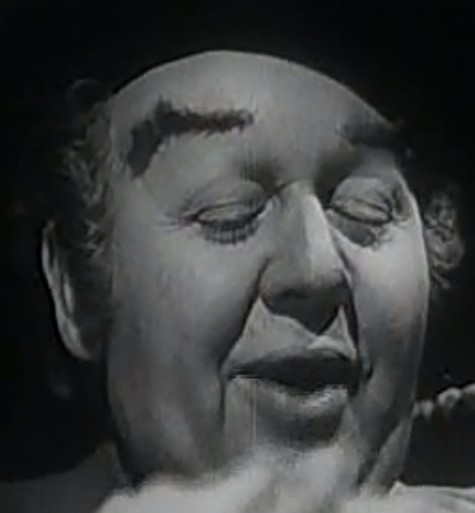


In the Hitchcock/Truffaut Book, Hitch has little good to say about Laughton, telling a story about how Laughton refused to be shot from the waist down until he figured out how his character would walk. Other weird elements are Laughton’s *eye brows* which have been shaved and replaced by crazy melodramatic eyebrows about halfway up his forehead. But the biggest problem are all of the endless scenes that feature Laughton but have little to do with the story - there is an additional writer credited and I wonder if Laughton brought in his own pet scribe to beef up his role. The character is supposed to be the villain (oops, spoiler!) but there are a bunch of scenes that show him descending into madness - which allow Laughton to chew through a whole studio full of scenery - so that by the end, instead of being the bad guy... he has a big end scene where we are supposed to feel sorry for him because he’s crazy. Even Mary, who he has tried to kill several times in the story, yells that the police should leave him alone because he doesn’t know what he is doing. They try to make the villain into the victim - and that manages to undermine the whole damned film! But it’s easy to image the Oscar winner Laughton insisting on the rewrite that turns him from bad guy into poor victim... even if it kills the film. Though I am no fan of the auteur theory and believe the *producer* should be in charge (though, maybe not if that producer is Selznick), I think actors are the last people who should be in charge. Most of them are vain and more interested in how many lines they have in the script than what the script is about. And this is a case where that prestigious star who could have turned a Hitchcock film into something critics may have respected ended up killing the film. It’s a great (over) acting showcase for Charles Laughton, but not a great movie. Watchable (it’s not drek like UNDER CAPRICORN) but coming between LADY VANISHES and REBECCA it’s kind of a disappointment. Hitchcock did not leave England on a bang, but on a whimper.

Hitch Appearance: I’ve seen the film several times now, and can not tell you where he is... but he claims he is in there!

Bird Appearance: Seagulls flying over the crashed ship as it is being looted at the beginning, also the woman with the duck on the stage coach.

Hitchcock Stock Company: Basil Radford from LADY VANISHES is one of Laughton’s cronies. Leslie Banks (Joss) was the husband in the original MAN WHO KNEW TOO MUCH (freakin’ great actor... he was also Zaroff in THE MOST DANGEROUS GAME). One of the other cronies, George Curzon, is also in MAN WHO KNEW TOO MUCH and YOUNG AND INNOCENT.

Screenwriting Lessons: Even though this is not a great film, it *does* provide some great lessons. Part of the film’s problem is that it gets so much right that when it goes wrong it ruins everything - like a cigarette put out in a fried egg in a big British breakfast. The film has a great “experiment” in using “bumpers” between scenes, is a model of how to start a screenplay (first ten pages), shows us how to individualize supporting characters, and is a good example of the basic three act structure... and has some nice little suspense scenes.

Opening Scenes: Edgar Allan Poe said, "If the writer's initial sentence isn't effective, then he has failed in his first step," and the same is true with the opening scene of your screenplay. You want your script to hit the ground running and pull the reader, and later the viewer, into the story. JAMAICA INN has a great opening scene. And a great first image...
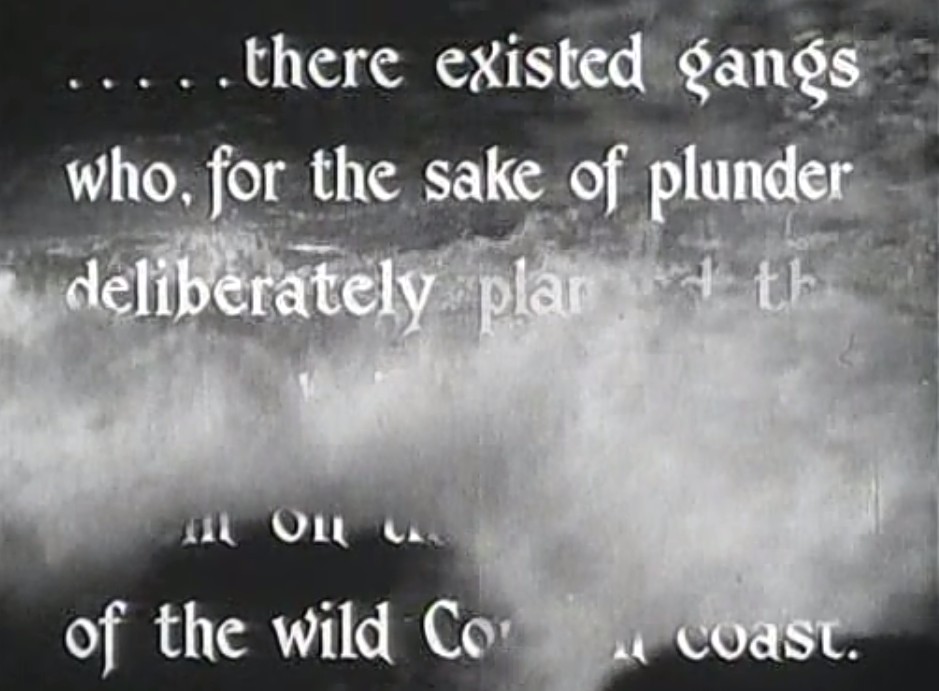


After the opening credit roll and a brief legend telling us about the treacherous coast of Cornwall, a wave crashes and *washes away the words*. Though this is direction rather than screenwriting, something like this might actually be in the screenplay. After you write the legend (similar to the one that begins STAR WARS) you could write that a wave crashes against the letters and washes them away. That would help illustrate that this is a savage place of action rather than words.

You want your opening pages to set the tone and mood and establish the world of your story in a way that is exciting and involving for the reader (and later viewer). My first experience at the American Film Market was at a screening where all of the buyers in the audience left after the first ten minutes... and every other film I saw at AFM had buyers splitting at about the ten minute mark. By that point they knew if they were going to buy the film (and it would be seen) or not buy it (and it would never hit a screen or video player or TV station). That was decided by the first ten minutes of the film. So if your script takes a while to get started, find a way to get the ball rolling earlier. Often the problem is just starting the story too soon - before anything happens. Start when the story starts.
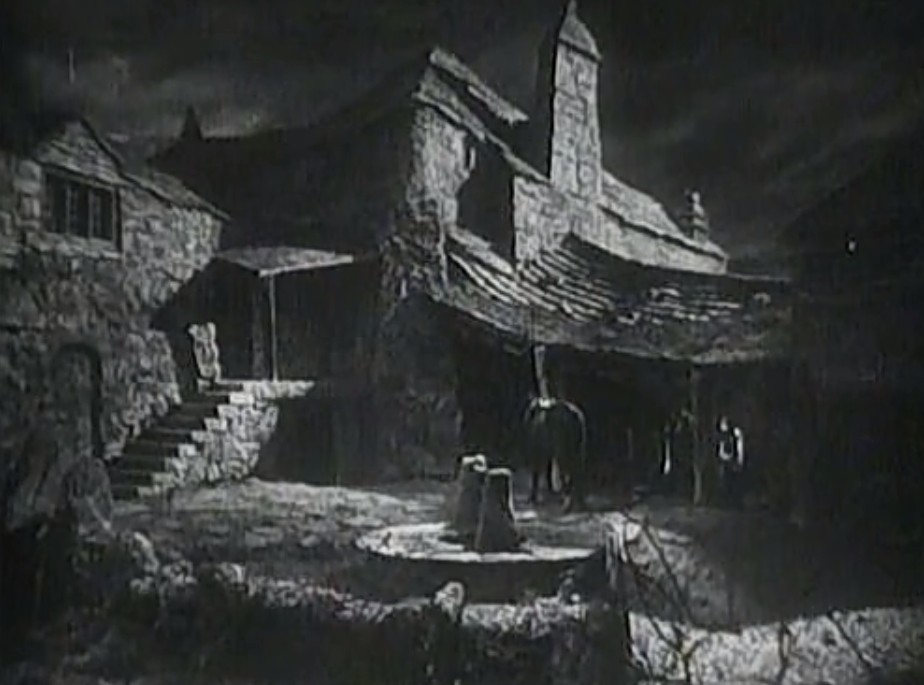


JAMAICA INN goes from that crashing surf to the Inn itself - a strange German expressionistic building - at night, as a man scurries down the stairs, mounts a horse and rides to the beacon on the coast. The ride is done with a series of quick wipes, like in STAR WARS. Hey, transitions are not our job as screenwriters, but this gives you an idea of how *little* time was spent on the page for his ride. It’s not about riding to the beacon, it’s about what happens next...

Off the coast is a ship, using the beacon to navigate around the treacherous rocks on the coast. There is a great combination of models and real shots here - we see a model ship pitching in the rough waters, and cut to a real ship set where the captain and crew struggle to keep the ship on course. This looks real - it’s difficult at first to tell that models were used. Hitchcock has great model work in his films, and we’ll talk more about that in the YOUNG AND INNOCENT entry. But what the model and real life set combination does here is create some amazing spectacle in the first minute or two of the film. This is not some little story set in a house, this is a huge event!

The rider looks away from the ship, and takes a black cloth and completely covers the beacon! Now there is no way for the ship to navigate around the rocky coast! This is a great moment because it’s not at all what you would expect, and that *intrigues* us. On the page that’s a WTF? moment where you *must* read on to find out why someone would do such a thing. The most important thing to do in your first ten pages is *involve* the reader - all of the car chases and actions scenes and spectacle stuff in the world is meaningless if the reader isn’t pulled into the story. You want them to need to know what happens next.
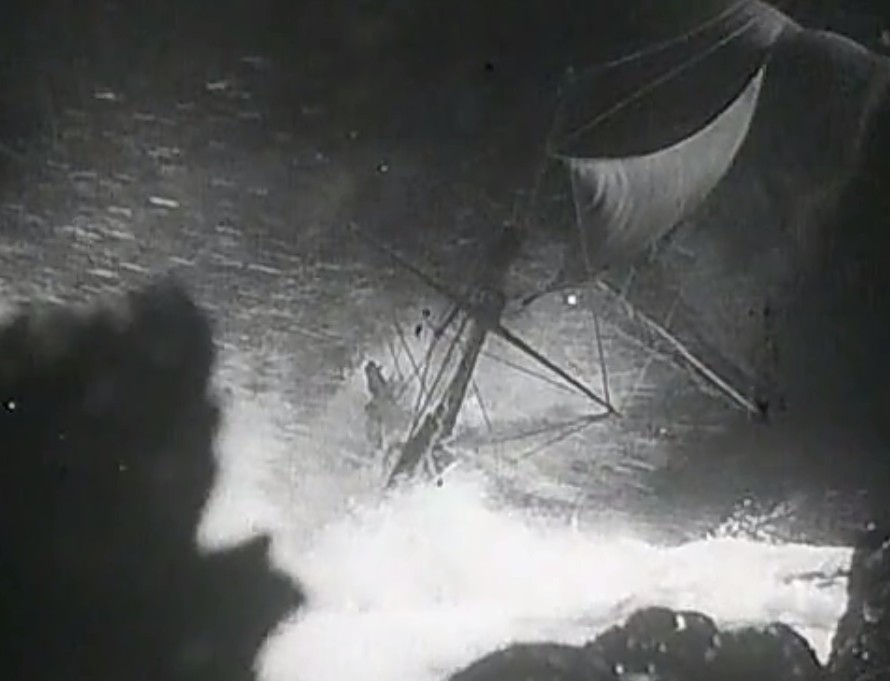


Back on the ship, they have lost sight of the beacon and believe they are heading *away* from the rocky coast... Then the ship hits the rocks along the coast again and again - smashing and crashing! The mast breaks and comes down! The ship rolls to its side and crashes into the rocky shore. This is *huge* spectacle, and is impressive even today. Again, that combo of model and real ship with real actors allows Hitchcock to show the whole ship slam into the rocks and turn on its side... then cut to *real people* on a *real ship’s deck* (a set) react. Water washes over the damaged ship, and the crew jumps into the water and swims to shore. We are still wondering why that rider would black out the beacon, when...

The crew members make it to shore... and are attacked by armed men. WTF? Now we *really* want to know what is going on. The leader yells for the armed men to make sure there are no survivors. Soon the sea is filled with the floating bodies of dead sailors. Okay - why run a ship into the rocks just to kill the crew? Then we get the answer when the leader, Joss, yells at his gang to get the cargo before the ship is destroyed, and the armed men jump onto the ship and start passing down the cargo, which ends up on a horse drawn wagon. As they are ready to leave, a ship crew member staggers out of the water and Joss has one of his men murder him.

Usually a script will begin with either the protagonist or the antagonist, or the physical conflict. In this case we begin with the antagonist, Joss and his gang of thieves - pirates without a ship.

From here we cut to our protagonist, young Mary, on a stage coach rambling through the darkness of the countryside. She tells the people across from her - a man and a woman with a duck - that she is headed to Jamaica Inn and asks if they know of it. Both are evasive... This shows us that she is a stranger in these parts and naive. Each line of dialogue or action in this scene serves a purpose - it is all establishing her character, but also giving us information about Jamaica Inn. A two-fer! When the coach gets close to Jamaica Inn it *increases speed* and passes the point where Mary should have been dropped off! She yells at the driver that she wanted to get off there - and this shows that she is not a weak woman. She stands up for herself. Even if she is not worldly, she is also not a wimp. The coach stops in front of the Governor’s Mansion and they throw her trunk down and then roar away, leaving her in the darkness.

Creepy Dudes: Part of the Gothic Melodrama genre is the innocent girl in a world of creepy dudes. Mary is an orphan - her father is dead - and she is given two father figures in the story: Sir Humphrey and her Uncle Joss.
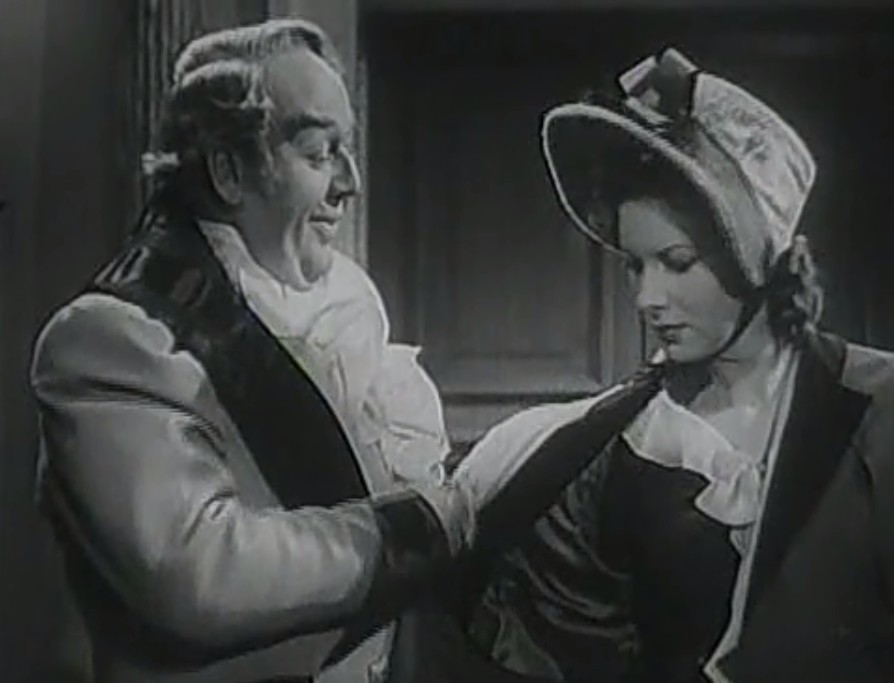


When Sir Humphrey is called away from dinner with his cronies by his butler because there is a young woman at the door, he waddles in to meet Mary... and goes into perv mode. He does everything he can to charm and flatter her, and asks for her to remove her coat so that he can get a good look at her. Um, total perv moment. When Mary says she is on her way to Jamaica Inn, he offers to put her up in his mansion. More prevy stuff. She doesn’t seem to notice - not worldly in the ways of men at all. Sir Humphrey insists on going with her to Jamaica Inn. When they arrive, he carefully lowers her trunk and then rides off... leaving her in the darkness in front of the spooky looking building.

She knocks on the door and it’s yanked open by Joss. Now, at this time we only know Joss as the leader of the gang that killed all of the sailors. Since he’s not dressed well, she believes him to be a servant or doorman and orders him to get her Aunt or her Uncle - the owner of the Inn. She has no idea how dangerous this man is. No idea that he is a cold blooded killer. This is a *good* example of audience superiority suspense - we fear for Mary because we know this guy is a killer and she just thinks that he’s a doorman or something, and is ordering him around. Then we get a good twist - he’s not a doorman, he is her Uncle Joss. Her Uncle is the leader of the gang of killers!
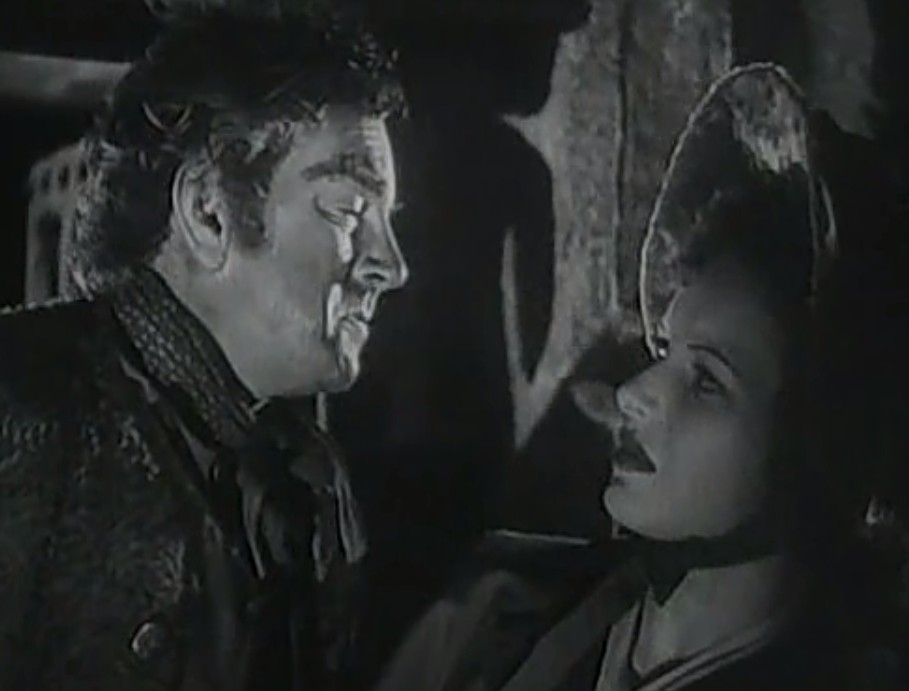


Now Uncle Joss shows what a great guy he is by trying to give her a big old incestuous mouth kiss... but Aunt Patience comes downstairs and Joss quickly moves away from Mary and puts his arm around his wife, trying to look innocent and failing miserably. Joss then orders his wife to grab the girl’s trunk or he’ll punch her... see what a nice guy he is! Once Patience is guiding Mary up to her room, Joss goes into the tavern where the gang waits...

Talk about creepy guys! The gang has seen Mary and are discussing who gets to rape her first. They are fighting about their place in the gangbang line when Joss enters the room and tells them to knock it off. The second in command, Harry, always trying to turn the others against Joss; asks why he wants her all to himself when there’s enough for everyone. After a bit more discussion Joss explains that she’s his niece... and one of the gang asks why he didn’t say that in the first place. It’s obvious that Mary is not safe here... there isn’t a single nice guy for miles!
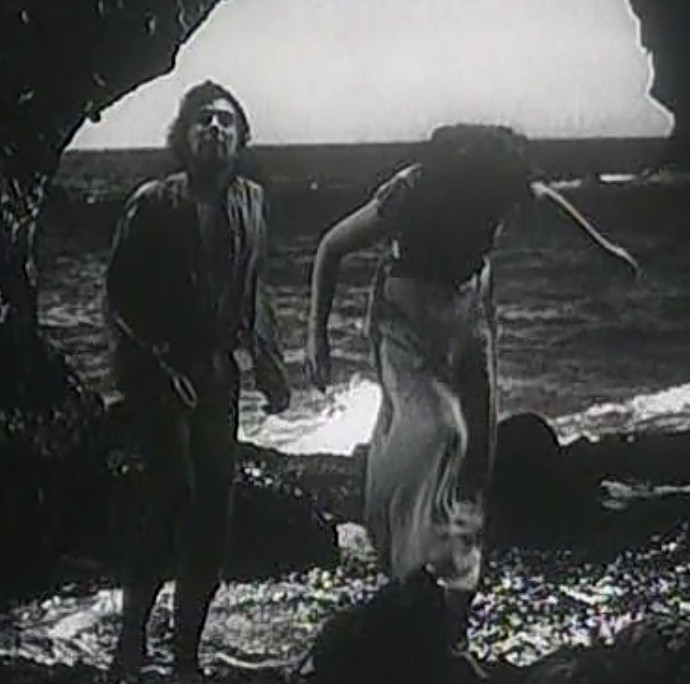


The other pervs in the room are Alfred Hitchcock and *us*. Nudity and the hint of nudity have been part of cinema since the very beginning - and JAMAICA INN has the beautiful 18 year old Maureen O’Hara and isn’t above a bit of titillation. In a scene were Mary must escape the villainous gang she is forced to strip down to her slip and dive into the ocean... and later we get a wet slip clinging to her curves when she comes out of the water. This scene is completely innocent by today’s standards, but I’m sure back in 1939 it was completely pervy.
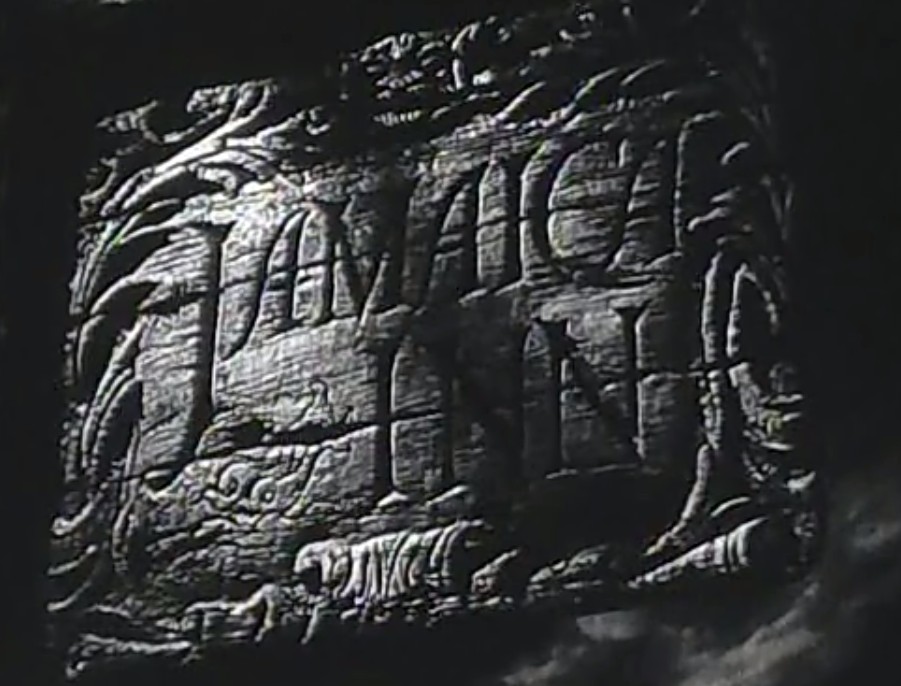


Bumpers: One of the interesting things done in the film (and probably the screenplay) is the use of a “bumper” between scenes instead of a fade out and fade back in. When we come to the end of a “chapter” instead of a traditional fade out we get a shot of the wooden sign for the Inn blowing in the wind. This is not only a unique way to marry scenes that may not connect to each other, it keeps the story moving forward. Every FADE OUT basically kills the pacing - putting on the brakes and bringing the film to a complete stop for a moment. By using the sign as a “bumper” we do not stop the story at all, we just move to the sign for a moment between chapters and then get back to the story. Because it is *always* the Jamaica Inn sign, we understand that it is an “end chapter” device and not just some random shot of the sign. If you do something like this, find a “bumper” that you can use throughout the screenplay.

Three Act Structure: Though the first screenwriting book was written in 1913 (and my Vintage Screenwriting #1 is from 1920), many folks think the three act structure is some fiendish device invented by Syd Field to sell books and shackle creativity. But the Three Act Structure predates movies by many years, being over 2,400 years old and the observation of that Aristotle dude. It’s kind of a story basic - a tool used to make sure you actually have a story. You can use the tool consciously or subconsciously - as long as in the end your story works. Let’s hear what 6 time Oscar winning screenwriter Billy Wilder (who made his last film years before Syd Field’s book came out) has to say about the three act structure...

Act 1: Introduce the conflict - get the cat up a tree.
Act 2: Escalate the conflict - throw rocks at the cat.
Act 3: Resolve the conflict - get the cat down from the tree.

It’s just that simple. No page numbers, no crazy rules. You have a person with a problem., the problem gets worse, the person solves the problem (or in a tragedy - the problem solves the person... Hamlet dies). Basic stuff.

JAMAICA INN was made when Syd Field was still a teenager, so he obviously had nothing to do with its three act structure, it’s most likely that Aristotle dude again. Whether the writers consciously used the three act structure or just wrote the screenplays and it ends up there subconsciously doesn’t really matter. It’s there, plain as day.

Act One has Mary coming to Jamaica Inn, surrounded by danger. No shortage of creepy guys who want to rape and murder her (in whatever order works) and because the Inn is in a remote area there is no place to run. Though she is not *locked in to the conflict* yet, she is surrounded by it. The conflict has been there from the very first scene.

When the gang in the tavern begins rumbling about not getting much from their haul, Trehearne (Robert Newton - who will also play a pirate later in his career) suggests that maybe the fence isn’t giving them good value. Maybe someone isn’t good at math. This forces Joss to defend his secret boss, and we see just how volatile this group is - several members think *they* should be running it, not Joss... especially second in command Harry (Emlyn Williams) who whistles his contempt for Joss.
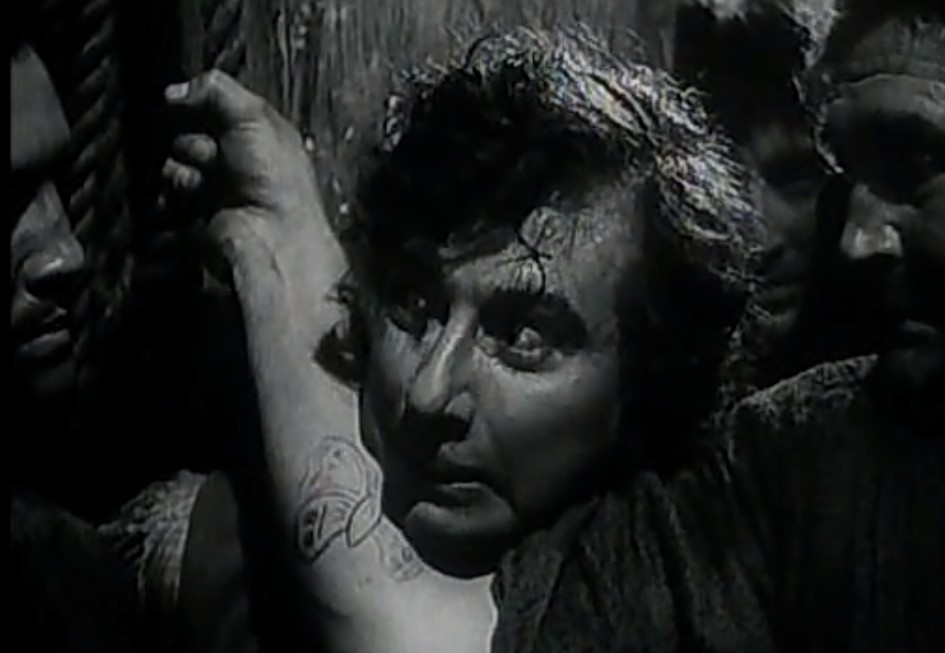


But Joss shows why he is the leader in a scene that shows a clever way to introduce each of the gang members. He asks each how long they have been looting with him, and each has a unique way of answering. “Salvation”, the religious member of the gang, “We’ve been lost souls together for two years and seven months.” Dandy, the tattooed member, remembers the woman he was sleeping with, finds the heart tattoo with her name on his chest (filled with heart tattoos with women’s names) and answers “Four years.” Each member has a character related way of answering the question, so we not only get all of the information, but we learn who each character is. Finally it comes to Trehearne, and Joss answers for him: “Mr. Trehearne has been with us the *enormous* time of two months. Eight weeks. Fifty-six days. How’s that for arithmetic?”

The gang focuses on the new guy Trehearne, grabs him, searches his pockets, and finds some coins - proving that he is the thief among thieves. They decide to hang him right there in the tavern!
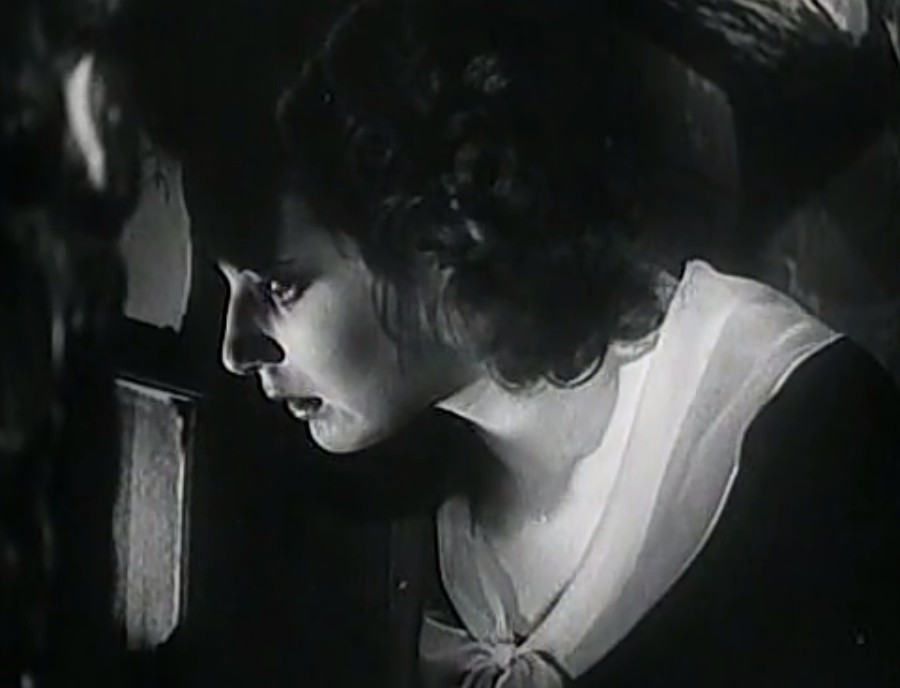


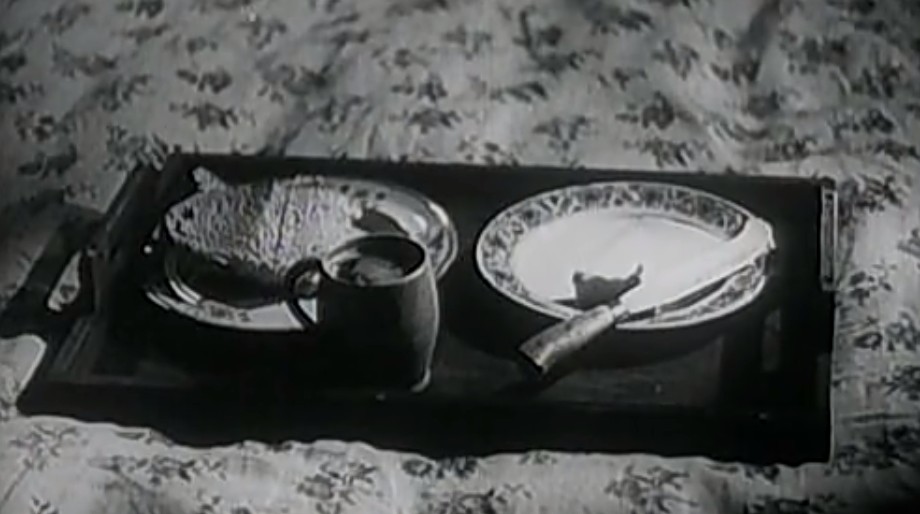
Mary’s room is above the tavern, and she has heard all of this - now she knows just how much danger she is in. Through a gap in the boards she watches as they grab a rope, make a noose, slip it around Trehearne’s neck... and hang him! One of the basic elements in a thriller is characters who spy on others, whether it’s Jimmy Stewart looking through binoculars in REAR WINDOW or Kyle MacLachlan looking through the slatted closet door in BLUE VELVET. Mary can’t just watch a man die, so she grabs the knife from her dinner plate (when they introduced the knife, you just thought it was for the meal) and pries off a board and cuts the rope - saving Trehearne’s life. But also ending Act One, because now the gang is after *her* as well as Trehearne! This is at the 30 minute point in the film.


Act Two has Mary escaping as the gang scrambles to find her. Outside the Inn (in the darkness) she tries to find a place to hide... can’t... and can hear the gang getting closer. When an arm descends from the roof, grabs her, and hauls her up... just as the gang storms out of the Inn. Trehearne has saved her life (just as she saved his) and they are on the run together. She has gone from being someone on the fringe of danger to the target for danger - and that’s why we are in Act Two. Now Mary is *locked into the conflict*. There are a handful of nice little suspense scenes were Mary and Trehearne must be quiet on the roof while the gang is right below them, one where they hide behind a boulder with the gang on the other side, and then Mary wakes up in a sea cave with Trehearne’s arm around her. Creepy dude alert! She tries to escape, finds a boat tethered outside the cave and unties it... when Trehearne pops up behind her. He drags her back into the cave, tells her she isn’t safe out there... but she thinks she isn’t safe in here with him and goes back out to the boat... which has now floated away. And on the cliffs above, one of the gang members sees the boat and yells for the others!
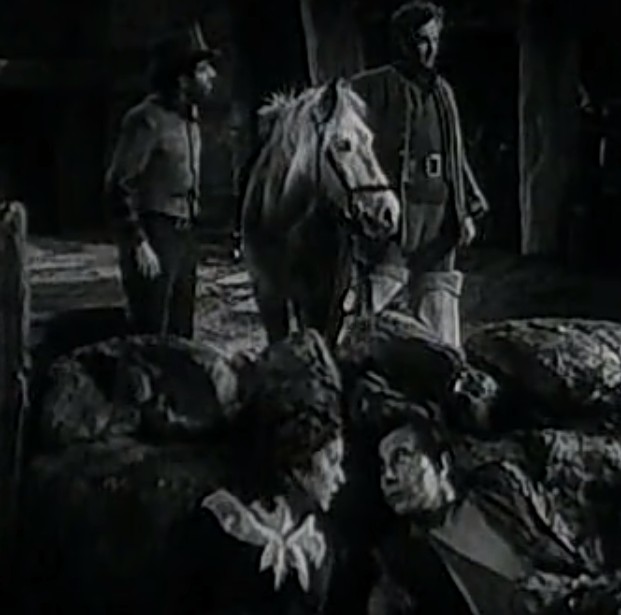


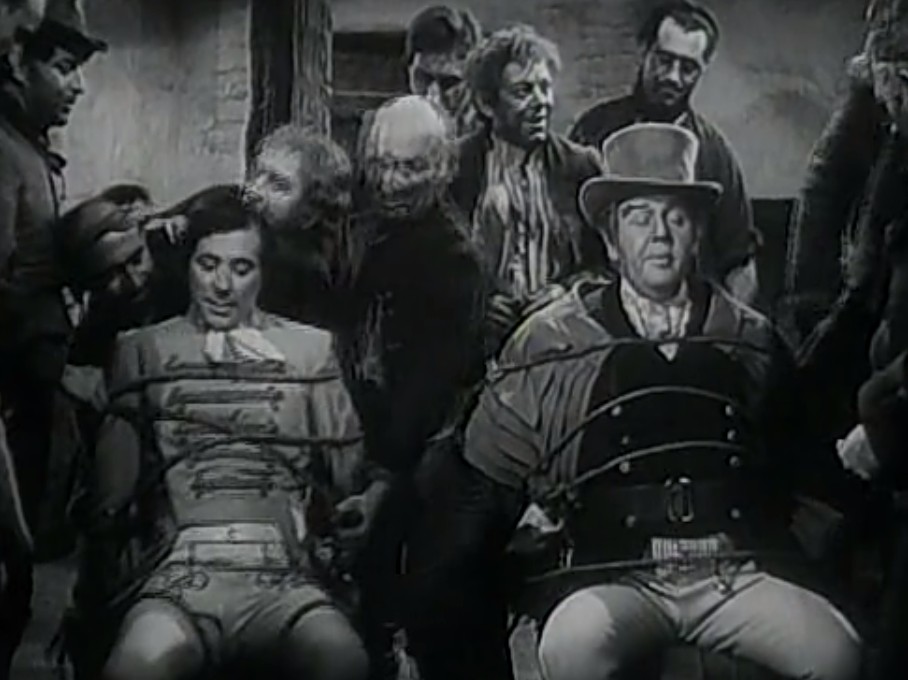
This is where we get the strip-to-your-slip scene so they can swim away (hiding behind a rock while gang members row past in a boat). Act Two is filled with conflict-conflict-conflict. They go to the Sir Humphrey for help (running from one father figure into the arms of another... and Humphrey is really creepy when she shows up in just a wet slip). And Trehearne and Sir Humphrey go back to Jamaica Inn to capture the gang... but end up captured themselves and tied to chairs where they await their deaths! Mary ends up captured by Joss, who takes her away to loot another ship. This brings us to Act Three, and it’s 100 minutes into the film.

Act Three has Mary grow a pair. She has been running for most of Act Two and now she is going to turn and fight. We get a replay of the opening scene - a gang member blacks out the beacon while the rest wait on the shore to kill the sailors and loot the ship. But this time, Mary is in the wagon. While the gang gets their weapons ready, Mary escapes and races up the cliff, fights the gang member at the beacon and *throws him off a cliff!* Then pulls off the cover so that the ship can see the beacon and steer away.
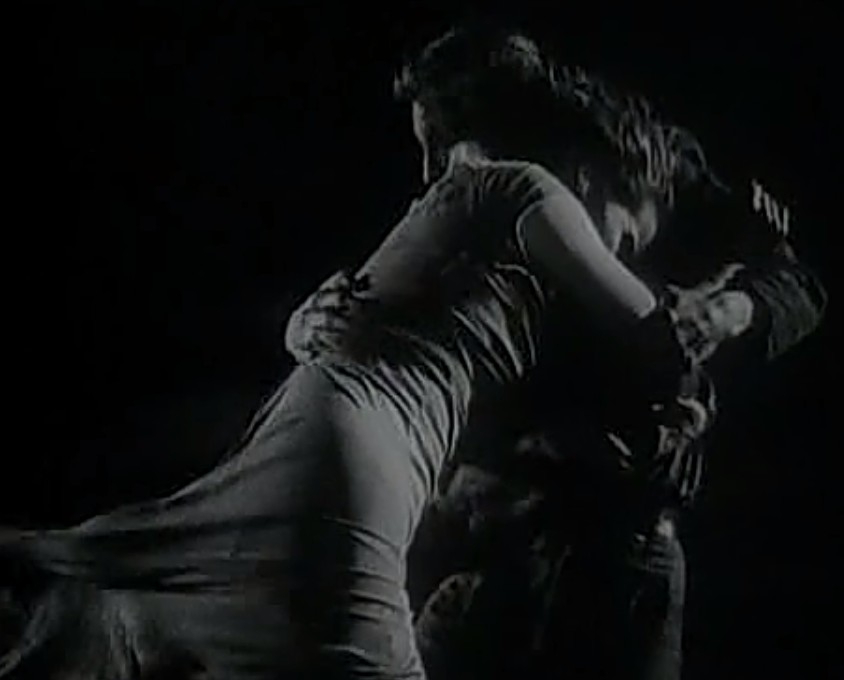


At the same time, Trehearne escapes and goes to the authorities about the gang. The gang is arrested, but the mastermind has escaped... and Trehearne and Mary team up to go after him... (even though Mary *does* managed to get kidnaped one more time - she is the most kidnaped person in the world!) This leads them to a ship in the harbor that the mastermind plans to escape on. From a production standpoint this is great, because I’m sure it is the exact same ship set they used in the opening scene. They corner the mastermind and we get a conclusion that resolves the problem. Act Three is all about resolving the conflict - and Mary becomes a kick ass heroine instead of the innocent woman surrounded by creepy guys. She and Trehearne are a couple... the end.

See how that works? Introduce the conflict. Escalate the conflict. Resolve the conflict. No page numbers, no formula, just kind of the basic way a story works.

Early Reveals: One of the issues with the film that can probably be traced back to Laughton is the early reveal that he is the villain. Instead of a twist later in the story, the reveal happens at the 23:30 minute mark. It’s a great scene where Uncle Joss goes upstairs to talk to his fence/boss and we do not see the mastermind’s face for a moment... just a roll of fine silk that is being pulled out by someone off screen... who asks for a pair of scissors so that he can cut off his share. That is obviously Laughton’s voice, and he is then revealed. Though this allows Laughton more screen time in Act Two (because we know he is the villain) it also wastes a twist at the end of Act Two when Laughton is revealed to Mary and Trehearne and everyone else as the villain. Though this may create some suspense from “audience superiority” when Mary and Trehearne go to Laughton for help, that is only a couple of scenes before his reveal, which means there isn’t much room for any suspense generated by the “audience superiority” to work. Instead, it kind of makes Mary and Trehearne look stupid.


Hitchcock does the same thing in VERTIGO when he reveals that Judy is actually Madeline - and that is controversial. People (including me) think by revealing the information instead of holding it for a twist, instead of creating impact on the audience it just makes us feel quesy and weird that Jimmy Stewart is making Judy over into Madeline. It’s off-putting. And I think that’s what happens in JAMAICA INN as well - instead of a great twist (which was probably in the novel) we get an entire Act Two where Charles Laughton gets to over-act and we think our leads are morons. When you reveal the information is an artistic choice, and there are times when an early reveal might intensify the suspense... but here it doesn’t serve much purpose at all. You have to weigh the decision and figure out whether your story is better served by and early reveal (and suspense) or a later reveal (and a twist).

Compare this to the later reveal that Trehearne is a policeman - something that really works. For most of Act Two Mary believes that Trehearne is a *criminal* and that she is in danger every moment that she is with him. Though he rescues her (and she rescued him), and protects her from the other cut-throats, he is still *one of them* and she doesn’t believe that she is safe. She spends much of Act Two trying to escape him, and it is only close to the *end* of Act Two when they go to Sir Humphrey’s mansion for help that he reveals himself to be an undercover police officer. At that point she believes that she is safe - and that would be a fine time to have revealed that Sir Humphrey is the villain. But throughout most of Act Two Mary is threatened both by Uncle Joss’s gang *and* by Trehearne who has kidnaped her. She is caught between a rock and a hard place. If Trehearne had been revealed as an undercover cop at the beginning of Act Two, it would have removed the conflict from them being together. She would have been between a rock and a comfy chair. Um, I pick the comfy chair.

Sound Track: Nice big adventurous score by Eric Fenby that fits the scope of the film.

JAMAICA INN isn’t a bad film, but Charles Laughton’s character and performance overshadow everything else making it a movie about a Governor going crazy instead of a movie about an innocent young woman in a world full of criminal cut throats. Laughton just knocks the whole thing out of balance, and you can’t stop looking at those crazy obviously fake eyebrows and wonder what the hell he was thinking. Laughton would later direct his own thriller, one of the best films ever made. But that’s for some other blog called One Friday With Laughton.

- Bill

Note: As an Amazon Associate I earn from qualifying purchases made from this website.

BUY THE DVD AT AMAZON:


Thursday, January 29, 2026

Thriller Thursday: THE GUILTY MEN

The Guilty Men

The spider web fills the screen, it's Boris Karloff's THRILLER!


Season: 1, Episode: 6.
Airdate: 10/18/1960


Director: Jules Bricken
Writer: John Vlahos
Cast: Everett Sloane, Jay C. Flippin, Frank Silvera, John Marley.
Music: Pete Rugolo.
Cinematography: John L. Russell


Boris Karloff’s Introduction: “Three boys from the slums. One wanted to be a doctor, one wanted to be a lawyer, and the third... he just wanted to be Mr. Big. All three achieved their ambitions with surprising results, as sure is my name is Boris Karloff. They are the guilty men, and that’s the name of our story. That sound you hear is a heart beat. A heart beat that held together a fantastically powerful organization dedicated to big business. The big business of crime. Let me assure you my friends, this is a thriller.”

Synopsis: Kind of a precursor to GODFATHER and GODFATHER 3, the story begins with a boy names Cesare is running down a city street at night, then climbing a fire escape to a New York City rooftop that looks a lot like the rooftop set from VERTIGO... where two other boys are hanging out. The other boys ask what happened when they hear the police sirens from below, and Cesare tells them he got the money to pay for their father’s funeral... $400. His brother Tony is outraged, but Lou asks if he’s going to need an alibi. Cesare says no alibi required, he’s a clever kid and got away clean. Tony doesn’t think their father would want to be buried in a fancy coffin bought with dirty money. Papa wanted the boys to get good jobs and be decent people. Brother Cesare disagrees: “I don’t want the neighbors to laugh, we couldn’t give the old man a decent funeral, capice? We needed the money so I got it, it don’t matter how.”. “It matters to Papa, how many times he tell us a man who lives by violence, he dies the same way.” “I gotta wise saying, too: He who takes gets, and it don’t matter how. You just take and take and take.” These three boys in the slums of New York in the 1920s talk about their futures... Tony dreams of being a doctor, Lou dreams of being a lawyer... and Cesare dreams of being the biggest mobster ever known.


Now we get a montage of Cesare Romano’s rise from that kid on the rooftop to crime kingpin through stock footage and newspaper headlines. As prohibition comes in, he rises to the top, and when prohibition is voted out he organizes all of the other bootleggers into a crime syndicate that controls all of the illegal vices people crave. When the feds begin cracking down, he turns his front businesses into *real* businesses and is able to walk away from Senate hearings a free man because his hotels and shipping and other businesses are legit... they make a ton of money (even though they are still used as fronts from some criminal enterprises). Which takes us to 1960, present day...

An aging “Charlie” (Cesare) Romano (Frank Silvera) is meeting with all of the mob bosses beneath him who form The Syndicate, and some are angry that they so corporate that they are no longer criminals. Leading the pack is Gans (Jay C. Flippin) who thinks they should focus on heroin and other hard drugs before someone else moves in. Charlie says they made record profits *legally*, why push their luck? Mob Lawyer Lou (Everett Sloane) agrees. But Gans is the up and comer, like Mantegna’s Joey Zasa in GODFATHER 3, and thinks heroin is the new Prohibition... and they could become so powerful the government couldn’t touch them. Charlie gets angry and... collapses to his chair, grabbing for his heart pills.


At Charlie’s estate, doctor brother Tony (John Marley... from THE GODFATHER) attends to Charlie as Lou looks on. Charlie and Tony are hardly on speaking terms these days, but Tony is still his doctor. Tony tells Charlie he needs to get his anger under control, that’s what triggered the heart attack today... and then calls his bother scum for being part of the drug trade and says goodbye to Lou and goes back to the hospital. When he’s gone, Charlie and Tony discuss their heroin business... should they drop it? Tony says they should either drop it or get into it 100 percent. Charlie wants desperately to be legitimate, to put his criminal past behind him and decides to get out: *not* allow any part of the syndicate to import or sell drugs.

At the next meeting, Charlie proposes they stop being part of the drug traffic... Gans argues that it’s millions of dollars being thrown away, and they should *focus* on the heroin business and make even more money. Lawyer Lou offers to mediate the dispute between the two men, and most of the other mobsters are dismissed from the meeting. Charlie and Gans face off, the argument becomes heated, comes to blows... and Charlie has another heart attack, reaching for his pills. Gans pulls them away. Charlie reaches, reaches, reaches for his pills. Can’t get them. Dies of a heart attack.


Twist: Lawyer Lou was in on it... afraid that Gans *would* take over the mob, and the mob is 98 percent of Lou’s business. He couldn’t survive if Charlie lost control, so he went along with Gans and kept his job.

Charlie’s funeral: all three boys together again, but one is dead.

Gans in now in control... and wants to go full force into the drug business. When some of the legit business guys and Lawyer Lou think they should not get into it, or at least be very very cautious, Gans rubs out one of them making it look like suicide. The problem with the suicide? It splashes mud on everyone else in the syndicate including Lawyer Lou. For Lou the plan has backfired: he never really wanted to be *Gans* lawyer. In trying to save his income he has sold his soul and is liable to go down with *Gans*. He decides to turn states evidence against Gans and the mob... not knowing that Gans has his phones tapped, and after cutting a deal, leaves to turn himself in... and is shot dead in the street by Gans. But the police arrive and shoot it out with Gans and his men, the end. Everyone who lived by violence has died by violence.


Review: There are a handful of THRILLER episodes that are crime dramas and seem like rejected episodes of THE UNTOUCHABLES that found their way to THRILLER. This is one of them. Many TV shows take a while to figure out what they are, and that must have been even more difficult with an anthology show like THRILLER. There are no continuing characters and no continuing storyline, and for a while no specific *genre*. Hitchcock has a history of films which set the tone for his show, but even that show had occasional episodes that didn’t seem to fit. Hey, it’s television, we have to make a one hour show every single week! Eventually THRILLER would find itself and center on suspense with a touch of weird tales thrown in, but this week it was a crime drama.

And the accent is on the *drama* here, as most of the episode takes place in the mob’s boardroom with dangerous men... talking. This episode could easily have been a stage play about corporate politics instead of organized crime. So it seems slow and stagey, and they chunk of stock footage from some other gangster movie or show with all of the car chases and explosions and tommy gun fights looks even more like stock footage because of it. And doesn’t really inject any action into the episode. Even the three murders on screen, Charlie’s and the other mobster who doesn’t go along with Gans and Lou’s, don’t have any have action. Lawyer Lou’s is the only one with the kind of action you’d expect in a gangster story: he gets plugged in a drive by. Charlie’s comes closest to being suspenseful (THRILLER material) because they have to hold him away from his pills long enough to die. Actually an okay scene. The other murder is off screen, with only the discovery of the body on screen. Imagine THE GODFATHER without the violence or the pageantry.

The scene with Charlie and his pills comes in the last half of the episode! That gives you an idea of how much talk there is. And after Charlie is dead... more talk!


One of the great things this episode does is give us a “bridge” between the boys and their adult counterparts, most notably with Cesare/Charlie who slaps his hand on a table hard when making a point. We end with the boy Cesare slapping his hand down and, after the credits and montage, begin with Charlie slapping his hand down on the board room table. Easy for the audience to understand that the boy is now this man. Things like this are part of old school screenwriting and I fear are being lost these days.

It’s great to see John Marley in a GODFATHEResque story made almost 15 years before that film... but his character vanishes at the end. After Charlie’s funeral he isn’t in a single scene. I would have squeezed him in at the very end, just because he *is* the surviving brother. Technically fine, and watchable. But the *next* episode gets us back on course to what THRILLER would become.

FADE OUT

Bill

Buy The DVD!


Wednesday, January 28, 2026

Can't Judge A Zombie By His Poster

Another ancient blog entry (from 2007) that I'm reprinting instead of writing anything new, because I'm lazy.

A whole bunch of posts and half a year ago, I wrote that my friend Rod and I were stuck in bumper-to bumper traffic on the 405, trying to get to a movie playing in Santa Monica. That movie is now out on DVD, so I thought maybe I’d talk about it. The movie was....

FIDO


Imagine that perfect 1950s suburbia from LEAVE IT TO BEAVER... combined with the bright, well manicured 1950s soap operas of Douglas Sirk (like ALL THAT HEAVEN ALLOWS)... and throw in that wholesome all American 1950s classic TIMMY AND LASSIE...

But Lassie isn't a dog, it's a domesticated zombie.

That's FIDO.

This is not some scary zombie attack movie, no friends, after we won the zombie war (which seems a lot like WW2 in the newsreel footage that opens the film) zombies have been domesticated and are a servant class. Every suburban family hopes to one day have a zombie of their very own - to take out the trash serve meals, mow the lawn, wash the car, and any other task that sophisticated people may find distasteful.

You end up with a send up of 1950s TV & films, zombie movies, suburbia, the class system, government, Douglas Sirk films, and all kinds of other stuff. I actually laughed so hard at one point that I almost lost consciousness. My stomach hurt. This was the best film I've seen in a long time.

Carrie-Ann Moss is mom, Dylan Baker is very repressed dad, Tim Blake Nelson is the next door neighbor and Henry Czerny (the asshole political aid who double crosses Harrison Ford in one of those Tom Clancy movies) as the pipe smoking perfect dad down the street... and Billy Connelly as the zombie Fido (an amazing performance, since all he does is grunt and growl).

The film is supposed to be the most expensive Canadian film ever made (cast, probably) but only played on a couple of screens in the USA and the showing we went to wasn’t crowded at all. The plan was to expand to more screens if the film is successful...

But it never came to a cinema near you. Instead it vanished, only to appear a couple of weeks ago on DVD.

And, just like HOSTEL 2, I think the problem was in the marketing. (That’s *twice* I’ve blamed marketing - really unusual). Here’s the thing - you need to get the people into the cinema on a movie like this, so that they will laugh and then tell their friends that have to see it. That’s where marketing comes in.

The first problem with this film is the title: FIDO. When I read a list of new films opening over that weekend, I saw FIDO and skipped right past it. G rated family film about a dog. Not even a good title for a G rated family film - tells us *nothing* about the story. LASSIE COME HOME - hey, Lassie is lost and has to find his way home! So FIDO not only makes you think it’s a family film when it’s really a horror comedy, it also doesn’t tell us anything about the film. Your title is like a mini logline - it needs to tell us what the story is about. Some of you may be thinking, “Hey, it’s about a zombie named Fido!” But we only know that *after* we have seen the movie. We want the title to tell us what the movie is about *before* we see it.

The target audience for FIDO would never see a film with that title.

Then we come to the poster...

What the hell is up with that? The poster is supposed to sum up the story in an image... Can you tell from the poster that this movie takes place in the 1950s? Or that it’s about a boy and his zombie? That it is a comedy? Or that Billy Connelly is even a zombie? He looks kind of weird in the poster, and has that punk collar thing, but that poster tells us *nothing* about the movie. The artwork that was on the NuArt Theater’s flyer was much better - it had silhouettes of the 1950s family (iconic images) and the boy holding a leash... with a zombie on the other end. That sums it up... but it’s not the poster.

The poster is in collage style - and I hate that. I was in a book store a while back and bought a Greg MacDonald book about Inspector Flynn. MacDonald created Fletch - the clever investigative journalist who always gets involved in some murder mystery - you may know the character from the Chevy Chase movie. If you haven’t read the books - check them out. Great writing and fantastically witty dialogue. The paperback versions in the 70s used to have a dialogue passage on the *cover* instead of art work. That was the selling point - really clever writing. Inspector Flynn pops up in the 3rd Fletch book, accusing Fletch of murder and chasing him throughout the book. He spun off into his own series, and this was a recent book I didn’t know existed...

Even when I saw it, I didn’t know it existed. Because the book cover was some sort of collage with the title written with every letter in a different font. It looked like someone dumped a bunch of stuff on a table, glued it in place, and that was the cover. Huh? I probably looked at this book a hundred times before realizing that it was a Flynn book. And the cover gives me *nothing* about the story - actually, under the crap there’s a sketch of a guy with a nail in his ear. That’s part of the story. But the sketch doesn’t look like a crime novel picture, it looks like something you’d find on the cover of a Gay romance. Cover doesn’t match the contents at all. Though there is a boy with a nail in his ear, the main story is something entirely different and much more exciting: someone is sending death threats to a Harvard professor and breaking into his house. Flynn has only a few days to stop the killer from striking. The nail in the ear thing is a minor subplot... but the cover of the book. Was that because they could find a sketch of a boy and add it to the collage?

When you look at old movie posters, they are amazing. They tell the story, set the mood, and usually feature the star’s face, The lower the budget of the movie, they less they could depend on the star and the more they had to find an *image* the sums up the story. I just did an article for Script about creating the poster image for your screenplay - because I think it’s important to know how they are going to be able to market your work down the line. When some producer says, “I love the script, but kid, I have no idea how the hell we’re going to market it”, you can pull out your poster. If you can’t figure out what the poster for your movie looks like, how the heck do you expect some non-creative guy in a suit to figure it out?

The thing about collage posters and collage book covers is that it’s just gluing together existing elements. It’s not creating the one iconic image that sums up the book or film, it’s using someone else’s stuff. The movie posters of the past were amazing, but somewhere along the line, movie posters have become all about star faces. Instead of finding that image that tells us what the story is about, we get George Clooney’s face. “I have no idea what the movie is about, but George Clooney is in it, so I’ll see it!” Hey, that’s great for Clooney fans, but what about everyone else? What about people who want to know what the movie is about before they plunk down their $11.50 (what I paid last night at the AMC in Burbank). What happened to those folks who created the amazing images that summed up the story?

Did collages - the concept of using pieces of *someone else’s* creation - squeeze them out? Have we been breeding humans to think “collage” instead of “creativity”?

I read scripts (and even see movies) that are just collages. Take existing elements from popular films and glue them together. Quentin Tarantino is the king of Collage Movies. Take a Ringo Lam Hong Kong cop film about a jewelry store heist gone wrong and the band of bandits in a warehouse aiming guns at each other and wondering which one of them is an undercover cop and add the color name thing from PELHAM 1-2-3 and the... well, eventually you have a bunch of scenes from other people’s films processed into a new movie. Check out Mike White’s WHO DO YOU THINK YOU’RE FOOLING and YOU’RE STILL NOT FOOLING ANYBODY (about PULP FICTION).

Tarantino is a genius - he can take the pieces of other people’s work and turn them into something uniquely his own...

The funniest thing are the collage scripts that use bits from Tarantino movies - for a while it seemed like every other script was someone pretending to be Tarantino.

None of the other “collage scripts” I read seem able to do what QT does (make it work). All they have done is lifted scenes from better films. No creation involved, just some cut & paste. These scripts have no soul, no point of view, no theme... but they often have all kinds of scenes that would look good in a trailer. I think that’s why they sometimes get bought and made.

Now, I’m not talking about those homage scenes, or those scripts that have been influenced by some other writer (FIDO is influenced by Sirk and Lassie and George Romero - three things that don't seem like they'd work in the same movie)... I’m talking about the ones that are just collages. Nothing original about them. They were made on some assembly line somewhere. Nothing was created, it was just glued together.

I think fan fiction is the ultimate in collage writing. They take someone else’s character, someone else’s world, someone else’s basic situation... and they put together some sort of story *based on those existing elements*.

For me, movies and stories are *about* characters. The most important thing is to create your own, personal, characters.

One of the message boards where I regularly answer screenwriting questions has a large number of fan fiction people, all writing INDIANA JONES and STAR WARS and LORD OF THE RINGS and PIRATES movies. *Not* creating their own characters. Whenever I feel like tilting windmills and mention this, I get the “Every writer started off writing fan fiction” from a half dozen people. Well, I have no idea if that is true today... but it was not true when I began writing. The idea then was to create your own characters and stories and situations. Sure, you may have read a lot of Raymond Chandler (like me) and your early work is about a private eye and seems influenced by Chandler (mine was) but my stories were about a private eye in my home town area who had completely different character issues to deal with than Philip Marlowe and what was cool for me was to *create* his methods, his office, his weapons, his *world* and make it completely my own - based on things I loved and problems I was going through and the world I knew. My first stories were about a Private Eye named Nick Carrico who had an alcohol abuse problem after accidentally shooting his partner when he was a police detective. Now, none of that is Philip Marlowe. The idea of writing something back then - when dinosaurs ruled the earth - was to *create* something. To *create* your own characters and situations and worlds and dialogue and scenes. Not to write about the time Captain Jack Sparrow and Will went on a pirate adventure in Cuba... and fell in love.

How we went from that to fan fiction is beyond me. At what point in time did people say, “I’d rather not go through all of the trouble to create my own characters... I’ll just use somebody else’s work”? When did *not creating* become the norm? When did people begin thinking that someone else’s creation was better than theirs? That their original work wasn’t good enough, so they should use someone else’s? That collage is art?

Collage is not better than creation.

YOUR individual creation is YOURS.

George Lucas can send of C&D letters from his lawyers closing down fan fiction sites - because *he* owns those characters... but no one can take away original characters that you created. Original situations and worlds you created. Those are *yours*. The thing about fan fiction is that it diminishes the writer.

The collage poster for FIDO was used on the DVD box... what a mistake! Was this because no one in the marketing department is capable of creative thought? That evolution has created a generation of people who can cut & paste, but not create? Or was it just some lazy guy in marketing who thought the collage was good enough for the poster (that managed to kill a great film) so why not use it on the DVD?

Whatever the case - create your own material... and check out FIDO on DVD. It's really good on a bunch of different levels.

- Bill

Tuesday, January 27, 2026

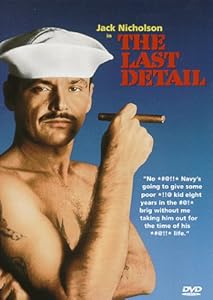
Trailer Tuesday: THE LAST DETAIL

Yesterday was Veteran's Day...

THE LAST DETAIL (1973)

There was a time when Jack Nicholson wasn’t a parody of himself and played a variety of diverse roles on film like the introverted writer in KING OF MARVIN GARDENS and the troubled oil rig worker in FIVE EASY PIECES. He usually played a rebel, but part of that had to do with the films being made in the 70s. Though he’d been in films and on TV since 1956, he got his big break when he replaced Rip Torn as the lawyer in EASY RIDER... which, of course, lead to the romantic interest in a Barbra Streisand musical. Seriously. Back in the late 70s the San Francisco Film Festival did a retrospective on Jack Nicholson, and being a stupid teenager I decided to sneak back stage after wards and talk to Jack, because he was a screenwriter as well as an actor. Did you know that? Yes, he’s written six produced scripts (and probably a stack of others) and directed 4 films. He’s not just a pretty face. Anyway, Nicholson could have had security remove me, but instead talked to me and called my business cards “pretty fancy”. Basically he encouraged me to stick with it, and told me it took him fifteen years to become an overnight success (everybody says that, but he *did* tell me that). So many of Nicholson’s films are kind of forgotten today, so I thought we’d look at one of my favorites.


Between KING OF MARVIN GARDENS and CHINATOWN, Nicholson made THE LAST DETAIL, which is another one of those “perfect storm” movies for me, where the writer is one of my favorites, the director is one of my favorites, and the star is one of my favorites. The script is based on a novel by Darryl Ponicsan, who was one of my favorite writers at the time... and was a hot novelist at the time who wrote CINDERELLA LIBERTY which was made into a hit movie, and his novels TOM MIX DIED FOR YOUR SINS, THE RINGMASTER, and THE ACCOMPLICE were some of my favorite books at the time. The screenwriter is Robert Towne, who wrote CHINATOWN and a bunch of others and got his start writing movies for Roger Corman (probably some starring Nicholson). The director is Hal Ashby, who directed HAROLD & MAUDE, SHAMPOO, BOUND FOR GLORY, COMING HOME, BEING THERE and many others. Music by Johnny Mandel who wrote the theme to M*A*S*H which you probably know. And, of course Nicholson starred in the film. All of these people I love working on the same film!

Best Movie Ever Made


The story is about an impossibly young Randy Quaid playing a new Navy recruit named Meadows who has been convicted of stealing some change from the camp charity box and sentenced to 8 years in prison. The two Shore Patrol Officers who will take him to prison are Badass Buddusky (Nicholson) and Mule Mulhall (Otis Young), and they start out thinking this is just another transport job, but when they find out Meadows is a virgin who has never had a drink in his life... they decide to take a little detour and show him a good time before he spends the next 8 years behind bars. Carol Kane is the hooker who pops his cherry and Gilda Radner is a hippy chick and Nancy Allen is in there, too. It’s basically a road trip with these three guys going by train, car, and on foot sometimes from the Navy Base to the Naval Prison, with some side trips to New York City. At the core of the story, the two Shore Patrol guys have to follow rules that make no sense at all... and begin to question the authority of the government and maybe even society. The film is funny and rebellious and melancholy.

"I am the motherfucking shore patrol, motherfucker! I am the motherfucking shore patrol! Give this man a beer."

It’s weird that films like this, which were hits in their day and starred people who are still stars and working in Hollywood, seem to have been lost. People don’t know about them, and they aren’t on BluRay and the DVD is 15 years old. I remember when the film first came out, it was notorious for having lots of bad language (which doesn’t seem so bad these days), but it may not be for everyone. Check it out.

Bill

Friday, January 23, 2026

Fridays With Hitchcock: Hitch's FRENZY BBC Interview

Hey, it's Friday The 13th! Let's look at a Hitchcock serial killer flick! Before Jason and Micheal and Freddy, there was Norman Bates... and this film from Hitchcock!

FRENZY was Hitch's second to last film, and his only movie with nudity... Trying to keep up with the times. After a rough patch with films like TOEN CURTAIN and TOPAZ, this was a return to Hitchcock's "wrong man" type of film, and a return to England... and even a return to the type of story that turned him into a major director - THE LODGER (1927) about a serial killer who crosses paths with an innocent man who just looks guilty as hell. I like the way this is also a story of divorce, and a guy who loses all of his friends along with his wife... and ends up being alone against the world... and how that is contrasted with the Detective chasing him whose scenes are often at the dinner table with his wife (and whatever horrible thing she has made from a new recipe). Hitchcock's humor is theer to balance out the horror of the killings and even the not-exactly-likeable protagonist.

This BBC interview was part of the publicity push for the film...


Of course, I have my own books focusing on Hitchcock...

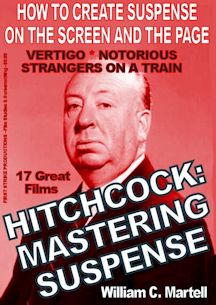
HITCHCOCK: MASTERING SUSPENSE


LEARN SUSPENSE FROM THE MASTER!

Alfred Hitchcock, who directed 52 movies, was known as the “Master Of Suspense”; but what exactly is suspense and how can *we* master it? How does suspense work? How can *we* create “Hitchcockian” suspense scenes in our screenplays, novels, stories and films?

This book uses seventeen of Hitchcock’s films to show the difference between suspense and surprise, how to use “focus objects” to create suspense, the 20 iconic suspense scenes and situations, how plot twists work, using secrets for suspense, how to use Dread (the cousin of suspense) in horror stories, and dozens of other amazing storytelling lessons. From classics like “Strangers On A Train” and “The Birds” and “Vertigo” and “To Catch A Thief” to older films from the British period like “The 39 Steps” and “The Man Who Knew Too Much” to his hits from the silent era like “The Lodger” (about Jack The Ripper), we’ll look at all of the techniques to create suspense!

Films Included: NOTORIOUS, SABOTAGE, STRANGERS ON A TRAIN, THE 39 STEPS, REBECCA, TO CATCH A THIEF, FRENZY, FOREIGN CORRESPONDENT, THE LODGER, THE BIRDS, TORN CURTAIN, SABOTEUR, VERTIGO, THE MAN WHO KNEW TOO MUCH (1934), THE MAN WHO KNEW TOO MUCH (1955), SUSPICION, and NUMBER SEVENTEEN. 17 Great Films!

Only 125,000 words!

Price: $5.99

Click here for more info!

OTHER COUNTRIES:


UK Folks Click Here.

German Folks Click Here.

French Folks Click Here.

Espania Folks Click Here.

Canadian Folks Click Here.

And....

HITCHCOCK: EXPERIMENTS IN TERROR


USA Readers click here for more info!

HITCHCOCK DID IT FIRST!

We all know that Alfred Hitchcock was the Master Of Suspense, but did you know he was the most *experimental* filmmaker in history?

Contained Thrillers like “Buried”? Serial Protagonists like “Place Beyond The Pines”? Multiple Connecting Stories like “Pulp Fiction”? Same Story Multiple Times like “Run, Lola, Run”? This book focuses on 18 of Hitchcock’s 52 films with wild cinema and story experiments which paved the way for modern films. Almost one hundred different experiments that you may think are recent cinema or story inventions... but some date back to Hitchcock’s *silent* films! We’ll examine these experiments and how they work. Great for film makers, screenwriters, film fans, producers and directors.

Films Examined: “Rear Window”, “Psycho”, “Family Plot”, “Topaz”, “Rope”, “The Wrong Man”, “Easy Virtue”, “Lifeboat”, “Bon Voyage”, “Aventure Malgache”, “Elstree Calling”, “Dial M for Murder”, “Stage Fright”, “Champagne”, “Spellbound”, “I Confess”, and “The Trouble with Harry”, with glances at “Vertigo” and several others.

Professional screenwriter William C. Martell takes you into the world of The Master Of Suspense and shows you the daring experiments that changed cinema. Over 77,000 words.

UK Folks Click Here.

German Folks Click Here.

French Folks Click Here.

Espania Folks Click Here.

Canadian Folks Click Here.

Thursday, January 22, 2026

THRILLER Thursday: God Grante That She Lye Stille

SEASON 2!!!

God Grante That She Lye Stille

The spider web fills the screen, it's Boris Karloff's THRILLER!


Season: 2, Episode: 5.
Airdate: Oct. 23, 1961


Director: Herschel Daugherty
Writer: Robert Hardy Andrews from the short story by Lady Cynthia Asquith.
Cast: Sara Marshall, Ronald Howard, Henry Daniel, Victor Buono.
Music: Jerry Goldsmith
Cinematography: Benjamine Kline
Producer: William Frye.


Boris Karloff’s Introduction: “God grant that she lie still. How would you like to have that grim wish carved on your tombstone? Not rest in peace, but fear - fear of the undead for whom there is no rest. Or, as Shakespeare had King Richard say: ‘Let’s take of graves, of worms, of epitaphs. Make dust our paper, and with rainy eyes might sorrow of the bosom of the earth, for nothing can we call our own... but death.’ Well, I trust that puts you in the proper mood for what you are about to see and hear. Our story is by Lady Cynthia Asquith, and to bring her tale to life we’ve chosen a cast of distinguished players: Sarah Marshall, Ronald Howard, Henry Daniel, Avis Scott, and Madeleine Holmes. They say that Elspeth Clewer dies three hundred years ago. But did she? We’ll find out now, my friends, as sure as my name is Boris Karloff.”

Synopsis: 1661: Condemned witch Elspeth Clewer (Sarah Marshall) is being burned at the stake in public by crazed local Priest Weatherford (Henry Daniel) “For if the body of a witch and vampire be not utterly destroyed by fire, her curse descends on her posterity until the last generation.” Elsbeth laughs at the priest and the townspeople, “You can not destroy that which will not burn. That within me will not be killed and will not rest!” They burn her alive - while she chants, “First fire, then death - so it shall always be until my body is returned to me!”


Present Day: Lady Margaret Clewer (Sara Marshall) hears her little Sheen dog barking, and ask him what’s wrong. She goes to the window to look out, but her maid Sarah (Madeleine Holmes) warns her not to - there’s... something... out there. Lady Margaret opens the doors and steps onto the balcony - nothing outside but a “witches moon”. The dog freaks and runs away... and Sarah goes to fetch him. Lady Margaret has returned to her ancestral home for her 21st birthday (this Sunday) in order to receive her inheritance, and this is her first night in the estate. Just behind the huge old mansion is the family cemetery... along with Elspeth Clewer’s grave. Behind Margaret her birds chirps in their cage and she puts a cover over them and wishes them a goodnight, then starts back to close the balcony doors...

When the ghost of Elspeth floats in. Margaret runs to close the doors... and the ghost vanishes. But when she turns to the mirror - Lady Margaret casts no reflection. What? Laughter from the bed - Elspeth’s ghost is in the bed, beckoning to her! Elspeth chants the fire & death thing... and Margaret screams and faints. Sarah runs in to find her on the floor... and the balcony doors open.

Next morning, handsome Dr Stone (Ronald Howard) arrives to check out Lady Margaret - who has been in some sort of coma. He tells Sarah to open the curtains and windows, and as soon as the sunlight touches her face, Lady Margaret wakes up. She says she saw a face outside the window... and then freaks at the memory. Dr. Stone says her heart is strained and she’ll need to rest and take it easy - and gives her a sedative. Says he’ll be back that night. Margaret asks Sarah where Sheen is - and is told he’s vanished. Maybe found his way out of the house.


Dr. Stone takes a look for the dog on the grounds... wanders into the family cemetery... to Elspeth’s grave with its strange epitaph. When he turns around there is a man behind him! He’s John Weatherford (Henry Daniel) the local Vicker - who likes to walk while studying his sermon. Dr. Stone asks about the inscription, and Weatherford tells him Elspeth was a with and a vampire... Stone doesn’t believe in such things. Lady Margaret’s 21st birthday is the 300th anniversary of Elspeth’s death at the stake. Dr. Stone says this is all very interesting, then gets the heck out of there.

That night Dr. Stone is reading by the fireplace when his phone rings... Maid Sara calling to report that Lady Margaret has vanished. He tells her to keep calm, he’s on his way. He drives over, and the first place he stops is the cemetery for some reason... where he finds Lady Margaret passed out in the rain on Espeth’s grave. When he lifts her up to carry her back to the house, there is that pesky Weatherford standing behind him again! It’s as if the Vicker lives to be a jump scare... except the shots are framed wrong so there’s never any actual jump scare.

The next morning, Dr. Stone opens the balcony doors and looks down at the grave. Lady Margaret is awake, wondering if they’ve found her dog. Nope, but she still has those birds. Dr. Stone wonders if she needs a psychiatrist - because of seeing that face - and tries to psychoanalyze her. She has no memory of last night and how she ended up on that grave.

That night Dr. Stone is at home reading again when there is a knock at his door. Weatherford, with the records of Elspeth’s trial... then he vanishes mysteriously.


Stone reads the trial records when his door bursts open, and there’s maid Sarah. Lady Margaret has locked herself in her room, taken her phone off the hook and is screaming... and talking to someone named Espeth. So they head on over to the estate.

At the estate, Dr. Stone kicks open the door to find Lady Margaret in bed covered in mud... and for some reason Sarah decides to look in the bird cage, where the two birds are dead! Their heads have been torn off! Wham! The door opens and Weatherford is there (does nobody knock in this story?) along with his servant, who has been with him for many years... The servant has found Lady Margaret’s dog... murdered! Throat cut! Weatherford offers to have his servant bury the dog, and suggests Stone just tell Lady Margaret that the dog ran away. Um, okay. Then Weatherford leaves and Stone returns to Lady Margaret covered in mud and gunk in bed, previously in progress.

Sarah says there’s something sticky in Lady Margaret’s hand... and her mouth is covered with blood! Did she bite the heads off the birds?

When Lady Margaret wakes up, Dr. Stone has to tell her that her longtime maid Sarah has quit and split... but Stone has hired a private nurse, Miss Emmons. Stone leaves and we leave with him, because a doctor is much moire interesting than a woman who may be possessed by a with and may have bitten the heads off her birds.

Dr. Stone reads the witch trial transcripts - which gives us a whole bunch of exposition read by Henry Daniel about this curse and the witchcraft stuff... including drinking the blood of birds. Dr. Stone sets down the transcripts and bolts out of his house.


Dr. Stone arrives at the estate, where Nurse Emmons gives him a bunch of exposition about how Lady Margaret has been acting strange and talking to herself and yelling “Ley me in, I need a body!” and other wacky stuff. As soon as she finished with the exposition, Lady Margaret screams from upstairs and they run up to find out what’s going on.

Upstairs, the ghost of Elspeth is at the balcony... but she vanishes when Dr. Stone breaks down the door again. Lady Margaret is fine, she just screamed because that’s what the script said to do. She falls asleep. Dr. Stone decides to spend the night.

That night.... a possessed Lady Margaret stabs sleeping Nurse Emmons with a knife!

Except, the next morning Nurse Emmons is fine. Huh? Lady Margaret is sleeping. Huh? Dr. Stone tells Nurse Emmons that he has called a psychiatrist from London to come down. Then he calmly asks the nurse how that cut on her arm is. Fine. Wait - so Lady Margaret stabs Nurse Emmons in the arm, and that’s that? They just act as if nothing has happened? Who reacts like that?


The Psychiatrist (Victor Buono!) tells Stone that Lady Margaret is wack-a-doodle... and her heart condition has worsened. Oh, and she’s been asking for Dr. Stone. He goes upstairs as the shrink leaves. Stone and Lady Margaret *flirt with each other*, because that seems like the right thing to do in the situation. Then Lady Margaret says the best thing for her now would be to die, so that she’d be safe... then falls asleep. Or maybe passes out.

Later, Lady Margaret is sleeping as Dr. Stone sits up next to her when someone knocks on the door. He goes to answer it, opening the door to expose - Weatherford!

Upstairs, Lady Margaret wakes up, walks to the balcony as if in a trance, opens the doors so that Elspeth can enter. “I must be lodged!”


Downstairs, Weatherford tells Stone that Lady Margaret isn’t the only cursed family - his family has been sworn to make sure Elspeth never possesses another body and does very bad things again. That’s why he’s been lurking. Of course, that’s when Lady Margaret screams from upstairs, and both men run up to find out what is going on.

The break open the door in time to see Elspeth’s ghost pulling out of Lady Margaret’s body and walking out to the balcony. Lady Margaret wakes up - says that she’s won! She’s won! And then kisses Stone and then drops dead. That’s just the kid of girl she is!

Weatherford says Lady Margaret has defeated Elspeth by dying without popping any kids, ending the family line and any chance for Elspeth to inhabit any more bodies. The end.


Review: After a strong start to season 2 we get an episode that doesn’t really work... but at least it has Henry Daniel in the cast. One of the big problems with the episode is that it has no idea whose story it is - we begin in the past with our villain Elspeth, then jump to the present with Lady Margaret and spend a while with her as the protagonist, then jump to Doctor Stone for the majority of the story. The problem is that we go from a “first hand” character who is at the center of the conflict (Lady Margaret) to some secondary character (Stone) who has zero involvement in the conflict - he’s a “second hand” character who doesn’t have a dog in the race or a horse in the fight. There’s a point early in the story where we leave Lady Margaret’s house with Stone and basically spend the rest of the episode with him - watching him *read* in his house. How exciting is that? This is Lady Margaret’s story... or maybe even Henry Daniel’s Weatherford’s sort (since he is tasked to make sure Elspeth doesn’t take over Lady Margaret’s body), but this secondary character? Who cares?


And that’s only one of the episode’s problems - it’s also filled with endless exposition that just drones on and on and on, characters often act weird - doing things that help the plot move forward rather than anything a real person would ever do. It’s as if the characters know what needs to happen next and just does whatever creates that result. Though the writer may know what happens next, the art is getting to that next plot point in a way that’s logical and natural and completely what the character would do in that situation. It’s not that the writer doesn’t know what happens next, it’s that they find the way to get there that feels natural. What real humans would do in that situation. But this episode’s story is so contrived at points that characters do crazy things like look for a lost dog in a graveyard and go *straight to Elspeth’s grave* for no apparent reason other than the story needs to introduce that information. Again and again, characters do things that move the plot forward that just make no sense at all.

Henry Daniel’s character seems to exist just for exposition and failed jump scares - shot wrong so there is no actual jump scare. He’s suitably menacing and creepy (as usual), but seems as if he was just pasted into the story to give us a ton of back story and be creepy.


Herschel Daugherty was a competent TV director who did 24 episodes of HITCHCOCK PRESENTS and 16 episodes of THRILLER and one or two episodes of just about every show on TV for a couple of decades... but his work always seems more competent than inventive. Though last week’s episode WEIRD TAILOR had some great shots, there was nothing there to compare to some of the best work by other directors on this show. I think that often a not great episode might be “saved” by some interesting direction. Had the jump scares with Henry Daniel worked in this episode, it might have been better... but it’s just kind of bland.

This is one of those episodes where 100 monkeys with typewriters could have written a better script... and then it was just directed blandly. It’s probably not the worst episode of the series, but it’s in the bottom third.

- Bill

Buy The DVD!

Wednesday, January 21, 2026

Robot Monsters With Breasts!

From The Vault...

Some movies are so bad that they're good... and others are bad and weird and make you wonder about the people who made them. Here are two of the strangest films I have ever seen - both are about robot monsters and both have no shortage of topless women...


EXTERMINATOR CITY is a train wreck of a film that combines puppet robots and GIRLS GONE WILD. You know how some films require that you consume a 12 pack in order to enjoy them (I've written many of these)? This film requires you to drop acid *and* do mushrooms to fully understand the story. The robot puppets are kind of MST-3000 style - and the only thing that moves is their mouths. The bodies don't move, the camera doesn't move. I got the feeling the whole film was made by one guy with a tri-pod. He would set up the camera, then operate the robot puppet. There are no "two shots" of robots - that would require an extra person. So we get close up of Cop Robot intercut with close up of Psychiatrist Robot. Never both in the same shot. Never any two characters in the same shot. No long shots or wide shots at all.

The "story" has a robot serial killer attacking big breasted women just as they begin playing with their upper torso bundles of pleasure for no reason. But the robot serial killer is never in the same shot as the babes - and they aren't even on the same tape stock - the robots are crisp, the babes are fuzzy grainy - maybe shot on the director's mom's camcorder.

There is *never* a shot of the robots *and* the babes. Even the killing scenes have no interaction.

The robot serial killer was an exterminator - and kills all kinds of big plastic toy bugs. Oh, and mounted animal heads on his walls often talk to him. He's crazy... It doesn't make much sense, but it's just so weird you keep watching to see if it ever makes sense. No - it gets *weirder*. The Robot Cop begins to develop the traits of the Robot Serial Killer! And those plastic toy bugs show up all over the place. It's like NAKED LUNCH made by a really horny 13 year old boy obsessed by robots!

Because there are never any shots where the robots *move* or enter a room, there are these crazy shots used to connect scenes - a really bad miniature building with a toy space ship on a wire zipping past really fast. I think he made it really fast so that we wouldn't be able to tell it was some toystore model, but it ends up so fast that we aren't sure *what* it is.

This is Ed Wood film making at its finest. "Perfect!"

The only humans in this film are the topless babes... puppet robots play every other role.

I found out about this movie on a message board where people were discussing the weirdest movie they have ever seen. This was the "winner". I'll tell you, it's hard to imagine any film that is weirder now that I've seen it... but, you should *not* see it. EXTERMINATOR CITY is like a giant zit on someone's face - not pretty to look at, but can you really *not* look at it?

* * *

Meanwhile, LADY TERMINATOR is a film that should not be seen sober. It’s a Indonesian knock off of TERMINATOR, but obviously someone in the legal department was worried, so the opening of the film sets it up as based on the legend of the South Sea Queen (I think) who had 100 husbands and bite off all of their man-parts with an eel she hides in her woman-parts. Blood sprays from many a man’s groin area in this film. Like a garden hose of red liquid. Not subtle or realistic. Well, after husband #100 pulls out the eel and saves his man-parts, the South Sea Queen puts a curse on his family - specifically his great grand daughter - and returns to the sea.

Cut to decades later, this smokin’ hot babe who could not act her way out of a rice paper bag, claims to be an anthropologist studying for her thesis who is researching the South Sea Queen legend. Whenever she said she was an anthropologist, it got a laugh - like Denise Richards as a nuclear scientist in that James Bond movie.

Just when you are about to leave the cinema because her acting is so bad it actually hurts, she dons a bikini and dives into the cursed area of the South Sea where the Queen vanished, and comes back as the Lady Terminator... hell bent on finding that Great Grand Daughter and killing her.


And now we get the silliest rip off of TERMINATOR you can imagine, as this often topless killing machine (not really a machine, just a possessed anthropologist) chases the Great Grand Daughter chick - who is a disco singer (so that we can get a bunch of disco numbers throughout the film) and also uses the eel hidden in her woman-parts to bite the man-parts off a bunch of guys. Yes, she comes naked from the ocean and steals the clothes from some punkers on the beach (and bites off their man parts with her hidden eel), yes there is a TechNoir bar scene where she finds the Great Grand Daughter chick singing and machine guns at least a hundred extras, yes there is a scene where her eye is injured and she cuts it out... then washes it off in the sink, dries it on a towel, and replaces it, yes there is a scene where she drives a car into the police station and kills at least a hundred extras dressed as cops with a machine gun, yes she (thankfully) doesn’t talk much as the Lady Terminator. She just walks around bare chested with a machine gun and kills people. Just like Ah-nuld did.

But the funniest parts of this movie are when they try to make it look like it takes place in America. The cops - in a police station unlike any you have ever seen before (there are sofas and recliners) have a never-ending conversation about how much they love hot dogs. After about the third hot dog conversation you wonder if there is supposed to be a strange Gay subtext to these scenes... and wonder if this is plot related. Will the Gay cops save the day because they don't put their man-parts in lady-parts and are immune to the Lady Terminator?

Two of the cops are some sort of Starsky & Hutch undercover team - one has a dyed blond mullet that does not match his very ethnic features at all. They say strange things like, “I’m here in the States” which make you wonder where they might have been before. It’s just crazy - bad!

The often topless Terminator chick can not be killed - she takes a million bullet hits that don’t scar her smokin’ hot body at all, her car gets hit by missiles (and even the car is unscratched!) and almost at the end of the movie after she has caught fire and comes out of it with a totally burned face - but her boobs are completely undamaged. This film has its priorities!

Oh, for some unexplained reason after catching on fire and losing her machine gun, she develops laser rays from here eyes that burn men’s man-parts off. The writer of this film has some issues.

What are your favorite So Bad They're Good movies and So Weird You Won't Believe It! movies?

- Bill


bluebook


NEW!

*** YOUR IDEA MACHINE *** - For Kindle!

*** YOUR IDEA MACHINE *** - For Nook!

Expanded version with more ways to find great ideas! Print version is 48 pages, Kindle version is around 175 pages!

Only $4.99 - and no postage!


bluebook


NEW!

*** CREATING STRONG PROTAGONISTS *** - For Kindle!

*** CREATING STRONG PROTAGONISTS *** - For Nook!

Expanded version with more ways to create interesting protagonists! Print version is 48 pages, Kindle version is once again around 208 pages!

Only $4.99 - and no postage!


bluebook

NEW!

*** DIALOGUE SECRETS *** - For Kindle!

*** DIALOGUE SECRETS *** - For Nook!

Expanded version with more ways to create interesting protagonists! Print version is 48 pages, Kindle version is almost *200* pages!
Only $4.99 - and no postage!
eXTReMe Tracker