Screenplay by Charles Bennett, Edwin Greenwood, and Anthony Armstrong, based on a novel by Josephine Tey (“Daughter Of Time”).
This is a forgotten Hitchcock film that deserves to be remembered... but it lives in the shadow of LADY VANISHES. It's a chase film like THE 39 STEPS with some amazing set pieces and some sparkling dialogue and clever scenes. In HITCHCOCK/TRUFFAUT, Hitch said he wanted to do a film starring young people... but I don't think the age difference between these characters and those in THE 39 STEPS isn't much – the leads are in their 20s somewhere, but both are adults and have already had some interesting experiences in life. My quip on the experiment behind JAMAICA INN was that it had a real star rather than some unknown like Nova Pilbeam... and *this* is the film with Nova Pilbeam above the title. This was her fourth film, and her best known role before this was as the kidnapped daughter in Hitchcock's original MAN WHO KNEW TOO MUCH. As the kidnapped daughter most of her role was offscreen. Right before this film she had played Lady Jane Grey in NINE DAYS A QUEEN, and her studio was grooming her to be a star.. and here she is in YOUNG AND INNOCENT – the *star* of the film.
Ten years later she would be retired.

I had never heard of this film when I first saw it projected at the old Telegraph Theater in Berkeley, California. I hadn't heard of many of Hitchcock's early films. They would show two or three Hitchcock films a night with the hits like LADY VANISHES up front and the ones you've never heard of at the end of the night to a mostly empty cinema. Some of those late films I fell asleep during portions of, but this film kept me awake. It was fun and exciting and if it had only had “name stars” we would all know about it now. But instead it's that footnote: the movie Hitchcock made before LADY VANISHES.
Nutshell: Struggling young screenwriter Rob Tisdall (Derek DeMarney) is on his way to movie star Christine Clay's mansion on the beach for a story meeting when he sees something in the water... Christine, dead, strangled with a belt! He ends up arrested for the murder because Christine left him the balance she owed him for a screenplay he had written for her... and he is unable to explain where his raincoat and belt is. Lots of circumstantial evidence against him, so he escapes – kidnaps the Chief of Police's daughter Erica (Pilbeam) and tries to find his raincoat belt and any other evidence that will prove he could not have been the killer. Unlike THE 39 STEPS which has some big set pieces that will set the stage for NORTH BY NORTHWEST, here we have smaller set pieces and a rural setting. Rob and Christine chase his raincoat to a pub, where it was stolen by a homeless guy Old Will (Edward Rigby) and then they track down Old Will... and then things take a turn for the worst! We'll look at how the plot works, because that is one of the little lessons this film has to offer.
Experiment: Not much of an actual experiment, but Hitch said he was making a film with young leads – and that may be true. Pilbeam was the studios rising young star, and Hitch was the one who made her that by casting her in MAN WHO KNEW TOO MUCH. She had been a child star on stage before that, and how much of her casting was Hitch's idea and how much was the studio's is anyone's guess. Looking back she seems an odd choice for a studio-groomed star – she's not the most photogenic person on Earth. Kind of like those child stars who grow up to look a little strange. Her problem is that she's kind of plain looking – and that's fine when you're a kid actor, but as an adult – as Valentin says in THE ARTIST – you need something that makes you look special and different. Pilbeam doesn't have a beauty mark or any other distinguishing features... except maybe unruly hair. Her co-star DeMarney had starred in a film called ADVENTUROUS YOUTH ten years earlier – making him probably not all that young when this film was made. Before this film he had been in THINGS TO COME – an international hit and one of the great science fiction films. But where Pilbeam did a handful more films and quit the business, DeMarney starred in British films until 1966. Though there are also some kids in the film, including one scene-stealer at a birthday party scene who has the greatest comic delivery I've seen on film in years, the rest of the cast are *not* young.
Some of the more interesting elements in the film are things that he had done before like use of models or “biggest to smallest” tracking shots or disaster movie elements that are particularly well done in this film. We will talk about them in the “lessons” section.
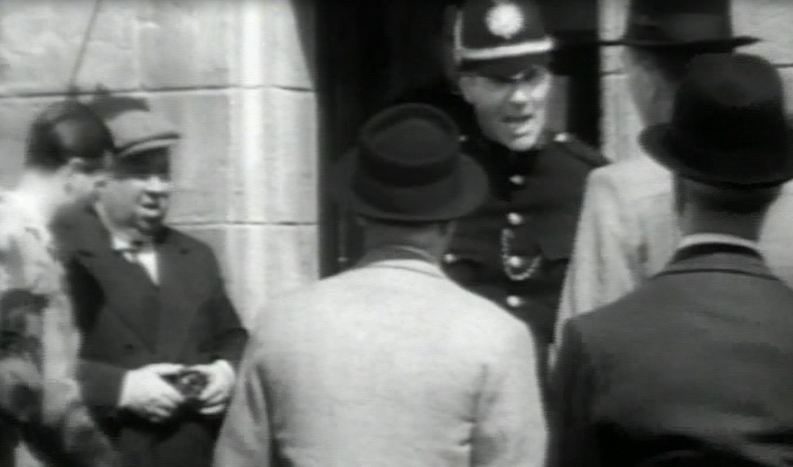 Hitch Appearance:
 He's a newspaper photographer outside the courthouse who does not want to go looking for the escaped murderer.
Hitch Stock Company: I mentioned that Nova Pilbeam was the daughter in THE MAN WHO KNEW TOO MUCH, and playing her father in this film is Percy Marmont from RICH AND STRANGE and THE SECRET AGENT, plus Mary Clare (the Baroness in LADY VANISHES) as Pilbeam's aunt and Basil Radford (Charters in LADY VANISHES plus a bunch of other Hitchcock films) as her uncle, and George Curzon who plays Christina's husband was in JAMAICA INN and MAN WHO KNEW TOO MUCH, and John Longden who plays the handsome detective was also the handsome detective in BLACKMAIL. I thought it was great to see Radford and Clare from LADY VANISHES as husband and wife – and they had a great chemistry together... you could have spun them off as series characters like they did with Charters and Caldicott.
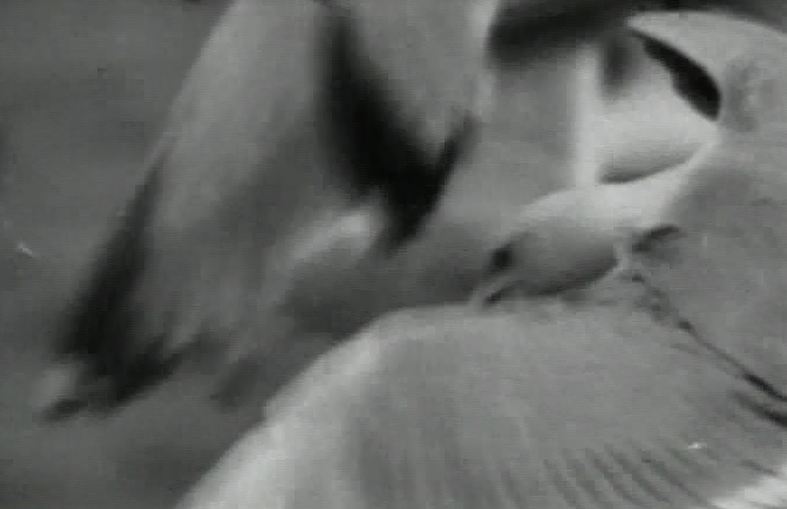 Bird Appearance:
 When the dead body is found on the beach there's a great shot of seagulls flying – I have no idea how he shot it, but we are in the air with the gulls!
Screenwriting Lessons: The film is a lot of fun, and I've used some of the elements in Script Tips in the past because it contains some great examples of gags and showing a decision on screen – we'll look at the gags and decisions, as well as opening your screenplay *in media res* and A-B-C plotting and disguises... as well as some film elements like models and biggest to smallest and disaster scenes. Though the last elements may not directly relate to screenwriting, I'll try to pull them in by looking at how those things might end up on the pages of our screenplays.
 In Media Res:
 Latin for “in the middle of things” - the idea of starting a story when it is already in progress rather than starting at the beginning. The story hits the ground running with very little exposition, and the audience figures things out as the story progresses, or the story may start in the middle (to begin with action) then flashback to how the characters got to be in such a place. This is a common way to start screenplays which may have a bunch of potentially boring exposition up front. You've seen it done in movies like HANGOVER – which begins very close to the end when all is lost, and then flashes back to show us how they got to this point.
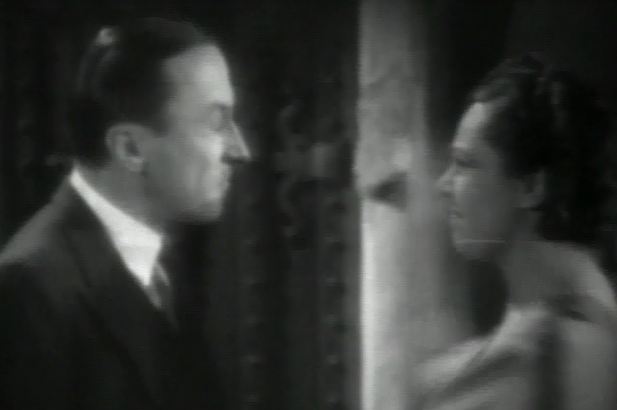
YOUNG AND INNOCENT starts in the middle of a *scene* and then just keeps going. No flashback to lead us up to that scene, the film begins in the middle of a major argument between movie star Christine Clay and her husband Guy – she wants a divorce and he refuses. He accuses her of cheating on him with a succession of “boys” - the 1930's term for boytoys or himbos. She is an attractive woman in her late 30s or maybe early 40s. The film begins with all of the dirt! The polite part happens before the film begins, and we are at the name calling part... and Guy calls his wife *something*, but thanks to a censor-friendly thunderclap we can't hear exactly what. Probably slut or whore. She slaps him *hard*... and does her best to explain away the parade of hunky men who have visited her bedroom.
The great thing about starting the film in the middle of this argument is that it allows a lot of secret exposition – when Guy says he found her in the chorus line and used his connections to turn her into a star, just so she can dump him and sleep with “boys” - it's like a verbal slap... but tells us who they are and why they are calling each other names and slapping each other. He's a musician, she's a movie star. She has outgrown him... but he will not allow her to divorce him. He has *invested* in her, and now that she's making money she wants to dump him? After the slap, Guy storms outside into the storm and puffs on his cigarette. When lightning flashes, his eyes twitch like crazy. That's a clue, too – but we don't know it at this point.
Starting a film with the story in progress like this forces the audience to pay attention. We have no idea who these people are or even their names – but they are yelling at each other and saying nasty things about each other.
The next scene has our hero Rob walking along the edge of the cliff overlooking the beach when he sees something in the water and climbs down to investigate – a dead woman! When he sees her face he says: “Christine” - so she is the woman in that first scene, and dead, and this guy knew her. One of her “boys”? As he runs to get help, two attractive girls come onto the beach, see the dead woman, see the man running away, and scream...
When the police arrive, they ask who found the body and Rob says he did... but the two girls say *they* did, and saw Rob running away. The policemen believe the attractive girls over the guy – and next thing you know he's being interrogated in the police station. Though these cuts to a scene in progress isn't exactly In Media Res, it's starting each scene *late* - when then conflict has kicked in. We don't need to see Rob arrested and driven to the police station and the beginning of the interrogation – it's more interesting to start the scene just before the big moment in the interrogation. The police ask Rob how well he knew the victim, and his answer makes him sound guilty... They ask if she had ever given him money (for services?) and he answers, yes – she paid him for a story. They're accusing him of being in the British version of SUNSET BLVD – some broke young screenwriter who took money from an older star in exchange for sex. Does he own a raincoat? Of course he does. Where is it? Well, it was stolen a week ago. Convenient... Everything makes him sound more guilty – then they drop the bombshell... she left him money in her will. Motive for murdering her?
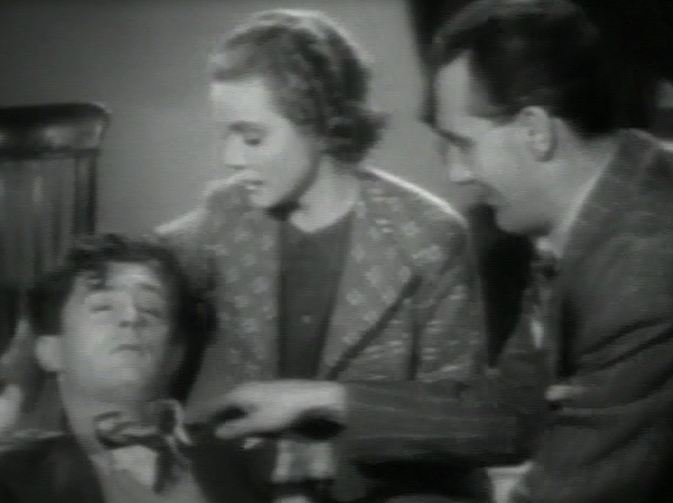
Rob passes out... and that's when Erica comes in and tries to revive him. She knows how because she used to be a Girl Scout. And she used to work with the cornerman for a boxer. And she knows that a stiff shot of brandy will get his heart racing again. And she knows how to slap really hard because she's used to driving around with horny policemen. She has a great comeback for everything – and one of this film's charms is that the characters all have quick wits.
Story Gags:
In the entry on FOREIGN CORRESPONDENT we talked about “gags” - which are one of my favorite things about older films. Gags don't have to be funny – they can be serious or suspenseful or romantic or “action gags” (covered in SECRETS OF ACTION SCREENWRITING) – they are little details in a scene. Older films, for whatever reason, seem to be filled with all of these great details that make a scene seem real and are often amusing or entertaining... and *full*. Scenes in older films seem *packed* with information and entertainment. Often when I watch a recent film there is the basic scene and that's it! None of the details or “mini story beats” that gags used to provide. In the VISUAL STORYTELLING book I look at gags in silent films – and I suspect that's where came from. In a silent film there was no dialogue or even sound effects, so they needed more *story* to fill the screen. Gags were those bits of story. Probably when silents ended there were lots of writers who were either used to writing gags, or writers who specialized in gags – and when they worked in sound films they just added all of those gags... and when they died off, so did the gags.
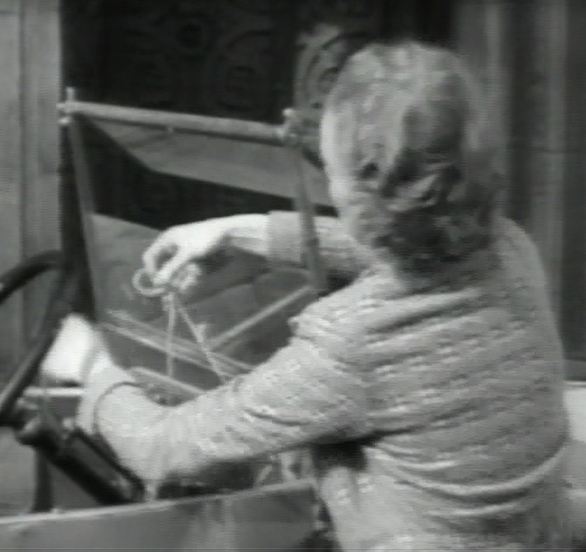
When they lead Rob across the street to the courthouse he passes Erica trying to start her beat up old jalopy. To do this, she has a string attached to the throttle and she can pull on while cranking the engine... and this is a gag. Not funny at all, just a detail... that becomes part of the story every time her car is started. It's used in a variety of ways, to create suspense, to force her to come along on a car chase (she's the only one who knows how to start the car), and it prevents strangers from driving her car. When the detectives pull Rob past the car he tells her it might need a shot of brandy in order to start.
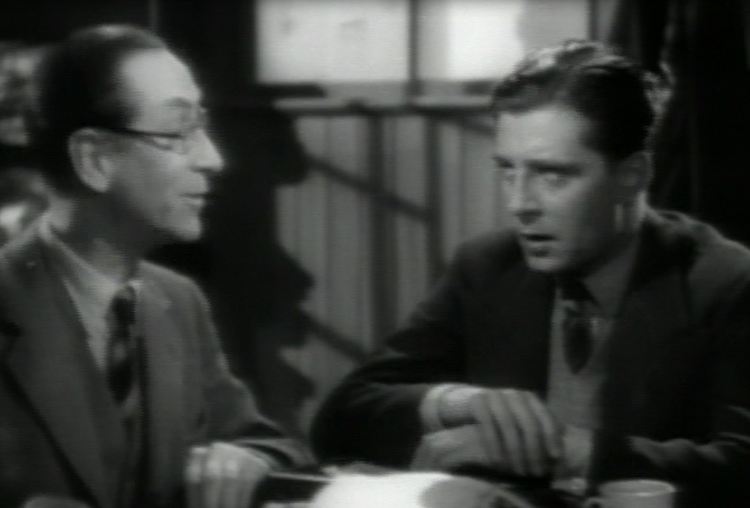
Rob gets stuck with the worst public defender in the history of courtrooms! He's scatterbrained, is sure that Rob is guilty, and wears glasses that are a quarter inch thick. And he wants to know how much Rob has on him, because once he's convicted they will take his money away and the lawyer won't make any money. He has 2.30 on him, and the lawyer takes the 2 (it's British money, so forgive me if I got the details wrong here). The money is part of an important “gag” that threads the story together – now that he's down to .30, and later in the story he will use that money to buy gas for the female lead... and she will realize he spent his last cent on her and that will be her motivation for going back to help him – to give him back the money she borrowed. We'll look closer at that in the section on Romantic Pivot Characters. But something as small as the coins in a character's pockets may be critical to your story... or *can be* fun to keep track of and use later. These details, or “gags” make a story seem real and “dense”.
When the lawyer puts his glasses down, Rob secretly snags them... and when their case is called Rob manages to give the bailiff and his blind lawyer the slip in a crowded hallway by walking next to a man of his build wearing similar clothes... and the police officer guides the other man into the courtroom.
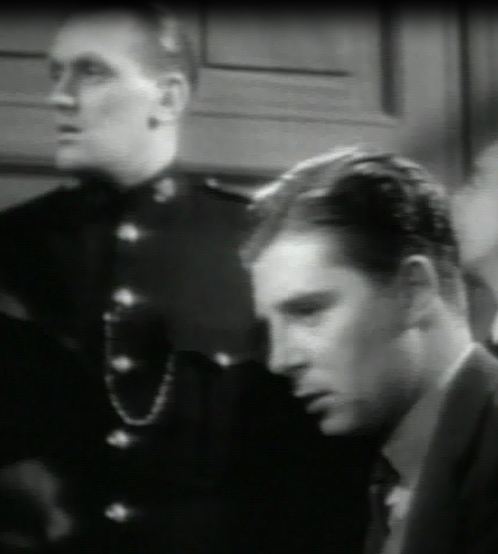
Rob escapes... ducking through a courthouse door... where another bailiff seats him in the gallery for a trial... which ends up being *his* trial! Every good thing that happens backfires into a bad thing – and that's something that happens throughout the story. It creates a balance... and keeps the story exciting and suspenseful because of the good news/bad news aspect.
So now he's trapped in the courtroom he was supposed to be in – will they find him? Rob tries to leave... but the Bailiff stands guarding the door. As word of his escape spreads, the courtroom begins clearing, except for his public defender who is lost in thought trying to read paperwork without his glasses. That's when Rob pulls out the thick stolen glasses, puts them on as a disguise (the first of many – we'll look at disguises in a moment) and walks out of the court house past all of the policemen and bailiffs who are looking for him.
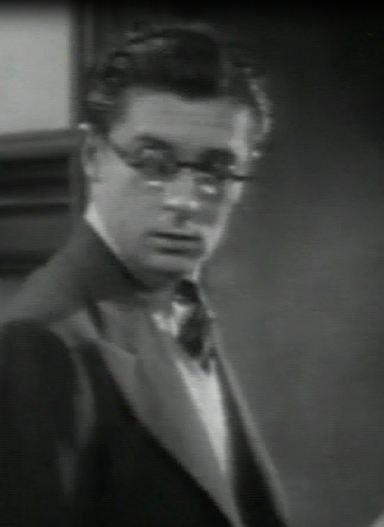
That's the good news – the bad news is that the glasses are so thick he *can't see where he's going*! And he is outside the courthouse where an army of policemen are searching for him! He stumbles down the sidewalk... to freedom.
Remember Erica's car gag? When a pair of policemen want to commandeer her car to give chase, they don't know how to use the string to start it... so she ends up the driver!
Next we get a great visual gag, as we see a beautiful country road as Erica and her old jalopy slowly enters the frame. Wait, where are the two cops? *Pushing* the jalopy – it's out of gas. When a horse drawn farmer's cart comes by, the two cops commandeer it... but the farmer has to drive... and the two cops have to sit in back with the pigs. Pigs and pigs? Was that a joke back in 1937? Yes it was! “Pigs” as slang for police goes back to 19th century Germany. Learn something new every day.
Romantic Pivot Character:
As soon as the two policemen leave in the pig cart, Erica pushes the car herself – and it's remarkably light... because Rob is actually doing all of the pushing.
One of the new chapters in
SECRETS OF ACTION SCREENWRITING is on “Pivot Characters” like Tommy Lee Jones in THE FUGITIVE who start out as an antagonistic character who believes the protagonist is guilty, but as the story progresses they begin leaning to the other side and end up *helping* the protagonist by the end. Pivots actually can work both ways, and we take a closer look at that in the book – but here we have a combination Pivot Character and Love Interest. Erica begins believing that Rob is guilty and that she will be arrested and convicted for helping him to escape... but as the story goes on, scene-by-scene she begins to wonder if he might be innocent, and then eventually she risks everything to help him.
The great thing about this is that it is a *gradual* change in Erica's character. Because she is also the love interest, and Rob is a charming man, the thing that comes between them in the “rom-com” thread of this story is that she believes he might be a killer... So they may have a witty conversation and we know they were meant to be together and hope they hook up by the end of the film, we understand why Erica isn't just jumping into his arms. This is a great combination of character purposes because when she begins to believe him, the barriers to their relationship begin to evaporate... so she can help him prove he's innocent *and* hook up with him at the end. But early on, she's just as much a kidnap victim as Faye Dunnaway in THREE DAYS OF THE CONDOR. Scared, wondering how to escape without maybe setting this guy off. He's accused of murdering the last woman he was with, right?
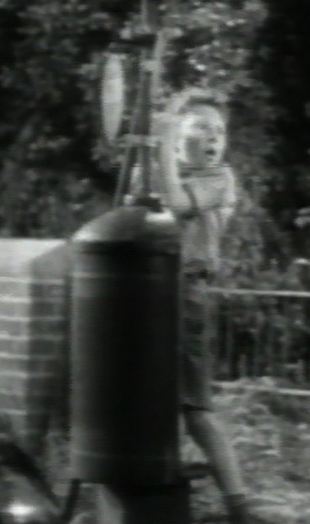
When they get the car to a gas station, we get some more gags – the gas station owner's little boy pumps the gas, and has to stand on a bucket to reach... and the bucket falls over so Rob has to rescue him. This is a great bit because Erica finally has a chance to escape while Rob is helping the kid – but would a killer help the kid? She sticks around, and Rob spends his last cent on gasoline for her car. She stresses that she is *not* on his side – her father is the chief of police – and asks why he isn't taking his situation more seriously. Rob says, “I can laugh because I'm innocent. You don't believe me. I wish you did.” That sums up her whole Romantic Pivot Character.
Show The Decisions:
Whether your script is a drama, a comedy, or a thriller there's always a decision that must be made in order to solve the external (plot) problem. The decision your protagonist makes is the most important part of your screenplay - it reveals the theme. The meaning of your script. In the Visual Storytelling Blue Book I look at decisions as a way to reveal character – and that technique is used in YOUNG AND INNOCENT.
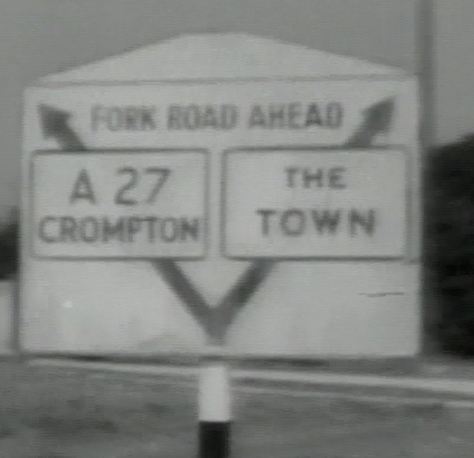
While they were at the gas station and Rob is helping the kid pumping the gas, Erica is unattended. Will she run? Will she tell the gas station owner that he’s a fugitive from the law? She almost does... but *decides* not to. When they are done, Rob asks the gas station owner for directions to the truck stop where he lost his raincoat - the evidence that exonerates him. “At the Y in the road, turn left ... if you turn right, it just takes you back into town.” The Y in the road is a *physical decision* - something where we can see the outcome.
But after they leave the gas station, instead of taking him to the Truck Stop where he lost his raincoat, she pulls up at a vacant old mill and kicks him out of the car. She is the daughter of the Chief of Police and can not help him. She drives home...
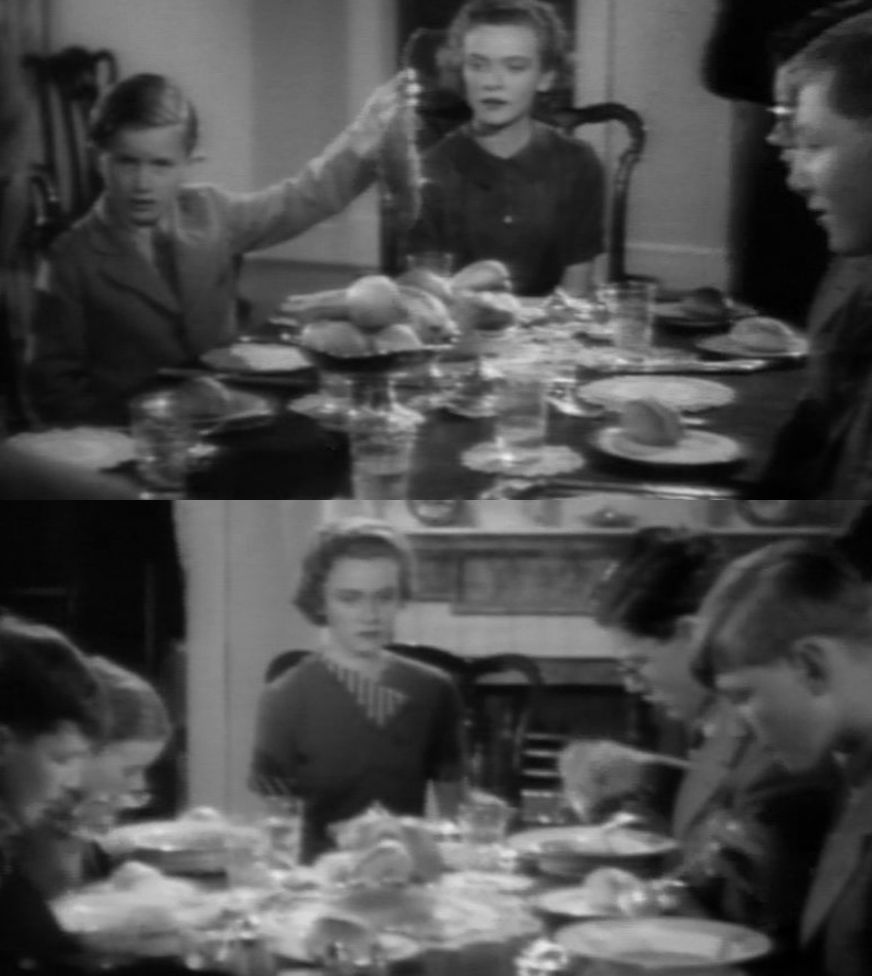
One of the other techniques in the Visual Blue Book is the Echo Scene – where the same location is reused in order to show the difference in characters or situation. Erica has dinner with her army of little brothers and widower dad two times - the first time shows the whole family (except Erica) happy and joking, the second time shows everyone quiet and solemn after Erica has been accused of aiding an escaped killer.
The first dinner scene the conversation is about the escaped murderer – and each of the brothers is a well defined character, from the intellectual brother to the youngest one who killed a rat with his BB gun and brought it to the dinner table. Erica listens to various theories on why he will be caught – biggest problem is that he only had .30 on him and will only last as long as the food he can buy. Intellectual brother says if he buys .30 of chocolate he'll last longer (and has a scientific argument to back it up). Erica realizes all of Rob's .30 went into her gas tank, and makes a decision...
So now we get the scene where she goes back to the old mill and gives Rob some food and repays the gas money. This is the first scene where she actually listens to him explain why he's innocent. But it's all cut short because the two policemen who were in her car and then the pig cart? They spot someone in the Old Mill and investigate. A gag where the policemen are “detained” by Erica's barking terrier – one cop says if he grabs the dog he'll earn an extra stripe on his sleeve, the other cop says what good is a stripe if the dog takes off his arm. It's a *terrier*!
Rob and Erica escape – starting the car string suspense – and race out of there with the dog chasing after them (as well as the two policemen). Erica wants to slow down so that they can grab the dog – Rob is afraid that will get them caught. A decision must be made. Rob decides to slow down for the dog – and this shows that he cares about her. He will put his safety in danger for her pet.
Now they are headed in the direction of that truck stop – and there is a road sign that shows the Y ahead and tells where each branch goes – just in case we've forgotten. Erica drives to the Y in the road, and she must make a decision - believe that he is innocent and turn left, or turn right and take him back to the waiting police. Which will she do? This takes something *internal* (does she believe him?) and turns it into an action. We can't see her believing him, we can see her turning one way or the other. She makes a left turn, and we know that she believes him and is going to help him. Each has made a decision that helps the other at the expense of their safety.
A B C Plot:
Plots can work in any number of ways – maybe as many ways as there are stories. In SECRETS OF ACTION I look at a few different ways that action films are plotted, and here's one of them: the A-B-C plot where one thing leads to the next thing which leads to the next. All of that sounds pretty normal, and you have seen this sort of plot in many films and stories. It's a staple of traveling mysteries – one clue leads to the next clue which leads to the next clue. There isn't a direct line from A to Z, it's a series of individual steps, each of them leading to the next step but none of them leading to the end.
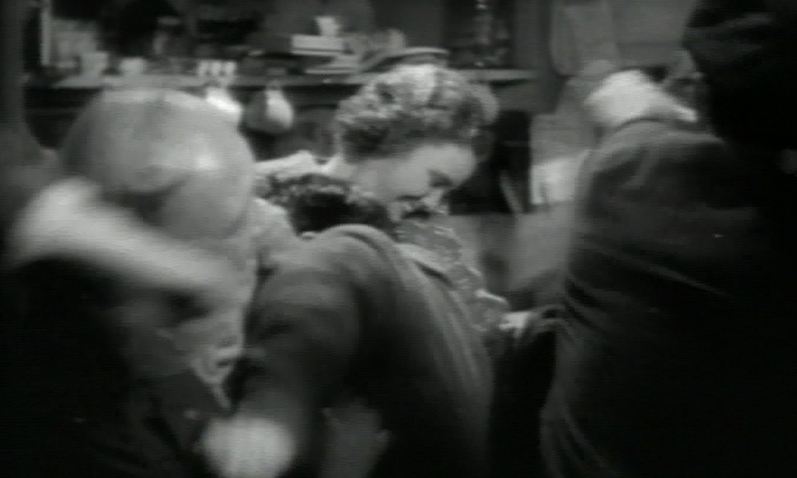
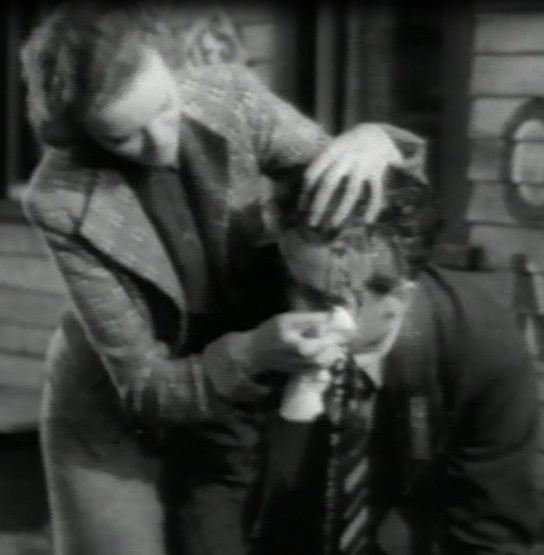
At the truck stop, Erica goes in to ask about the raincoat while Rob waits outside. Surrounded by truck drivers, this gives her a great situation to show how clever she is when she slings a zinger at every trucker with a pick up line or rude remark. But when she asks about the raincoat – everyone clams up. When one trucker talks – saying that a homeless guy known as Old Will The China Mender was wearing a new coat one day, the whole joint erupts into a fist fight – which is filled with great gags. Erica must get across the room – which is filled with punching people. Once she gets out through the back door she sees Rob going in through the front door to rescue her – and now he's got to turn around and get out... and gets punched in the face, Another great gag as Erica tries to clean the wound in a drinking fountain where the water goes up and down in an unpredictable rhythm, so she never knows where to position his head... then the trucker who talked to her before tells her she can find Old Will at Nobby's Homeless Shelter by the railroad. That's where the next clue is – from A to B. Instead of the truck driver leaving the scene in any normal way, he's yanked back into the fight!
So the next clue leads to Nobby's and Old Will, and Old Will ends up having the raincoat – but it has no belt (meaning Rob has no proof that he's innocent) but Old Will says when the man gave it to him it didn't have a belt. A man? Old Will says the man had twitchy eyes – blinking all the time... but that's the end of the trail. Until Rob finds a matchbook in the raincoat pocket from the Grand Hotel – and that's the next destination (A to B to C). Each clue leads to another clue – but the first clue does not lead to the last. You have to take it step-by-step.
But before we even get to Nobby's, the story takes a detour to play...
Blind Man’s Bluff:
There are scenes in movies which are so well crafted that the purpose of the scene may not be apparent – that “drinks with an old friend” scene in FARGO is a great example. Here we have a similar scene – it seems as if you could cut it and not hurt the story... except it's one of those quiet pivotal scenes in the story. Erica needs a cover story to tell her dad (the Chief Of Police) where she went to today – and her aunt lives on the way to Nobby's, so if they can stop in there first for a minute...
Rob waits outside while Erica goes in to visit her Aunt for a minute – but today is her niece's birthday, and the Aunt insists she stay and have some cake. Now Erica is trapped inside while Rob waits outside... until Erica's Uncle pulls up and asks who he is and then why Erica would leave him outside... and brings him into the party!
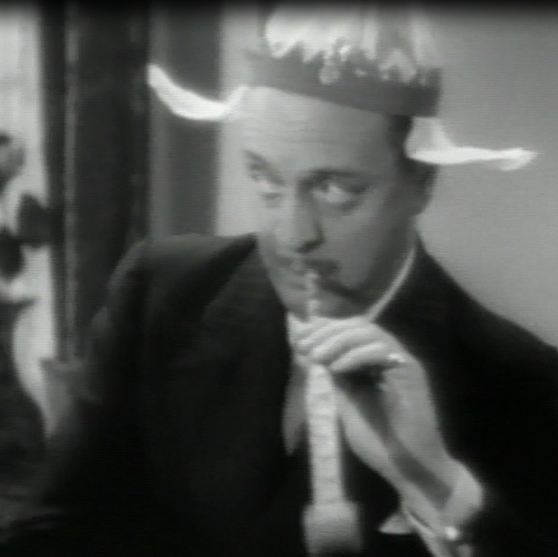
Though the party is filled with silly hats and gags like the little boy who wants to go outside... because he has to pee, there is a deeper reason for this scene than its entertainment value. Erica's Aunt asks her who the young man is – typical relative reaction to a single gal turning up with an attractive guy - but Erica can't tell her his name (since he's wanted by the police) or even any details about him. Rob pops over and introduces himself – giving some crazy name right out of the FLETCH movie, and now he's stuck with that name for the rest of the party. When he zips away the Aunt asks what he does for a living and she makes up an occupation – advertizing slogan writer. The problem is, a moment later Erica has joined the festivities and the Aunt asks Rob about his job... and he has no idea what Erica has said – so his answers are *crazy sounding* (if he writes advert slogans). This makes the Aunt suspicious... and now Erica and Rob must work together to make all of these various lies sound like some form of truth.
In the past scenes with Rob and Erica – they were *together* and that meant the conflict was between them: she didn't believe he was innocent (and even if he was – he'd kidnapped her), but this scene has Rob and Erica surrounded by other people. Instead of the conflict being between them, it's the two of them against the world. This is the scene where Rob and Erica actually become a team and work together. It seems frivolous and funny, but it serves a deeper purpose – and when Rob makes jokes, Erica laughs at them. Earlier she wondered how he could joke at a time like this – now she is joking along with him. Before this scene they were at odds with each other, during this scene they must work together.
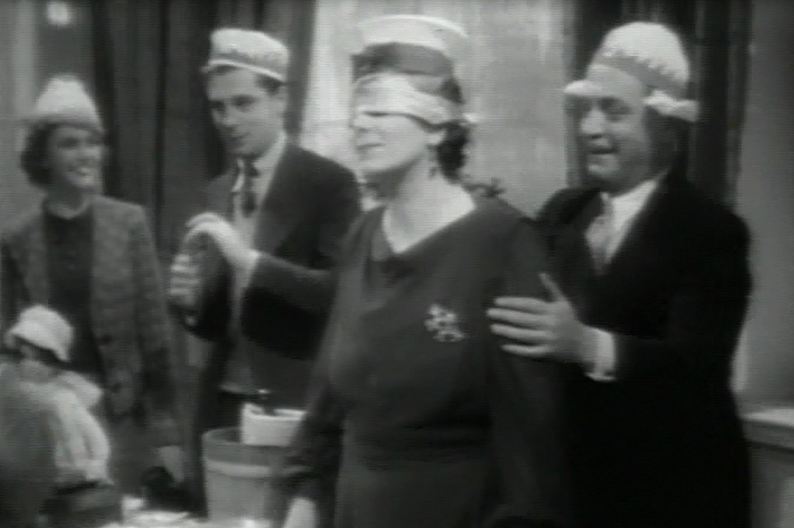
Where the Aunt is suspicious, the Uncle believes that they are young lovers who just want to get out of here so that they can make out – so within the party we have a quiet conflict between the Aunt and Uncle. When the Aunt does something that will force them to stay and give her more information, the Uncle finds some way for them to get out of there. Eventually it comes down to a game of Blind Man's Bluff, where the Uncle insists that the Aunt be “it” and wear the blindfold. Now we get a great little suspense scene where Erica and Rob must get out of the room quietly before the blindfolded Aunt grabs them (and that's who she's trying for). Several close calls, and finally they escape.
Rob and Erica *laugh together* in the car as they zoom away – on the same side for the first time. But remember the good news/bad news thing? For every good thing that happens there is some bad thing to balance it out? As soon as the Aunt finds out they have escaped, she rushes to the phone to call Erica's Father and ask who that man with Erica is... and the Aunt's description matches the escaped killer. Erica's Father calls for the police to be on the look out for his daughter's car, and things have just gotten much worse without Erica or Rob knowing about it.
Doesn't take long for them to find out – they get pulled over by one of the pig cart Cops as drive through town... and have to escape at high speed. Now Erica's Father knows she's somehow mixed up with the escaped killer – and Erica realizes that it is now serious – she is an accessory. Before she might have found a way to escape prosecution – now the only way for her to stay out of prison is to prove that Rob is innocent. Good news – they are together. Bad news – if they can't find the evidence, they are both going to prison.
Only A Model:
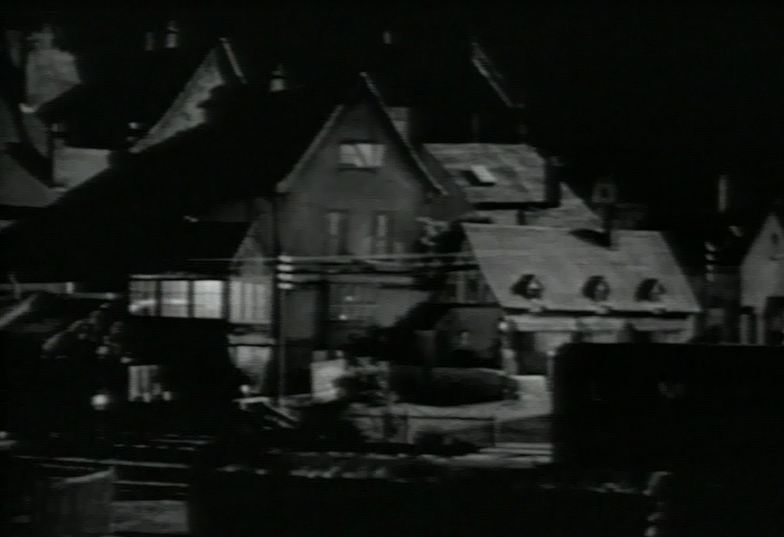
One of the amazing things in older films like this is the use of *very* detailed models. The exterior of the snowed in ski chalet at the beginning of THE LADY VANISHES and the beautifully detailed miniature of Hitler's headquarters at the beginning of NIGHT TRAIN TO MUNICH look like the real thing – it's only the knowledge that they didn't have helicopter shots (and that the camera is not moving as if this were an actual location) that tips us off. The amazing thing about many of these models is that they are “articulated” - portions of them move, and they may even feature moving *humans*. All of this makes them seem very real. Even though modern audiences will know they are models, they will also probably think they are pretty amazing.
In YOUNG AND INNOCENT we have this amazing overhead shot of the industrial section of the city down by the railroad track and slowly move in – past a moving truck on the street – and as a train passes by on the tracks, and move down to a parked car – where Rob stands outside talking to Erica behind the wheel. At one point Rob and Erica are miniatures – little model people on this detailed train set – then we cut to a different angle of the real people in the exact same positions for a conversation. Shots like this give the film a huge scope – these are *helicopter shots* of the town, which were pretty much impossible in real life back then. The moving model cars and trains look real – as do the buildings.
In LADY VANISHES we go from a high overhead of the train stuck in an avalanche and move slowly down to the village and the ski lodge... then – in the same shot – move up to the window of the ski lodge lobby and look inside. That's when we cut to a shot of inside the ski lodge with real people. But the detail is amazing – and having the ability to do a “helicopter shot” before there were helicopters adds production value... And gives us a “Biggest To Smallest” element, which we will discuss later in the blog entry.
After the Nobby's scene which comes next, more models are used in a car chase in the rail yards where Rob cuts across the tracks in front of a speeding train, leaving the police behind them. This would have been a dangerous (if not impossible) stunt to do at the time, but with the use of very realistic models you get all of the thrills. If you think the use of models and miniatures is something from the distant past, they were commonly used in films up until the advent of high quality CGI work – and the next time you watch THE STING note that the elevated train is a model! My friend Fred who does disaster movies for cable has used toy store model cars and forced perspective to create a street full of wrecked and burning cars – without having to wreck or burn any actual cars (which would be expensive). So the old techniques are still in use.
In a screenplay, there is no need to identify what is going to be a miniature or CGI or a special effect – just write what we see and let the people in charge decide how these things will be done. If a building blows up, it blows up. If a giant shark attacks, a giant shark attacks. No reason to call attention to what kind of special effects will be used – just write the screenplay!
Disguise & Disguise:
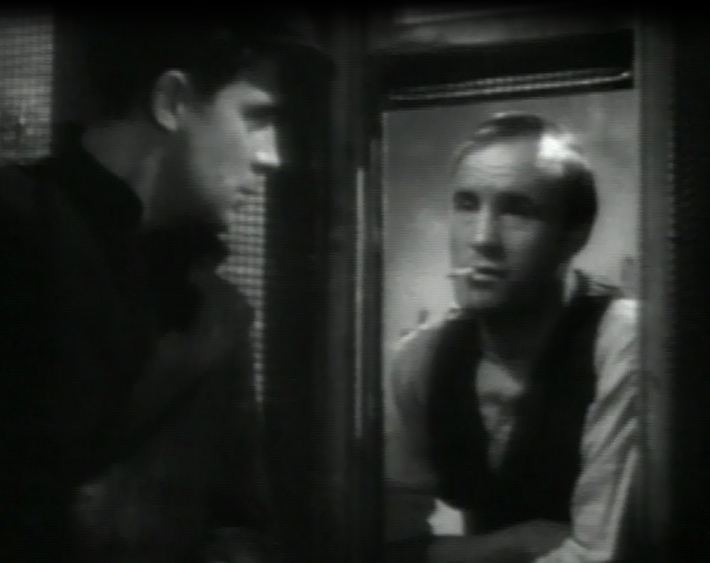
Rob is going to go into Nobby's to look for Old Will, and tells Erica that she will be safe in the car. Both are exhausted by this point – running on very little sleep. Because Erica's old jalopy is parked between two trains it is impossible to see, and she can sleep in the car without much worry of being disturbed.
But to get into Nobby's, Rob will have to disguise himself as a homeless man. One of the motifs in the film are people wearing disguises or altering their appearance. This may tie in to Rob appearing to be guilty, but it's used in several different scenes. Here Rob puts on an old cap, turns his coat inside out, covers it with dirt, and tries to look and act like he's homeless. At the front desk of the homeless shelter he says hello to Nobby behind the counter... except it's *not* Nobby – Nobby has been dead since before the war. Rob claims to be a friend of Old Wills and asks if he's there. The (suspicious) guy behind the counter says not yet, but they've held a cot 68 for him. Rob gets onto his cot, keeps his eyes on cot 68... then falls asleep. Wakes up and cot 68 is empty – but has been slept in. There are a bunch of homeless men hanging around talking, so Rob asks the guy behind the counter which one is Old Will... and the counter guy answers with “I thought he was your pal?” This disguise isn't working very well.
Rob knows that Old Will repairs china, so he breaks a cup – which does the trick, but also gets the counter guy on the phone to the police. Rob grabs Old Will and runs for Erica's car – and we get our car chase with the near miss by the train.
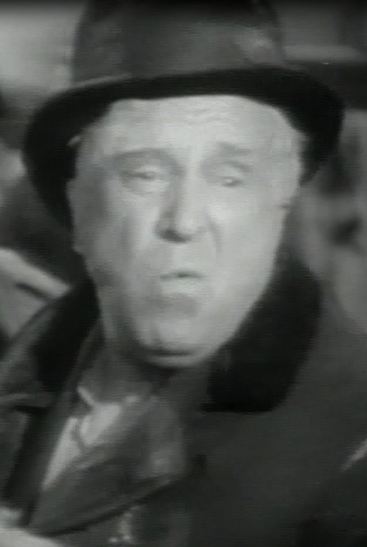
Later in the story we will get two more examples of disguises – the matchbook that leads them to the Grand Hotel, an elegant place with a grand ballroom. So Old Will the homeless guy (with an attitude) must be transformed into a well dressed gentleman to get through the doors and look for the nan who gave him the raincoat. They take him to a suit rental place, and Old Will is Cinderella headed to the ball – except he's still a homeless guy under the fancy suit and top hat. He has a bad attitude, and when he orders tea at the Grand Hotel the waited asks “China or India?” and he yells “TEA!” no even understanding that there might be different kinds of tea. Just like Rob's homeless disguise, Old Will's gentleman disguise doesn't cover who he really is.
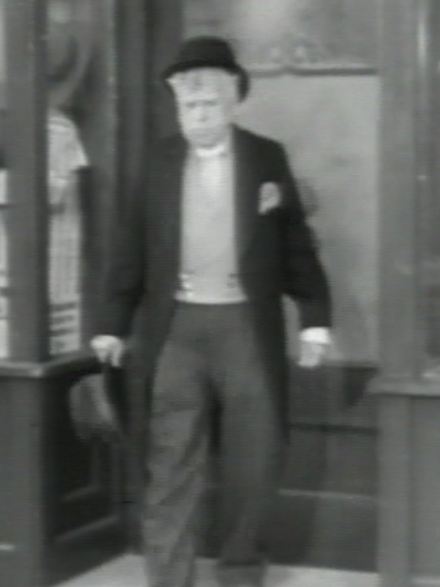
Once in the Grand Ballroom Old Will can't spot the man who gave him the raincoat... because *he* is in a disguise! So we have one disguised man looking for another disguised man! I don't know whether using the disguise motif was thematic or some sort of amazing creative coincidence (which is just another term for subconsciously thematic) but the characters keep dressing up- as people they are not throughout the film. Everybody does it!
Disaster scenes:
Back to the homeless shelter – after Rob drags Old Will out to Erica's car and they zoom away with the police in hot pursuit, they get a head start when they zip past that speeding train... but the police are still back there. So, in the middle of this car chase Rob grills Old Will about the raincoat, discovers that Old will *is* wearing it (he sports the homeless layered look) – but there is no belt! The belt that killed Christine Clay came from *Rob's* raincoat! Old Will tells him the man who gave him the coat had a twitch – both eyes blinking at the same time. Hey, we know that's Christine's husband! But Rob and Erica don't know that, and have no idea where to find the twitching man... and the police are chasing them. Old Will suggests they hide at the Old Mines, and she pulls her jalopy off the road and into the mine...
And we get an amazing disaster scene.
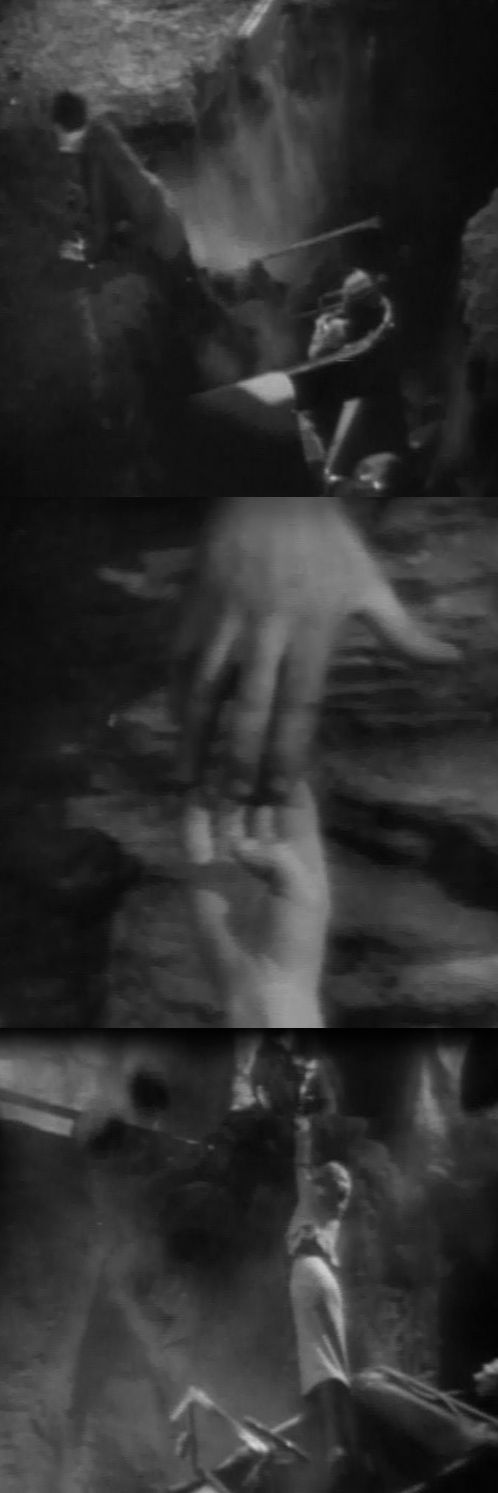
What's interesting about Hitchcock movies are that many have disaster scenes: the plane crashing and sinking in FOREIGN CORRESPONDENT, the ship sinking in LIFEBOAT, and here we get a great mine cave in YOUNG AND INNOCENT. They drive the jalopy into the mine to hide... and the ground gives way and the car begins sinking. Rob and Old Will scramble out... but Erica is still in the car, and it begins falling faster! Rob reaches down to grab here, and we get that signature Hitchcock shot of hands grabbing for hands that's in almost all of his films. To add to the suspense of this scene – the police arrive! Rob finally grabs Erica's hand, just as the ground completely gives way and the car plummets! He pulls her up, then scrambles away – but the police grab Erica.
The great thing about the mine cave in scene is that it is amazing spectacle – much like the plane crash in FOREIGN CORRESPONDENT. This is the kind of huge scene that elevates a little movie like this and gives the audience an exciting experience they probably did not expect. Our job as screenwriters is to fill the screen – and a movie screen is pretty darned big, so we will need some big scenes like this.
As Low As You Can Go:
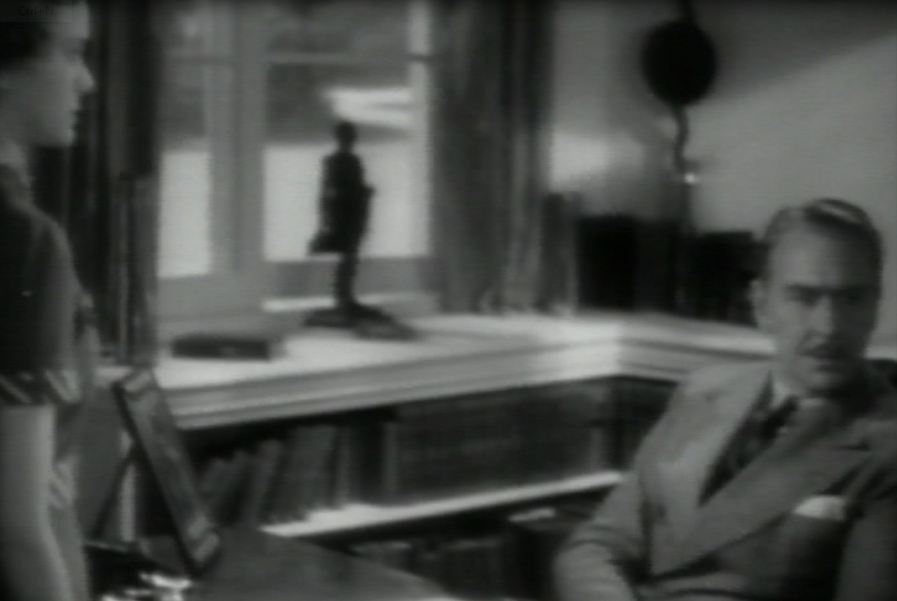
Good drama is about conflict – and at this point the characters are overwhelmed with conflict. Rob has found his raincoat on Old Will – but not the belt. It seems that the evidence that he thought would prove him innocent proves him guilty. Erica is questioned by the police and may be charged – she goes home and we have the echo of that earlier dinner scene with all of her brothers, but this time they look on her with pity – she's either a criminal or a kidnap victim (or both). It is a tension filled meal, and after dinner it gets worse: Erica's Father calls her into his study and shows her his resignation papers. He can't be Chief Of Police if his daughter helped a killer escape. They have a big dramatic father-daughter conversation which might be at home in an Oscar nominated drama. But remember that even in a thriller or any other genre film, drama is basis of the story. It always comes down to the *people*. The events of the story have seriously damaged Erica's relationship with her father. Her whole life has gone to hell. She goes to her bedroom and cries herself to sleep.
This is the ultimate low point for all of the characters. One of the problems with many screenplays is that the characters never hit bottom. The writer doesn't want to make it too hard on them, wants to protect them, and makes their problems easier than they should be. But the lower you go, the greater the stakes and the conflict, the more we will cheer when those problems are resolved. Never make it easy on your characters!
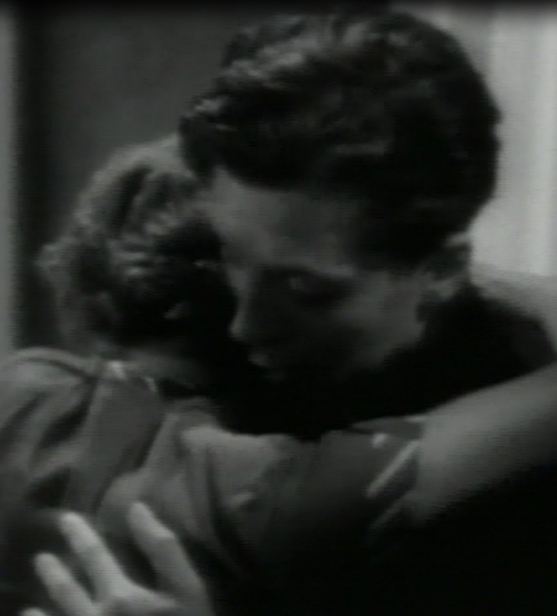
Just when we think all is lost, Rob climbs through Erica's window – and they embrace. Part of going so low is giving them (as a couple) something to lose. That means they must be a potential couple by this time. I think part of saving her from the mine cave in was to solidify their relationship. They *are* in love – which means in addition to everything else they will lose, they are also going to lose each other. Rob has decided to turn himself in and stop running – probably end up convicted of a murder he did not do. Even if Erica is not convicted, she has caused her father to be ruined. It can not get any worse than this...
And that's when they find that matchbook from the Grand Hotel and have a new lead to the real killer.
Biggest To Smallest:
So once Erica and Old Will get to the Grand Hotel, with Rob hiding outside, they have to find a man who twitches... in a huge luxury hotel's ballroom. How do we show that needle in a haystack situation visually? One of the Hitchcock theories was biggest to smallest – and in the entry on NOTORIOUS we took a look at that theory in action in the party scene where the camera goes from a high overhead of the party and cranes down in a single shot to focus on the key in Ingrid Bergman's hand.
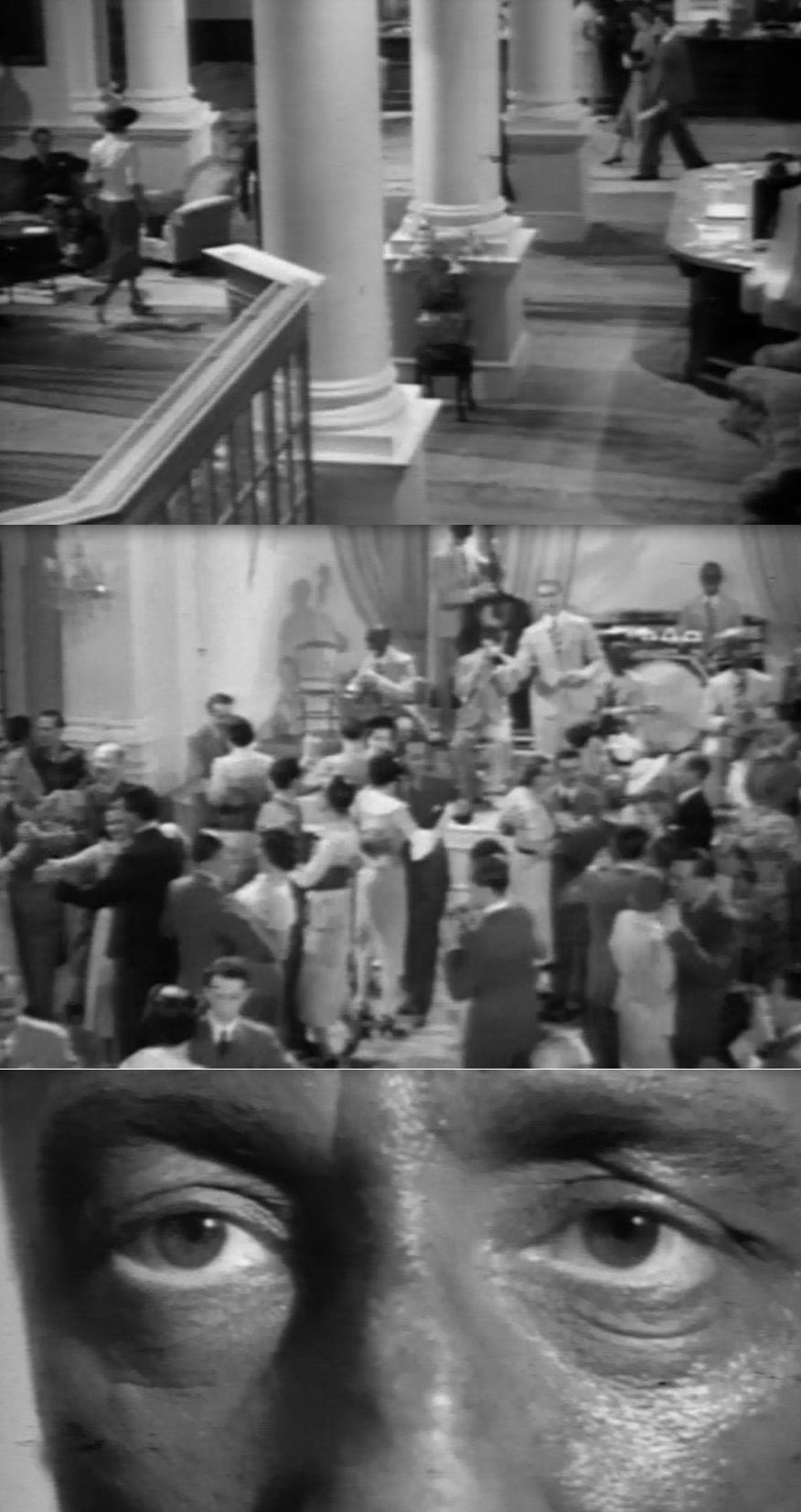
In YOUNG AND INNOCENT we have one of those amazing tracking shots – it starts outside, overhead - enter the night club - hundreds of people, which one is the killer? And as the camera slowly moves over the room with too many suspects for them to weed through before the police arrive, the camera slowly moves down to eye level and creeps up to the killer's *eyes* - they fill the screen... and then twitch! Cool shot and it makes us wonder how they will ever get through all of those false suspects to find the real killer - the needle in a haystack.
Though the two examples from Hitchcock films seem to be director related, *we* can also use “Biggest To Smallest” to show how a large event (like the party in NOTORIOUS) actually comes down to something small and personal. In the original DAY THE EARTH STOOD STILL, Klatuu causes the power all over the Earth to cut out for half an hour as a sample of what he can do. The sequence begins with global issues - the big picture - as cities across the globe go dark. Then each successive piece of the sequence gets “smaller” - from freeways filled with stalled cars to city streets... and finally down to a woman pulling wet clothes out of her stalled washing machine. From the global problem to the personal problem. You might not be able to relate to a whole city going dark, but you can sure relate to a bunch of half washed clothes. The “Biggest To Smallest” technique is a great way to take a major problem and show it at a personal level - and that’s something we can use in our screenplays.
To add to the difficulty in YOUNG AND INNOCENT – disguise and disguise – Old Will is dressed as a gentleman and the killer – Christine Clay's musician husband Guy – is in blackface. The whole band is in blackface. So even with Old Will looking around the room, he doesn't recognize the man who gave him the raincoat. The police are on their way – so the clock is ticking. Erica and Old Will decide that dancing around the ballroom will allow them to look at more people, only Old Will has no idea how to dance. They do it anyway – a bit of comedy – but Old Will doesn't see the man.
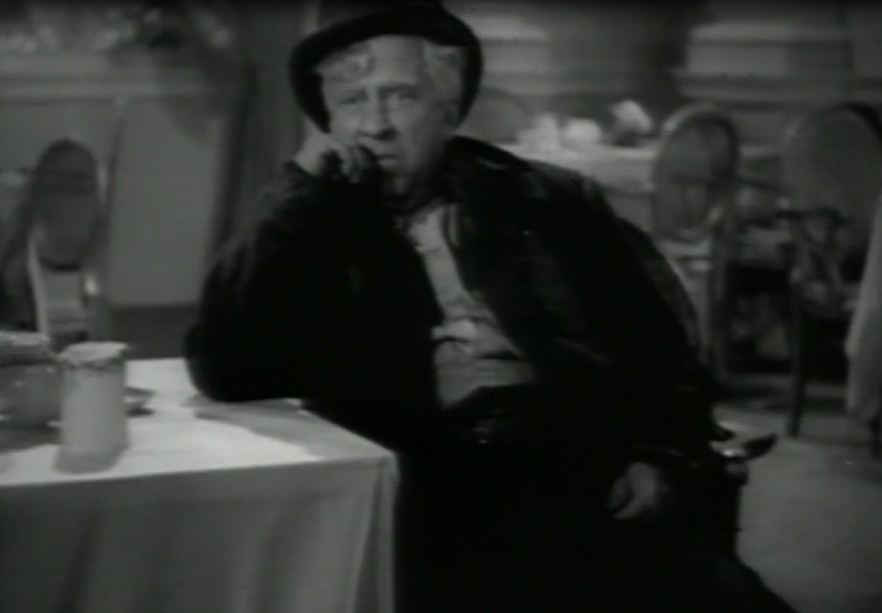
But the man sees Old Will – Clay recognizes the homeless guy he gave the raincoat to and begins twitching like crazy. There's a great visual here where Clay *sees* the dressed up Old Will as the homeless bum. When the police arrive and seal off all of the exits, Clay's twitch goes out of control and he's screwing up his music.
Just when you think the problem will be resolved, Rob steps forward and gives himself up to protect Erica. The police send a waitress in to ask Erica and Old Will to give themselves up and leave without incident – and they do! The killer is this close, and they are all leaving!
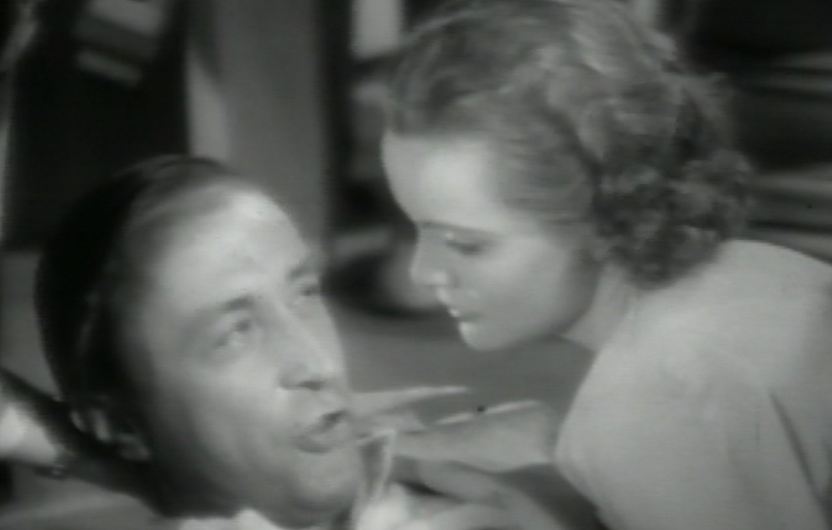
Just as we had good news/bad news to balance things out, at the end of the story we have some bad news/good news. Clay sees the police talking to Old Will and Rob (and Erica) and assumes they are here for him – and collapses. Someone calls for a doctor, but what they get is a Police Chief's daughter who learned first aid in the Girl Scouts... who helps the musician in blackface... and notices his eyes twitching... and calls over Old Will... who identifies him once they remove the make up... and when they ask Clay what happened to the belt on the raincoat, Clay is sure they are already here to arrest him and confesses to killing his wife. That solves all of the problems...
But there is still an important story moment.
Erica runs into Robs arms... then goes to hug her father and apologize... then brings the two men in her life together to shake hands. While all of these chase scenes were going on, another story was playing out in the background about a young women who meets a man and realizes she must leave her father's home to be with this man. The normal story of first adult romance. And even though her father at first does not approve of this man, she must make peace between them so that she has *both* of the important men in her life. All of that is done in a silent scene where she goes from one man that she loves to the other, and then brings them both together... THE END.
Sound Track: Louis Levy - nice score.
YOUNG AND INNOCENT is a fun forgotten Hitchcock film that deserves to be remembered. It's a chase film, about a struggling young screenwriter who is accused of murdering a famous actress, and the daughter of the police chief who hates him then loves him as he finds the evidence that proves he's innocent. This is a breezy chase film, kind of like 39 STEPS. Probably less known because the cast isn't as attractive nor as famous. But fun to see again.
- Bill
The other
Fridays With Hitchcock.
BUY THE DVD AT AMAZON:


FINALLY!
*** THE SECRETS OF ACTION SCREENWRITING *** - For Kindle!
*** THE SECRETS OF ACTION SCREENWRITING *** - For Nook!
Why pay $510 for a used version of the 240 page 2000 version that used to retail for $21.95? (check it out!) when you can get the NEW EXPANDED VERSION - over 500 pages - for just $9.99? New chapters, New examples, New techniques!
"SECRETS OF ACTION SCREENWRITING is the best book on the practical nuts-and-bolts mechanics of writing a screenplay I've ever read." - Ted Elliott, co-writer of MASK OF ZORRO, SHREK, PIRATES OF THE CARIBBEAN and the sequels (with Terry Rossio).(ie; 4 of the top 20 Box Office Hits Of ALL TIME.)
Only $9.99 - and no postage!