Monday, December 17, 2007

Going Postal (part two)

stuff Uwe Boll in here then have DeNiro from Mean Streets walk past(When last we left our hero, he was standing in a slow moving line at the post office remembering past lines in the post office when he was just starting out writing short stories... much as Marcel Proust ate a cookie and remembered things past...)

GENT & DUDE

Most of Stephen King’s short stories had been published in magazines called Gent and Dude, published by Dugent Publications... in exotic Florida. The editor was a guy named Maurice Dewalt. I read the King stories, and decided to write some horror stories similar to them for Dugent. Now, I was a fan of King and Matheson and Bloch and many other horror writers, and one of the things I loved about King’s work was that the lead characters were normal guys - some guy working in a factory picking up an extra shift cleaning out the basement who runs into some pretty big rats down there. I could see myself writing this kind of stuff. So I wrote a stack of short stories and began sending them to men’s magazines - even Playboy - why not? Just another day standing in line at the post office.

Now, I wasn’t just sending these guys horror stuff, I was also writing James M. Cain style noir pieces and John D. McDonald style action pieces, and some Chandler influenced mystery stuff. There were dozens of magazines, and if I were going to make a living and pay the rent on the *house* that Wendy and me and the three dogs and a horse were living in, I needed to sell a lot of stories every month. I had a day job at Safeway, but what I wanted to do was write full time.

(Okay, the horse wasn't living in the house. It wasn't living in the back yard, either. It was boarded at some ranch where we had to clean the stall. But it ate like a... well, like a *horse*!)

I was writing screenplays, too, and making short films. In fact, Wendy starred in my CARRIE take off, just to bring it back to Stephen King. It was part of my MONDO SHORTS - UNDERWEAR OF THE WORLD complilation. I made a lot of short films back then, and my first 35 minute compilation was called SHORTS OF BILL MARTELL and the titles were on underpants. The "sequel" was a mocumentary like MONDO CANE that looked at underpants from all over the world... and would then use a kind of Monty Python inspired stream on consciousness to go from undershorts to film shorts. Part of the fun was trying to figure out how to get from a CARRIE parody to NIGHT OF THE LIVING LIFE INSURANCE SALESMEN using underpants from around the world. But the short films and my super 8mm feature and 16mm James Bond parody were things that costme a lot of money so that I could show them in the garage - turned into a cinema by removing our cars and adding folding chairs - to my friends. No way to make any money from the shorts... the money was in short *stories*.

All of this work resulted in an even larger collection of rejection slips.

Just as a test, I sent some stories to literary magazines that only paid in copies. You’d get 5 or maybe 10 copies of the magazine. And that’s what I’d get. No rejection slips, just copies of some magazine that was probably self published (back when that wasn’t easy). Now, here’s where I missed learning a valuable lesson - I should have been self publishing my own damned magazine! I knew all of the printers in town, I probably could have used some of my Safeway money to start up the magazine and hopefully subscribers would have kept it going. But I was a *writer* not a publisher. Creative, not a business guy. I already had a job...

Well, two jobs if you consider all of the time I spent standing in line at the post office to mail short stories.

But a strange thing happened. Maurice Dewalt began sending me scribbled notes on the bottom of my rejection slips. The guy who published Stephen King’s early work liked my work! After a bunch of notes, Mr. Dewalt wrote one that said they would have published this one, but I needed to read some short stories from the current magazine. Editorial needs had changed.

So I went down to the book store... and they didn’t have any copies of the magazine. The clerk told me to try a liquor store.

That’s where I found them. I bought a copy of Dude and a copy of Gent and a couple of others I had been submitting to. I had a *subscription* to Playboy, so I knew exactly what the stories in Playboy were like, and I’d bought a few issues of Penthouse now and then and knew what the stories in there were like... I just figured that the smaller magazines had the same kinds of stories, just not by big name writers.

Well, that might have been true once, but now these magazines were competing with *Hustler* magazine, not Playboy and Penthouse. The stories all had sex in them. Graphic sex. Often, unusual sex. Could I write that? Could I write stories that were, well, pornography... then stand in line at the Post Office surrounded by other people, and *mail* the porno stories to exotic Florida? Could I write that kind of stuff for a living?

- Bill

IMPORTANT UPDATE:

TODAY'S SCRIPT TIP: Story from character.
Yesterday’s Dinner: Burger and fries at Nation's Giant - which used to be across the street and a couple of blocks down, but they moved when they put in the new downtown shopping center - they moved *everything* that was the old downtown Pleasant Hill. What didn't move, got buldozed.

Murder My Sweet - the DVD DVDs: MURDER MY SWEET with Dick Powell and Claire Trevor and Mike Mazurki. My favorite Chandler film - yes, I like it more than THE BIG SLEEP and some of you will now want to burn me at the stake. Sorry. I think Bogart does the Marlowe tough guy stuff great, but nobody captures the smart-ass whimsey of Marlowe like Dick Powell. He insults everyone with charm. When Bogart insults you, you stay insulted. Powell sneaks the insult in, pulling one over on the insultee. And the rest of the cast is just amazing - who other than Mike Mazurki could ever play Moose Malloy? And Otto Kruger was born to play Jules Amthor, psychic to the stars. And Claire Trevor - one of the most amazing actresses *ever* - plays a great fake rich woman: she is *all* attitude with nothing at all behind it. You know, it's difficult to play a bad actress in such a way that we know it's the character. When we finally pull away the attitude, she's an ex-hooker struggling to keep her past a secret. Claire Trevor is one of those actresses like Gloria Grahame, she shows up in all kinds of Noir and crime flicks, but you never know if she'll play a femme fatale or a sympathetic gal from the wrong side of the tracks who helps out the hero.

The thing about MURDER MY SWEET is that I know every single line of the movie by heart, and watching it becomes kind of a ROCKY HORROR experience. There was a time when I knew the difference between the two versions that showed on TV - all I can remember now is that one of them had the scene where Marlowe lights a match on a statue's ass and the other doesn't. But there were two versions - each missing scenes that the other included. Maybe there was a 5 minute difference in running time or something and one fit a certain number of late night commercials and the other fit the other used car lot commercial formula. Who knows? But just a great flick.

Gun Crazy - the DVD
DVDs: GUN CRAZY - So I’ve been watching a whole bunch of Film Noir in prep for the audio class and since I mentioned this film when I was talking about THE BIG COMBO a few entries ago, I had to pull it out and watch it again. I probably first saw this film at the UC Theater in Berkeley a couple of decades ago, and was blown away by it. First, like most noir, it’s an adult story. Not Hollywood fluff. It’s dark. It’s sexy. Probably the thing that impressed me the most when I first saw it were Peggy Cummins’ *very* tight black trousers. Women in 1940s movies always wore skirts and dresses. If they did wear pants they were non-sexual - often mannish. But here we have pants so tight it’s almost as if she’s naked.

SPOILERS!
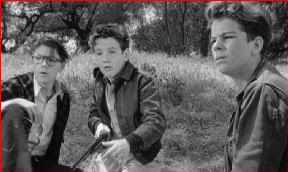
The three boys look at the bobcat
The story is about a boy (eventually played by John Dall) who has a gun fetish. In the opening scene he steals a gun from a shop window, admires it while the alarm blares, then takes off running... tripping on the wet street. The gun goes sliding across the wet street until it hits a man’s boot... tilt up... a *Police*man’s boot. Next scene - the boy in court explaining to the judge how much he just loves guns. He doesn’t feel whole unless he has a gun in his hands. We’ll leave that up to Uncle Sigmund... but that’s what drives the film - this guy needs a gun to feel like a man. At the trial we meet his two best friends - one is the policeman’s son, the other wears glasses so you know he’ll grow up to be a writer - and they tell the judge that our hero isn’t a killer, on a camping trip he couldn’t shoot a wildcat that was hanging around their campsite (great flashback). He couldn’t bring himself to shoot at it. Wow, same problem as Jon Voight in DELIVERANCE! Boy is sentenced to reform school, from there he goes into the army, then he comes home.

Now we have adult John Dall and his two pals - one is now a cop and the other is a writer for the town newspaper. The carnival is in town, so that’s where they go.
Peggy Cummins - trousers so tight there's a visible panty line
The great thing about this film are the set pieces. In case you missed that Script Tip, a set pieces is a big scene. In the old studio days, it was a scene so juicy the studio would pay for a new set to be built. You don’t need a new set for a set piece, you just need a big juicy scene... and even though GUN CRAZY was a low budget film, probably shot on leftover sets that had been used a million times before and real loactions that could be got cheap - and in the case of one set piece, probably shot without any set at all - the film is full of amazing set pieces.

sure - shoot at my head
The Carnival - maybe the same one from THE RING (1927) - has a sharp shooter as it’s main attraction. Sexy Peggy Cummins in those skin-tight pants. She shoots balloons from around her assistant, shoots a cigarette out of her mouth, and all of the other carny tricks you usually see with a knife thrower. The Barker, an aging pretty boy, announces that for a mere $50 you can test your shooting skills against the master... and possibly win $500. Kind of the same deal as THE RING, just with guns instead of fists. John Dall’s buddies put up the money, and we get a great set piece as Dall and Cummins try to out shoot each other... and fall in lust in the process. Because Dall is an amazing shot, the Barker keeps upping the ante in order to win the bet. Eventually it comes down to this insane trick where a crown that holds a half dozen matches is put on Dall’s head and Cummins *lights the matches* with her bullets. All but one. Then it’s her turn to wear the crown. Dall lights them all. Look, I don’t want even the best sharp shooter in the world to be aiming a gun at my *head* from across the room, let alone firing at me six times. That’s just crazy! Dall ends up with a job at the carnival...
sex and violence - the film was made in the 40s, how old are your grandparents - could this be them after doing it?
Now we have a great scene - not a set piece, but a juicy *dramatic* scene that deals with the romantic triangle between the Barker and Cummins and Dall. One of the interesting things is how they used a metaphor to tell us who was sleeping with who. When Dall first joins the carnival, the Barker asks if he has a car... he says no. Cummins wants him to ride with them, the Barker says there isn’t room in their car... Dall can ride with the clown. If you watch who rides with who in the carnival scenes, you can see Cummins and Dall getting together and the Barker riding alone. Which brings us to the big juicy scene where all of this blows up. Real good. The Barker has a claim on Cummins and tells Dall he’s out of here if he doesn’t honor it. The result of the big blow up is *Cummins and Dall* leaving together (in the same car), which leads us to some relationship stuff where they realize they are broke, and then Cummins’ plan to make money...

By armed robbery.
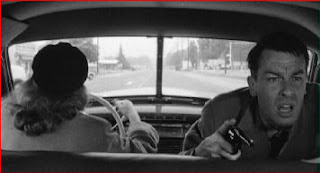
John Dall exits the bank as Peggy tries to sweet talk the cop - all from the back seat of the getaway carNow we get one of the greatest set pieces in low budget history - the “backseat bank robbery”. It’s a single continuous shot - several minutes - taken from the back seat of their car as they drive down the street of a town, find the bank, hope that there is a parking spot, Cummins pulls into a spot near the front of the bank and Dall gets out. After Dall goes into the bank, a cop walks down the sidewalk, stops near the front of the bank! Cummins pulls the car up, gets out, flirts with the cop, and tries to steer him away from the bank. Not happening. This builds suspense. She keeps trying to get the cop out of the way, but he won’t budge. Then the alarm goes off. She hits the cop, just as Dall bolts out of the bank doors with the money.back seat cameraThey get in the car, Dall driving, and now we get a shoot out and car chase from the back seat of the car. All one shot. The great thing about this is that it was probably dirt cheap - we don’t need the bank interior and extras and setting up lights in the location. It’s *one* camera set up. But it gives you the feeling that you are right there - in the getaway car with them. When the cop fires at the car, he’s firing at *you*. And it’s all one cool shot.
John Dall with a bag full of guns and steaks
The big set piece is the armed robbery that will make them rich. Dall thinks this means they can retire to some exotic location and just be together for the rest of their lives. Cummins thinks only about how much money they will end up with. The target for the armed robbery - the Armour meat packing plant payroll. Well before anyone thought of product placement, we get a *real* company name and a *real* meat packing plant. Again, this was probably due to the low budget. They found a practical location and probably couldn’t afford to change all of the signs.

everyone tells him hes in the wrong area including this armed guardThis is one of those split second timed robberies where all kinds of things can go wrong... and do. It’s a tense scene, then it blows up and becomes a big action scene. The great part about it are the pieces of the set piece. Dall drives up in a truck filled with beef on hooks. He gets some steaks from a butcher and puts them in his bag, then walks to the offices and has to get past a half dozen people who tell him he’s in the wrong area. Dall tells them he has the steaks for the boss’s barbeque. Everyone tells him there’s no refrigeration here - he should take the steaks back to the plant. The deeper he gets into the office, the more he and the steaks are out of place. Eventually he gets to the boss’s floor... where Cummins is working as a secretary, Here it’s Cummins who tells him he’s in the wrong place - as she leads him right into the boss’s office, where they kidnap him and have him fill the steak bag with payroll money. And here’s where we see the beginning of the end - Cummins gets trigger happy and shoots a whole lotta people on the way out. It’s a great big run and gun scene - lots of action to break the tension that has come before.

After that set piece they are on the run, and we get a great sequence where they have their last night out as a couple. They go to the Santa Monica Pier and go on carnival rides - bringing us back to the beginning of their relationship. Then they go to a dance hall, and have a nice, tender, relationship scene... not knowing that the police have traced them to California and are waiting outside. They manage to escape with nothing - they even lose some of the clothes on their backs. Only one place to go...

Back to Dall’s home town. Now we get a great scene with the criminals and Dall’s sister’s family.... trying to act normal when people come over. Dealing with kids playing in the yard when you are harboring a pair of fugitives. And eventually a great scene with Dall and his two childhood friends - the cop and the reporter. A low budget film needs big scenes like this one - juicy drama where childhood friends are on opposite sides of the law... and Dall is kind of in the middle. Cummins is all for just killing them- in fact, she’d kill anyone if it allowed them to escape. She’d kill the kids (and that is in the film). In fact, there’s a great unseen scene where Cummins does *something* to Dall’s sister and her entre family - maybe she just locks them up, maybe she kills them all. We never find out which it is, because we come to the other big amazing set piece...

The one that probably has no set!

smoke and tuleDall and Cummins end up chased by every cop in the state, and blood hounds, and posses and probably villagers with pitchforks... but since they are chased through a foggy swamp, we just *hear* all of these things. I’m not sure if we see a single dog - though there may be a stock shot of dogs chasing - but we *hear* packs of blood hounds chasing them. We hear hundreds of cops searching the foggy swamp for them.

The swamp is... well, it’s 99% fog and 1% a couple of thatches of tule grass.
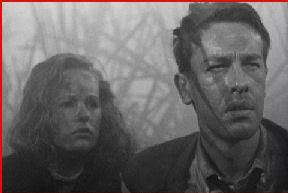
can you hear all of those cops and dogs?
The big scene where they hide and the cops and dogs search - is just them behind a thatch of tules surrounded by fog. And it works! It’s an amazing scene. Probably shot in some warehouse with a smoke machine. Just goes to show you, *imagination* and *inventiveness* can create production value if you don’t have any cash.

GUN CRAZY still holds up, mostly due to the amazing set pieces and great sequences and fairly obvious sexual overtones... oh, and Cummin’s skin tight trousers.

- Bill

Nothing sexual about this


Nothing sexual about this...

Friday, December 14, 2007

Going Postal (part one)


A couple of days ago I spent over an hour in line at the post office. I timed it. Now, this is the holiday season and lines get longer... but I frequently stand in line at the post office, and the problem isn’t the number of people... it’s the post office.

We live in an e-mail world, now, but in the recent past writers spent a great deal of time in the post office. We knew how much things cost to mail, because we had lots of experience. The Writer’s Market book even had a guide to postage in the back, and from that I know how many *pages* are in an ounce of mail. When I first began writing, I wrote short stories. Mysteries mostly. I had a subscription to The Writer Magazine, and eventually to Writer’s Digest (the better of the two). I would also subscribe to any magazine I planed to write for - and usually these were magazines (I already had subscriptions to: Alfred Hitchcock Mystery Mag, Ellery Queen Mystery Mag, Mike Shane Mystery Mag. I would read the stories every month and try to come up with something that matched the contents. The Writers Market gave you the address, the editor’s name (always good to double check with the magazine’s masthead) and the *exact* number of words and the *exact* subject matter... along with payment per word.

So, I would write a 2,500 word thriller with a twist end for AHMM, hoping to get my 2 cents a word... $50! You would send these stories along with a stamped self addressed envelope to return your story when they rejected it (and they always did). But that meant standing in line at the post office so that they could stamp the inner envelope, you seal the outer envelope, and they stamp that. Lots of work!

I would write short story after short story. Mike Shane Magazine paid 1 cent a word, they were located in exotic Florida, and the editor there started sending me little notes scribbled on the bottom of the rejection slips. I had a *huge* collection of rejection slips!

After the movie CARRIE came out, I bought the book in paperback... then continued to buy Stephen King books whenever they came out. I also read every interview with King I could find. He started getting published in men’s magazines... and when I looked up how much they paid in Writer’s Market, I had a new target. They paid *hundreds* of dollars! If I could get a couple of stories published every month, I could make a living!

Now, the odds of getting a couple of stories published every month were pretty low... in fact, the odds of getting *one* story published every month weren’t so hot - there was a writer, his name escapes me, who was famous for having one story a month in print... usually in AHMM. When AHMM and EQMM merged, he moved on up to the higher pay of EQMM (5-8 cents). A 2,500 word story at 8 cents a word is, what? $200? You can’t live on $200 a month!

So the men’s magazines were the key to earning a living. Playboy was the king - they paid $1k for a short story. And look at the guys who wrote them! Ray Bradbury, Isaac Asimov, Don Westlake! Oh, and those literary guys, too. And those were some great short stories - I read lots of them in collections.

And by then, Stephen King had a short story collection come out. By now, I was buying King books hardback, and would drive to Berkeley and stand in line *all day* with Wendy to have a one minute conversation with King as he signed my book. Wendy and I had a collection of Stephen King autographed hardbacks, and a collection of past due notices, and a collection of rejection slips from my short stories. Plus I was spending about half my life standing in line at the post office. Would men’s magazines be my salvation? Could I break in the way Stephen King had, and write my way up to Playboy and eventually the best sellers list?

- Bill


IMPORTANT UPDATE:

TODAY'S SCRIPT TIP: Six Pre Pro Mistakes... and how to avoid them.
Yesterday’s Dinner: Mom's meatloaf at home... part of the home experience.

Movies: ATONEMENT - On Sunday, John and Van and I met in San Francisco to see ATONEMENT, which has now been nominated for a zillion Golden Globes. We went to a brand new cinema in a brand new shopping center downtown - I think last year the three of us wandered around the construction site. The shopping center is huge - and has spiral *escalators* - I do't know how that works mechanically. They also have computerized touch screen mall maps... which don't work. All three of us seperately got lost using these maps. We were supposed to meet at the cinema a half hour before show time. Being the one traveling the farthest, I got there first. John was closest, he got there last. But we all had problems with these computerized maps. You type in the name of the store, and the map is supposed to show you how to get there... but instead it told me to go from level 1 to level 2 to an escalator on level 2N... 2N? I got to the escalator... and there was no sign of the cinemas... because they are on level 5 and the computerized map doesn't tell you to keep riding the damned escalator to level 5. In fact, it doesn't even tell you there is a level 5. It *only* shows you one floor at a time, and never showed anything past 2N. But we all managed to figure it out without the map - eventually you look up and see other floors and you go up and check them out... and on floor 5, the cinemas!

The story of ANTONEMENT is kind of ENGLISH PATIENTy, so some of you will probably think it’s boring as hell... but I liked it.

The film uses all kinds of different story forms - no doubt taken from the novel, from altering points of view to playing with the chronology... and had one of the most amazing tracking shots I’ve ever seen on film. Story begins at an English country estate on the cusp of World War 2 - Keira Knightly is the older sister, just out of college. She has a younger sister, maybe 12 or 13. The younger sister has a wild imagination, and writes stories and plays. She looks out her bedroom window and sees Keira and the hunky gardener (James McAvoy) standing next to the fountain. The Gardener makes some threatening gestures, and Keira *strips down to her underwear*! Then she jumps into the fountain, and her underwear becomes transparent! The sister looks away, thinking that the Gardener must be some sort of sex fiend.

That’s when the film zips back and shows us the exact same scene from Keira’s point of view. She has dropped something valuable into the fountain, asks the hunky Gardener to retrieve it for her, he jokingly refuses - gesturing for her to retrieve it herself. She says fine, strips down to her underwear, jumps in the fountain to retrieve the lost article, comes out... and her underwear is embarrassingly transparent, throws her clothes back on and storms away. All completely innocent.

The story does this a couple more times - showing us a character's point of view, then zipping back to show us a different character’s point of view. We see how different points of view can lead you to see the exact same action differently. When you only see part of an event, it can seem as if something entirely different is happening. Perception of the event is everything. Eventually an event occurs that creates a major story conflict - and *we* know that it has been misinterpreted. *We* know that things are not as they seemed... but we also understand how from that one particular point of view, the event was shocking and scandalous...

Then the story begins playing with chronology. It jumps four year ahead in time, showing MacAvoy (the Gardener) and the scars this event has left on him... He is now a soldier on the front lines in France during WW2. Wounded, he and his men just want to make it back to the pick up point where a ship will take them back to England.

Then the story jumps *back in time* six months, to show Keira Knightly working as a nurse in a London military hospital... and the scars the past event has left on her.

We keep jumping back and forth in time between the two, until we reach a point where we jump *forward* in time to see what has happened to the younger sister... and see her point of view for a while... and, of course, the scars the past event has left on her. Now a young adult, she is living in London, working as a nurses assistant in a military hospital, searching for her sister and MacAvoy.

These three characters are entwined in a story, and we jump back and firth between story threads, knowing that they all come together at the end.

Along the way, we get one of the most amazing tracking shots I have ever seen as MacAvoy and his men see the chaos and horror of war... in one never-ending shot through absolute hell. Completely amazing.

Another cool thing this film does is make everything completely logical - in one scene a character is opening a window to release a buzzing bee and sees something, in another scene a character spots a dropped piece of jewelry by a door, which leads them to open the door and see what is on the other side. This does a great job of removing coincidence from the story - one event leads logically to another.

I did not like the end of this movie - it does something that yanked me out of the story. Maybe the ending will work for you. It’s an interesting film, and tells its story using an interesting method. Changing points of view and playing with chronology.

After the movie, John and Van and I walked around looking for a place to eat. We went to a sports bar we had gone to before... it was packed. So we wandered some more and ended up at the old standby - Mels Diner. You know, from AMERICAN GRAFFITI. And if you didn't know it, walk into Mels and they'll make sure you know it. Wall to wall posters and pictures and even model cars from the movie.

After dinner we walked back to a high end bar where we had once celebrated New Years Eve several years ago. The place is the same, the waitresses have changed... but kind of stayed the same age. It's as if once a waitress is older than 28, they retire her and hire a new mid-20s waitress. We all flirted with her, but Van has this amazing gift - and he got a hug and kiss on the cheek when we left. I don't know how he does that. If I did some of the stuff he does, I'd be arrested or slapped. He gets a hug. Anyway, many beers later we left... and I took the BART train back.

DVDs: I've seen a bunch of movies on DVD, and I'll be filling in each part of this 4 part post with some info on them.

Pages: Yesterday I blasted out over 5 pages of brand new material on a script I've been rewriting. This script is *20* years old and really needs a rewrite. As I mentioned in an earlier entry about NO COUNTRY FOR OLD MEN, the problem with this old script was the *obligatory scene* was missing. I probably thought it was clever at the time - have the whole story leading up to this one big amazing scene... then just leave out the scene. If I were to see a movie that did that, I would want to beat the writer to within an inch of his life. So, to prevent myself from being beaten by audience members, I needed to write this scene. The most important scene in the script. The most complicated scene in the script... and I have just kept putting it off. Until yesterday - when I just *forced* myself to write it. My plan was to write a crappy first draft and fix it later. Instead, I fixed it as I went, and I really like how the scene turned out. One of the unexpected things about the scene is that it ended up providing a big dramatic moment for the *villian*. It humanizes him... which makes him more frightening. He's a real flesh and blood person - who shoots people in the head when they make him angry. That's better than a 2D villain who kills people because it's part of the job description. Anyway, the scene kicks ass and I really like it. Still needs some work, but it's better than I thought it was going to be... and it's DONE!

- Bill

Friday, December 07, 2007

Old Friends And Hollywood Friends


Sorry I haven’t been posting more, but I’ve been recording and editing new audio classes and hanging out with old friends. That’s the great thing about being in my home town for an extended period - I have more time to hang out with friends.

I have two groups of old friends - the folks from that big table at the back of Denny’s from my film student days who are still around, and the guys I used to work with. Over the years, the guys I used to work with have scattered - all of them have new jobs, most of them have moved. I used to visit my old boss every year and go out for beers with a few of the warehouse guys - but that was several phone numbers ago. Used to be, people had a phone number, they had it for life. My parents still have the exact same phone number as when I was a kid - only the area code has changed. Now, people change cell phone companies and land-line companies every year - and their numbers change with them. They move every few years - a new apartment, then a starter home, then a new home, a few missed payments and they’re in an apartment somewhere, then a condo somewhere on the outskirts of town where you can still afford a place. Or maybe they took a new job in another state. Or got married and moved away. Or got divorced and moved away. All of those phone numbers, all of those addresses - I’ve lost track of all of those guys, now.

The people I haven’t lost track of, that I see every year and talk to on the phone about once a month, are the film guys. Sure, some are MIA, some I just don’t talk to, and some have been banished... but the handful that are left I’ve been hanging out with. Paul lives in another country, now - but I saw him when he came to LA a couple of months ago for the You Thought They Were Dead Actor’s Autograph Convention. I plan on seeing Bruce sometime while I’m here - he was the TA for the DVC Film Appreciation Class before Tom Ross and I took over... I wonder what happened to Tom Ross? Anyway, the main two guys left - my oldest friends - Van and John. I’ve been hanging out with them since I got here.

DVC - Diablo Valley Community College - still in the news for the Sex For Grades scandal. Never had anything like that when I was there - or, maybe they did... the reason why they needed two teaching assistants is that the teacher was often with some female student. I assume the female student passed the class - so I guess that was sex-for-grades.

Anyway - I’ve known Van and John forever. Sometime I’ll tell some stories of the months after my first film NINJA BUSTERS limped to a finish and killed my first screenwriting career and Van and I did carpet and linoleum to pay the rent. That’s still Van’s day job. John does construction - mostly home remodels. John could retire any time he wants - a few years ago he bought a fixer-upper duplex in San Francisco and turned it into a 8 unit apartment building. The rents not only pay for the place, but supply John with an income. He took a year off and made short films - entered them in contests - won a couple. But missed having his construction crew nail his feet to the roof of a house before lunch, so now he’s back working on houses.

The three of us are going to do dinner and a movie on Sunday, but I’ve already seen a couple of movies with John and spent a day hanging out with Van eating pizza and drinking beer... and talking movies.

Whenever any of us get together, that’s what we talk about - movies. And if the movie is from the 1980s or late 70s, chances are we all saw it together. We are the “survivors” of a big group of film folks that went to the Capri (Crapy) movie theater in Concord once a week... and a couple of other theaters in town as well. The Century in Pleasant Hill, where I was acting manager in High School, the Festival in Walnut Creek and the Regency in Pleasant Hill. There would be days when I’d just be driving down the street - maybe heading to Hop Sings Chinese Take Out (no tables - just take out) and see Van’s red Bronco in a movie theater parking lot and pull in... then wander down the aisles until I spotted him. I remember the day the forklift ran over my foot and the boss made me complete my shift. I drove to the Crapy - my foot swelling up like crazy - and pulled into the parking lot... found John, Van and the rest of the gang in theater, and they took me to the emergency room. I had no idea they would be in the theater - nothing planned - that’s just where you might expect to find them. Anyway - we saw *thousands* of movies together.

Now, here’s the strange thing... these two guys know more about movies than my friends in Los Angeles... who are in the business (or trying to break in). Not just the watching movies part - they know more about *making* movies.

HOLLYWOOD FRIENDS

I have a handful of people I hang out with in Los Angeles - and whenever I actually think about them, I wonder if it’s time to “upgrade”. My Hollywood Friends fall into two categories - screenwriters I’ve known since moving to LA and people I know from my neighborhood. There used to be a guy who was a member of both groups, David, but he finally quit trying to break in and broke out - he lives in Texas, now. The people in my neighborhood are all on the fringes of the biz or trying to break in. Actors, writers, directors... and some production people. After a couple of times hanging out with Van and John I realized they know more about movies than the guys I know in LA who are *working in the business* or trying to break in. And that makes no sense to me.

All of the breaking in director guys I know - some I’ve talked about here - aren’t guys who can hold up their end of a conversation on film theory or film history or even just film making. One director I know is completely unable to think visually, and just sets up the camera and has the actors act in front of it. The result looks like a filmed stage play - you keep looking for the proscenium arch on the sides of the screen. And he’s constantly breaking the 180 rule. And *not* shooting close ups of *objects* even if they are critical to the scene. Often his films have these weird jump cuts - because he has nothing to cut to except the exact same shot from the same angle. And he’s directing low budget movies.

CROSSOVER NIGHTMARES

John and Van and I know a director working in the biz (actually, we know a couple) - this is a hometown guy who began making short films. It’s strange, because he wasn’t someone who was a movie addict, and you could never talk movies with him - he’d hardly seen any. But he decided to make short films one day. I helped him on a couple, then stopped. A local actor who John and I both know ended up starring in some of his shorts. His shorts did not win awards... but he *did* use them to find funding to make more shorts. It was strange on his film sets - he seemed to have no idea what he wanted. You’d set up shot after shot until he found the one he liked. And he wasn’t able to communicated very well. The films of his that I worked on were disasters... and tough on the friends he rounded up to crew for him...

A couple of years ago he called me - he had just moved to Los Angeles to further his film career. I’ve had dinner with him many times since he moved to LA... and he now knows how to fake talking about films. He’ll gush over some director, but the more you talk to him the more you realize he’s never seen any movies from this director - he just knows the name. Maybe he’s read a synopsis of their important films. But he still doesn’t seem like a guy who loves movies - or even likes them. I have no idea what his motivations for becoming a director are. Anyway, he found an investor and made an indie film that came out on DVD... and it was the topic of conversation one of the days John and I hung out.

John and I discussed *film making* and this guy’s films in a way the director and I could never discuss. We talked about his shot choice - which makes no sense. We talked about the emotional reactions of his characters - which make no sense. We talked about his complete inability to create suspense or reveal information - probably because he has no idea what shots are required, and has never actually watched any suspense films (just read the synopsis). We talked about a scene in his film that didn’t work, and John came up with a great idea to make it work that was different than the idea I had come up with.

A couple of days later, Van and I are in Melos Pizza in Pleasant Hill talking about the same movie, and Van comes up with a third great idea on how to make that crappy scene work. So there were all kinds of ways to make the scene work - but the director couldn’t come up with any of them. Van and I talk about some other scenes from the film, and again - we can discuss the “mechanics” of the scene from a film maker’s perspective - how the shots need to add up, what shots and angles and camera moves you need, what real people would do in this situation and what things they could do that would create a reaction in the audience.

After seeing the film at the premiere, I talked to the director about the same scenes... and it was like speaking to someone from another culture. The most obvious thing in many of these scenes was that the characters did not react like real people react. He blamed all of this on the actors. In fact, he blamed everything on somebody else. Except this guy wrote the script, cast the film, directed it, etc. No one else to blame - he was in charge! One of the things we all mentioned was a fight scene that was shot in a master and not a single punch even came close. After the premiere, I asked him about this, and he blamed the two actors. Um, that’s why you shoot all of those close ups of punches landing - so you can cut to them when the wide shot makes it seem obvious that the swing was a complete miss. That’s why you don’t just shoot a master - but do that Robert Rodriguez thing where every take is a different angle, so you can cut it together and have lots of different shots - using the speed of *editing* to make up for the slow punch swings. But I’m sure the director never saw EL MARIACHI or watched any of the RR film lessons on the DVDs or read REBEL WITHOUT A CREW... he just read the synopsis so that he could “pass” as a guy who knew what he was talking about when he was talking to other guys in the biz who only read synopsis.

Where is the fun in that? Why would you want to *sound* like you have seen a film, without the pleasure of actually seeing it? Why would you want to gpthrough the hell of making a film, if you don’t love films?

The more I talked to both John and Van about this film, the more I realized that the obvious solutions to all of the film making problems could not only be solved in a number of different ways - but the director didn’t think of any of them... and my friends back home who probably thought they weren’t talented enough to go to Hollywood and make film, could. Woody Allen was right, 98% of success is just showing up. This guy showed up in Hollywood, and now he’s got an indie film on the shelf at Bloockbuster.

Crap.

Pisses me off and also makes me think I’m blowing it.

Because *I* know more than these Hollywood guys do, and yet if someone were to offer me a director job tomorrow I would think I don’t know enough to be a director. Because I know how much you really have to know... as opposed to these ignorant guys who have no idea how much they don’t know. I have to *think less*... and show up more.

So that’s going to be a New Years Resolution I’ll probably forget by the end of January.

Meanwhile, I’m having all kinds of great conversations about film - the kind I never have in Los Angeles - here in my home town. Van and I had a great conversation about Joseph H. Lewis’ GUN CRAZY - that bank robbery scene that was all shot from the backseat of the getaway car - while having a beer or six at Farrington’s Bar in Pleasant Hill. Farrington’s is in a strip mall where the Pleasant Hill Motor Movies used to be and features all kinds of pictures of the old drive in, plus movie posters and art from the drive in.

Joseph H. Lewis is one of those guys who knew how to turn a no money movie into *art* back in the late 40s and 50s. That lead to a discussion of Lewis’ BIG COMBO, and the way he used fog to cover the bad sets - or lack of an airport in the big airport scene. Shot it in some warehouse and claimed it was an empty hanger at the airport, fogged the street outside the warehouse and put in a strobing searchlight and airplane sounds. You’d swear you were at an airport. And that lead to a discussion of the end of GUN CRAZY, which also used fog to cover a lack of budget. Our fugitive Bonnie & Clyde type couple escapes into a marsh... and as they hide in the fog, we hear dozens of dogs and hundreds of policemen searching for them. Can’t see all of those people because of the fog, but we hear them. And that might seem like a cheat to you, but it works really well because the fog is a *plus* - we worry that the policemen may be closer than we think. Any moment, they could break out of that fig and capture our couple. Okay, none of my friends in LA could discuss these films... which is why I’m thinking I need a “friend upgrade”. I casually know people who probably have seen all the Lewis films - I need to hang out more with *those* people and less with the others.

My old friends, my film friends from my hometown - we’ve *really* seen all of these movies. We can really discuss how and why they work (or don’t). And that’s the best part about this extended holiday vacation - I get to talk film after a year of just talking film business in Los Angeles. Nothing gives me more pleasure than talking about films... except seeing them on the big screen.

- Bill
IMPORTANT UPDATE:

TODAY'S SCRIPT TIP: Ummm, something? All I know is that *Monday* I have a new tip on SUPERBAD.

Yesterday’s Dinner: Some Mexican place on Grand Avenue in Oakland a couple of blocks from the Grand Lake movie theater where John and I saw BLADE RUNNER. I had the taco plate - kind of disappointing. The food seemed home made in the worst sense - I kept thinking that I could have made these tacos myself. The rice was kind of blah and the refried beans were *runny*. When you spend money for food in a restaurant, you want the food to be something special, something that you *couldn’t* throw together at home in a couple of minutes. After dinner, John and I had a couple of beers at Smitty’s Bar on Grand - a place that has probably been there for a hundred years.

Movies: ENCHANTED. A really fun film that manages to be both cynical and romantic. I love how there are parallels between fairy tale land and NYC - like the horse drawn carriages and the grand ball at the end. If you *hate* fairy tale movies, this is the film for you because so much of the humor comes from fairy take characters having to deal with ugly reality. Nothing is more fun than seeing some fairy tale Princess get mugged by a dirty smelly homeless guy. If you *love* fairy tale movies, this is the film for you because it becomes a fairy tale in real life by the end. And you’ll just want to break out in song in public... and wonder if cockroaches really can clean tough soap scum stains from your shower.

Movies: BLADE RUNNER: FINAL CUT. First, let me set the stage.... John is doing a remodel job in Oakland, so we decided to catch a movie at the old Grand Lake. A huge movie palace from the 1930s that seems big enough to house the entire population of Oakland. Huge, beautiful, ornate. I took the BART train into Oakland’s 19th Street station and walked around Lake Merritt to the theater - a beautiful walk full of memories. I passed Children’s Fairy Land, a special place to go on your birthday before you became a teenager and thought it was silly. The lake itself - an oasis in the middle of Oakland. No paddle boats yesterday because it was sprinkling. After a wonderful walk, I grabbed a coffee in a place next door to the cinema called Day Of The Dead Café. Had a conversation with a couple of locals about the Raiders - total strangers... I think that’s the cool thing about sports and movies and TV - it’s common ground for conversations with people you don’t know... and something you can share. Brings us together. John shows, we go to the cinema, it’s *free popcorn night* - sweet! The Grand Lake has been chopped into 3 screens, now - two downstairs and one upstairs. BLADE RUNNER was playing upstairs in what used to be the balcony... I swear, as many seats up there as in the biggest cinema in Burbank! Houselights lower, the movie begins....

Okay, I’m gonna get flack for this, but the more I see BLADE RUNNER, the less I like it. When it first came out, the special effects were amazing, but the story and over-production design aspects were disappointing. As years pass, the FX work (still great) has kind of faded - so many movies these days have *tons* of amazing FX work, that the novelty has worn off. That makes the over-production designed aspects really stick out - the over-the-top wardrobe and hair, the *indoor* rain and mud and filth in a building owned by a genius tech guy who is probably a billionaire. The anti-tech equipment that looked like an antique in 1977 when the film came out. And just the *lack of logic* behind the production design and costuming. Rachel is dressed, hair styled, and made up to look like a freakin’ Mattel doll, and we’re supposed to be surprised that she’s a replicant? None of the other Repicants look and act that fake.

Every room is *filled* with dense smoke - even if the characters don’t smoke. There is junk and clutter everywhere - and even a small apartment has a piano! The top scientist dude lives in a dump where it rains indoors and dresses like an escapee from a Village People video. And when we get to the story - you’d think one of the things they’d do in the “Final Cut” would be to remove the duplicate scenes. M. Emmett Walsh gives the complete back story on the four repicants once in his office, then again - almost word for word - in the screening room with slides. Harrison Ford is *amazed* that Rachel has had a memory implant, and Tyrell says it’s something brand new - yet Roy Batty and all of his crew have had memory implants... and Roy is 4 years old. The very next scene after Ford is amazed at the concept of memory implants, he knows all about them and tells an overly-production-designed Rachel every single memory she has... you see, only a scene later knowing all of the false memories and where they came from are part of Ford’s job... and he spits them out just like he does every other day.

And I still have no idea how Edward James Olmos knows what Harrison Ford was fantasizing about - how can anyone know what another person is thinking? Let alone *why* Ford would think about unicorns, or why - if that was implanted - they would decide to have a tough guy think about unicorns. Or why hire a replicant to be a blade runner, or... well, nothing is logical in this film. If you really look at the story, it makes no sense - Brion James is wearing a hospital gown when he’s being scanned in the opening scene - but has managed to smuggle in a gun. Um, I don’t want to know how he did that, but if *I* were looking for dangerous replicants who had killed a whole bunch of people, I might have the suspects pass through a metal detector. Later, Ford finds photos in his hotel room - but not any sort of real photo - the one that ends up being a clue is a photo of an empty hotel room. Um, who takes photos of an empty room and thinks they are so valuable they will risk their lives going back to retrieve them? The empty room photo has a stupid clue - in the mirror is a reflection of a woman off camera- Joanna Cassidy. Ford takes the photo and a snake skin scale that was *easily found* in the hotel room and without much work - just some time killing - traces them to Joanna Cassidy. She escapes, there’s a big chase, he shoots her, in this new version they have *Cassidy* - not the burley stuntman - crash through the window and die on the sidewalk... where Brion James is waiting to meet her. Huh? How could he be waiting to meet her there if this was where the chase ended? Makes zero sense.

A similar nonsense scene happens a minute later where M. Emmett Walsh tells Ford that Rachel has split - no one can find her... and when he drives away, she’s standing *right behind his car*! Man, if Walsh had just looked through his car window, he could have captured her! Okay, how did Rachel know to be there? Or, *why* was she there? The story makes no sense!

Batty and Brion James go to see eyeball guy James Hong to find out how they can extend their lives. Hong says the only one who can hep them is Tyrell... and this is new information for them... except the opening scene is Brion James being scanned because he’s infiltrated the Tyrell Corp to get to Tyrell. Later, they tell Sebastian that Tyrell is impossible to get to and they need his help... but Sebastian basically just saunters up to Tyrell’s *bedroom* with Batty. Easy to get to. No security at all. Just an elevator that pauses before Tyrell gives the okay. The elevator doesn’t have a freakin’ *camera* in it, or sensors, or anything else. There’s a video pay phone in a bar, but no camera in the elevator that leads right into the richest man in the world’s *bedroom*. And he has no guards or assistants or even a panic button. You know, when Van and I were installing carpets a few years after this film came out we did a bunch of dentist’s offices - and they had alarms up the wazzoo - pressure alarms under the carpets, door alarms, etc. All of that because they had laughing gas that might be stolen. It’s as if no one ever thought through anything in this story... and didn’t worry about things like duplicate scenes when they made the Final Cut. Second time I’ve seen the FINAL CUT... and I thought the first time I wasn’t thrilled because I may have been in a bad mood. This time I was in a good mood... and liked it even less! Okay... now I expect a million responses that I just don’t understand the brilliance of BLADE RUNNER.

DVDS: All three CREATURE FROM THE BLACK LAGOON movies. First one, pretty good. The music is way over the top, but it has some real suspense and real thrills and actually has an environmental message (great shot of a cigarette butt being thrown into the lagoon... camera dips underwater to show the Creature looking up at the butt and garbage floating in his pool). Second movie REVENGE OF THE CREATURE - great idea - Creature at Marine World on display. Science poking and prodding. Way too much exposition, but makes up for it with suspense and hand-on-shoulder shock moments (about two dozen of them - everyone in this film enters a room by sneaking up behind the person on camera and grabbing their shoulder!). Great scene with a lost dog in the darkness... and the creature lurking. Third film CREATURE WALKS AMONG US - almost impossible to watch it’s so bad. It’s all exposition - people sitting around table on board a ship *talking* about what happened. And the dialogue is just awful. The characters are cliches of cliches. Nothing scary. Hey... and the third film was the one written by Gary Ross’ father. Yikes!

Pages: Editing audio and working on the book rewrite.
- Bill

Thursday, November 29, 2007

The Wall


Not the Pink Floyd movie directed by the great Alan Parker (which I need to add to my DVD addiction) but that one you hit when the brain says “No more, reached your limit, time to take a nap.” Yesterday I hit it.

It’s been a long time since I hit the wall, and I’m wondering if that’s a bad thing. Maybe I should be pushing myself even harder than I already do? Maybe I should frequently test the limits?

But I’m more of the tortoise than the hare - I know that I can easily write 5 “good” pages a day... and get that up to 10 a day if required by some crazy deadline. And 5 pages a day gets me a first draft in a month and usually allows me relax time. It’s like working a real job - you put in the hours, and you have time for a beer afterwards.

The last time I hit the wall was a couple of decades ago when I wrote 27 pages in one day... and then my brain just shut down... for a couple of days! That was an experiment in seeing how many pages I could write in one day. Not nonsense pages that hit the trash can the next day, but pages that would part of the script until *this* day.

But I’m not sure I could write 27 pages now. I’m not as young as I was... and I find myself having to think of things more than I used to. A large part of that is that I think I am a better writer, now, and if I were to re-read those 27 pages I would say, “This is complete shit!” and do a page one rewrite on that script. I say that about most of my old scripts, anyway. Now I really consider every line when I write it - and often every word. Even in the first draft. I think more about the characters, the subtext, the situations. I know what is likely to make an impact on screen and what will probably just sit there like a carp. So I’ve lost some speed and gained some accuracy.... and I can still easily do 5 pages a day (so I’m not one of those “it took my seven years to write my masterpiece screenplay” guys - and when you read their script, “master” is not the word you use with the word “piece” usually). I can still crank it out - it’s just better sausage, now.

Though this hasn’t been tested by an insane deadline in about a decade, I’m pretty sure I can still do 10 pages a day and whip out a script in 2 weeks. I wrote GATORBABY over the Christmas holiday a couple of years ago - it was about 12 days of writing... but with extra days off for those pesky holiday events. It wasn’t a *sustained* 10 pages a day. I had lots of time to recharge the mental batteries.

So, I’m home for the holidays (and one of my nieces getting hitched) now, with no deadlines and no deadlines on the horizon. Nothing to do but work on specs, new tips, finally rewrite the action book, and record and edit some new audio classes. No picketing going on in my home town, so I’m not on the line. I’m almost done with a new spec (SLEEPER AGENT - some of you read along as I was writing it) and set that script aside for Expo and a handful of other responsibilities. Now I’ve pulled it out to finish it... and I can’t remember what the hell I was doing with it. I also set it aside at the exact wrong point - at the end of a scene... in fact, the end of a “chapter” in the story. Now I have to start the ball rolling again after a complete stop and I’m not even sure which is the best way to push it. So I’ve been struggling with that spec - making no progress - and I decided to work on something else... an old script that needs a page one rewrite. It had been on the long list of old gold scripts - the ones that need lots of work, but have been out of circulation for so long - when I do the rewrite they are like new scripts - no one has read them in *decades*. I have a huge stack of these scripts - kind of a hidden stockpile of salable material. All I have to do is apply nose to grindstone and rewrite them.

So I started on this rewrite - and one of the things I decided to do was completely change the characters from almost-cliches to what’s probably a different kind of cliche, but one that I can flesh out better and make more original and individual. The other big change was location - from New York (never been there) to Oakland, CA (was there two days ago... and lived a few miles away for most of my life). I think it’s interesting that when I wrote this script (and many others) I always tried to drop the story into some sophisticated setting to make *me* look worldly and sophisticated.... but now I just want to stick around the house and use places that are “home” and situations that are “home” in my scripts...

Oh, wait, SLEEPER takes place from Turkey to Paris - places I’ve never been - and deals with spies and terrorists. So maybe I’m still doing some armchair adventure.

Anyway, I was *ripping* through this rewrite, and then I realized something. The whole script is leading up to one big juicy scene... that’s not in the script. The events after than scene are in the script and the events leading up to it - but not the scene. Now, I wrote this script so long ago that I may have thought it was *clever* not to show that scene - I don’t remember. Today, I think the audience would try to find me and kill me if I left that scene out. My friend John and I went to see NO COUNTRY FOR OLD MEN, and both of us were pissed off that they didn’t show a pivotal scene - just the aftermath. It’s like MISSION IMPOSSIBLE 3 - the whole story is about how impossible it is to break into this place and steal this thing - a million alarms and guards - and Tom Cruise gets in and out... and we don’t see any of the details, They left the impossible mission part off screen! I felt cheated. And I didn’t want anyone to feel cheated by *my* script, no matter how clever it made me feel. So I’d have to write that scene.

Now, if this were a screenplay, I would have hit the wall writing that scene. But this is real life. It’s messy. It makes no sense - and doesn’t have to make sense. So I *avoided* writing that scene by writing something else.

No, not the last scenes of SLEEPER... this is messy real life.

I worked on a completely dead project. One I hadn’t even thought about. And found my new wall seems to be 18 pages. Completely from scratch pages. And I finished those 18 pages at about 8pm last night... then went into a walking coma. My brain shut down. I could not tell you what 2 plus 2 equals. I could not tell you my name... let alone could I tell you anything about the Ipcress File. I was a zombie.

I thought if I walked to the local Starbucks and drank some peppermint hot chocolate and went online I might be able to get my brain going again. No luck. I basically just sat there, drooling. I was Randall McMurphy at the end of ONE FLEW OVER THE CUCKOO’S NEST. So, that’s the new wall number - 18. If I ever need to crank out 18 pages on a script to meet some deadline, I can do that... then, probably sit there and drool for the next couple of days. I’m writing this, just to make sure I didn’t do permanent brain damage. I can report - but it may take a day or two before I’m up and creating.

So that big scene in the rewrite and the end of SLEEPER will have to wait.

- Bill


IMPORTANT UPDATE:

TODAY'S SCRIPT TIP: Character Creation, using GHOSTBUSTERS as an example.
Yesterday’s Dinner: Chicken Ceasar salad at La Scala in Walnut Creek.

Movies: Saw NO COUNTRY FOR OLD MEN, and as mentioned - the “obligatory scene” isn’t in the film... but then, The Dude didn’t get a replacement for his peed on rug at the end of LEBOWSKI, either... and that rug tied the room together. That’s one of those terms nobody uses anymore - “obligatory scene”. Hey, it’s obligatory for a reason!

DVDs: Watched all kinds of stuff on disk over the past few days - some early Hitchcock like THE 39 STEPS... still holds up. One thing that is amazing about this film are the “gags” - there is a density to films from the 1930s that we seem to have lost. Little details that are obviously the work of the writer.


Here’s an example - our hero is on the run for murdering a woman who was actually a spy.... he is captured by two men who claim to be police, but are really bad guys.... and escapes handcuffed to the woman who helped capture him. She is the leading lady - but at this point she thinks he’s an escaped killer. They check in to a B&B for the night... and there must be a dozen gags with those handcuffs. To hide the cuffs, our hero places his hand in her coat pocket. He can’t sign the register, so she has to. He can’t take the keys. He can’t shake hands. He has to use his other hand to eat and drink with (and can’t do both at once) and the topper - the one everyone remembers - when the girl takes off her stockings, his hand has to rub against her legs! But there are probably 5 or 6 more gags having to do with those handcuffs - they have to sleep next to each other in the same bed, and neither can roll over without pulling the other one, etc.

And while all of this is going on - there are about a dozen gags with the innkeeper and his wife playing out downstairs about the “runaway couple” and how in love they are... and keeping the register from the bad guys when they show up looking and kicking them out because they can’t serve drinks after hours - basically, a bunch of gags about running a B&B are going on downstairs while the leg-feeling is going on upstairs. The *density* of this scene is amazing.


DVDs: Hitchcock silent film THE RING... also holds up. Almost no “dialogue cards” in this film - visual storytelling. Story is about a boxer at a carnival, “One Round Jack” who will fight anyone in the audience for a price... and if they win, they win some huge amount of money. The girl selling ticket’s is Jack’s fiancé. We see a bunch of guys get knocked down by Jack within moments of entering the ring. The “Round 1" card is dirty, torn up. Then a Big Guy starts flirting with Jack’s fiancé. Jack is jealous, goads him into paying to fight him. The Big Guy gets in the ring... and puts up a fight! After the first round, they put up the “Round 2" card and it’s brand new - never been used before!


Now you see the fiance at the ticket window and a big roll of tickets... which spins into a very small roll as a crowd buys tickets to see the fight. When the Big Guy knocks Jack down and wins the fight, the carnival guy doesn’t have the promised winner’s money - this has never happened before! He has to go around collecting money from other carnies.

The Big Guy uses his winnings to buy a piece of jewelry for the fiancé - a gold band that goes around her upper arm. He flirts with her and gives her his card... he’s a professional boxer. Jack sees the way his fiancé looks at the Big Guy - so he proposed to her.

They get married - and we have a different kind of ring. It’s a funny wedding - a *carnival* wedding - so we get a dozen gags just in the scene where the guests are being seated, ending with the topper: Siamese Twins, one wants to sit on the groom side, one wants to sit on the bride side.

After the wedding, Jack just isn’t his old self in the boxing ring. You can figure out the symbolism of that on your own.

And you remember that gold arm band the Big Guy gave the fiancé? It keeps sliding down her arm and covering the wedding ring. There have got to be a half dozen different scenes with that gold band *showing* us the fight between Jack and the Big Guy for his fiance’s heart - two pieces of jewelry fighting it out.

Failed fighter Jack quits the carnival... and ends up becoming the sparring partner for the Big Guy as he makes the Big Guy run at champion. Jack’s job is now to get beaten up on a regular basis by the guy who made passes at his fiancé... now wife.

Well, kind of now wife - because she is less interested in Jack The Loser and much more interested in Big Guy The Winner... and starts an affair with the Big Guy! Now Jack is beat up by the Big Guy every day and goes home to an empty bed. You can see why they didn’t need many “dialogue cards” - this story is told through the actions and situations.

And I’ll bet you can tell where this story is going... Jack is going to have to get into the ring again, and work his way up to fighting the Big Guy (who will be champion by this time) in order to win back his wife. This was in the days before Viagra, you had to fight your way back.

There’s a great visual for Jack’s rise from nothing to contender - outside the big boxing arena there’s a huge wall-sized sign listing the weekend’s bouts. Jack begins at the very bottom of the sign in letters so small you can barely see them... then with every fight we see, his name moves up on the sign and the lettering becomes larger, until he is on the line just below the Big Guy in lettering almost as big. Again - this is a way to *show* his progress and *show* what these fights we see mean. No one has to say, “Hey, if you win one more fight you’ll be a contender for champion” - we can see it on the sign outside the boxing arena.

There’s a scene in the film that really choked me up - amazing how a scene from a movie made in 1927 can do that to a viewer in 2007. Jack wins the fight that bumps him up to the same line as the Big Guy and celebrates with his entourage. The entourage is an interesting bunch - they are the same guys who were part of the carnival boxing crew, and Jack has brought them along on his rise to contender. So we’ve had a whole movie to get to know them. By now, they are *our friends* as well as Jack’s. So Jack invites them back to his apartment to celebrate, and can’t find his wife. She’s not in the kitchen when he gets the champagne and glasses, so he searches the bedroom... she’s not there either. Well, not in *his* bedroom. So there’s a big embarrassing scene where Jack looks at his watch waiting for his wife to return before they drink the champagne... and his friends wait... and they *know* his wife is somewhere with the Big Guy... and the champagne in the glasses goes flat - we *see* it go flat. Then it gets late and the friends all have to leave - flat champagne untouched in the glasses. It’s a heart-breaker. Your tear-ducts get a work out. But it also primes you for the championship bout with the Big Guy.

And I’m going to give away the end - after that big championship bout, the Big Guy’s trainer finds the gold arm band discarded ringside - just thrown away - and gives it to the Big Guy. Okay, what has that shown us?

Pages: 18 big ones, baby!

Saturday, November 10, 2007

Writers Get No Respect On News

So, on Friday, while I was having lunch with a friend that couldn’t be cancelled or rescheduled, there was a massive rally at 20th Century Fox. Somewhere between 3,000 and 4,000 writers in a great show of solidarity... and a great call for the studios to come back to the bargaining table so we can hammer out a contract and ends this thing.

Because I couldn’t be there, I got the play-by-play online... and watched it broadcast on the evening news. Great helicopter shots of a mob of screenwriters. Ground level shots of the massive crowd of screenwriters. And interviews with about four...

Actors.

Kelsey Grammar and three other name actors were interviewed about the strike on the news, but not a single screenwriter was interviewed. I mean, even when they had a clip of the Governor talking about how he hopes the strike will end soon, well, he’s an actor, too!

So, even when the story is *about writers* they only pay attention to the actors.

That’s just screwed.

THE PETITION

If you wish to support screenwriters, take a minute and sign this petition, and pass it along to everyone you know:

http://www.petitiononline.com/WGA/petition.html

STRIKE COVERAGE

Since 99% of screenwriter's blogs are now devoted entirely to the strike, I've decided this blog will be like that TV station that had regular programming during Hurricane Katrina and 9/11 and the California Fires. So this will be the last strike post, unless something really noteworthy happens or I find something to say about the strike that all of the other screenwriter blogs haven't yet said. Please support the WGA.

- Bill

Wednesday, November 07, 2007

WGA Strike Stuff
For Writers Trying To Break In

Lately I’ve been answering a whole bunch of strike related questions on message boards, so I thought I’d set down my picket sign and put together a blog entry on the subject. I did a script tip on the strike a few weeks back (before there was a strike) and this will probably repeat some of that information.

WHAT IS THE WGA?

Some of you may have heard the Writers Guild Of America is on strike. The WGA is a labor union, just like the United Auto Workers. Basically, once you sell a script to a union signatory company, you have to join the union. And that’s a good thing - the union is designed to protect the writer from being exploited. So they set up a minimum wage for writers and workplace rules to protect us, and a pension fund and health plan. The union is really just all of the members - if a studio tries to exploit one writer, all of the other writers (the union) back that writer up. A union of writers all looking out for each other. Every 3 years they get together with the studios and hammer out a new contract. Just like the United Auto Workers, they try to get raises and keep the studios from slashing heath & pension funds... unlike the UAW, there are often creative issues involved in the contracts. You know, until a couple of contracts back, writers were not allowed on the sets of their own movies, not were they invited to the premieres of their films. The WGA fought for those things and won them.

WHY STRIKE?

The contract was up on October 31st, and despite negotiations before that date, both the WGA and studios were far from agreeing on the key issue: Residuals.

Residuals are the royalty writers make when their films are shown on TV, sold on DVD, etc. Actors get royalties, directors get royalties. When a studio makes extra money from some source outside of theatrical, we all get a share. Not a big share.

Way back when VHS was brand new the writers, directors & actors asked for residuals from home video. The studios said that video was new and who knew if it would catch on? Plus, those danged video tapes are expensive to manufacture.That was back when VHS tapes came in huge clamshell boxes and sold only to rental stores - at about $100 each. No one *bought* VHS tapes. The studios wanted to wait and see what happened before giving everyone a share of the profits. Well, eventually the three creative unions managed to get the studios to budge a little, and they agreed on a small royalty on this new VHS technology.

And nothing has changed since then.

Even though DVD has replaced the expensive VHS tapes. And everyone *buys* DVDs.

Though the residual formula is kind of complicated, it averages out to about 4 cents per disk. That’s not 4 cents for every dollars they make, it’s 4 cents on every disk they sell for $20 (or more). And this home video thing seems to have caught on. Do you know anybody who doesn’t have a DVD player in their home? I know people who have two or three DVD players... and I personally am addicted to DVDs and probably own over 500 of the things. I don’t think I’m the only one with a collection.

DVDs are cheap to manufacture - most studios have theirs made in Mexico. I just googled “DVD manufacture cost” and found a place that will burn my DVDs, do the labels and box and shrink wrap the whole thing... for 38 cents each.

http://www.copycatsmedia.com

You know, I’ll bet the studios get a better price. This guy says studios pay around 25 cents for a ready to sell DVD, and that seems about right. So cost to make the DVD is 25 cents, cost to the customer is $20-$30 retail, after the store takes its cut the studio ends up with about $17.26... of which the writer gets around 4 cents. (source) When you add up the SAG, DGA and WGA residuals, you end up with around 50-60 cents (there are lots of actors in movies). So the *total cost* to studios for a DVD is around 75 cents (including residuals) and they make $17.26... so, what does that make the profit going into the studio’s pocket? $16.50 per DVD? Okay, that iffy home video market is now a $16 billion (with a b) business... and writers are still getting 4 cents a disk. Not a good deal. One that the WGA is trying to renegotiate (and SAG and the DGA will deal with early next year). It’s obvious there is money to share, here... and the studios aren’t sharing.

NOTE: "profit" here refers to the DVD disk, not the the movie. A big budget flop like SUPERMAN RETURNS may require all kinds of revenue streams before it makes a profit. * - see below. (thanks to Fun Joel.)

WHY SHOULD THEY?

Well, that’s a very good question, Frank. I mean, writers are rich enough already, right?

According to the stats, the median income for a *working* WGA member last year was $106.756.00. Not millions. Not even the $200k that gets bounced around in the media. Just over $100k. Now, that may not sound too bad...

But that’s for *working* screenwriters. And last year, only 57% of screenwriters made any money writing scripts. What about the other 43%? Well, they were living off savings and residuals. This is a business where you may go a couple of years without *any* income from writing.

And here’s what sucks - writers are independent contractors (who, oddly, write on work for hire contracts so that the studios can keep copyright) - so we aren’t eligible for Unemployment. Actors are, we aren’t. So when we have no writing income, the only thing we have to live on is our residuals. Oh, and as you know from reading this blog - just because you aren’t earning any money doesn’t mean you aren’t *working*. Writers are constantly creating new spec scripts... which usually don’t sell. They go to endless meetings where they try to set up some project. Producers are always giving us books to read and magazine articles, so that we can come back and pitch our take on the story - hundreds of us do this, an *one* gets the job. For the rest of us, we read the book and developed the story for *no income*. I have gone 3 years without any sales or assignments... but that entire time I was doing *constant* meetings trying to set something up. No pay for that. So when a writer *isn’t* earning any money, they are usually working ten times harder than when they are earning something... and we need our residuals to survive.

One of those other stats - the average WGA writer writes 9 screenplays before making a cent. Name some other business where you do that much work for nothing. And even after you make that sale, not every script you write sells - most don’t. But you need to write a new script so that you have something to send out to producers so that they can have you come in and pitch your tale on some novel or magazine article... on the slim chance that they may actually hire you to write a script. Lots of work without pay. I like to think of residuals as the money that covers the time spent spinning your wheels on things that never happen.

WAIT, THERE’S MORE!

Hey, there’s a *second* residual issue involved, too! “Internet and new media”. Right now, when you go to Amazon or Netflix or some other site and download a movie... the writer gets *nothing*. No residuals at all.

The studios are saying the same thing they said about Home Video - internet is a new media and who knows if it will catch on? We should just wait and see what happens before we start handing out money. This is an rerun of the Home Video thing, and my guess is that people will like the idea of instantly downloading a movie... and that may take the place of rentals in the not so distant future. Technology doesn’t get worse, it gets *better*. This isn’t some thing that is happening in the future, you can download a movie on Amazon and Netflix *right now*...

And there are no residuals for that. All of the money goes to the studios. All of it. And the manufacturing costs? There aren’t any! No disk, no box, no shrink wrap! It’s 100% profit!

Um, why should *all* of that money go to the studios? Can’t we get a fair share?

CAN I SELL A SCRIPT?

The biggest question people ask is if the strike will open any doors for new writers. The answer is... no.

Today some of the studios told employees in development that pink slips are on their way. The strike has pretty much closed down every aspect of the biz that has to do with scripts. I have a couple of friends who are readers - and they are not being given anything to read. Now the studio employees involved in buying scripts and developing them are being laid off. The script part of Hollywood is closed until the strike is over.

There was a huge rush to get scripts for projects already greenlit polished and ready to shoot (even over the weekend before the strike). They will be busy making those films over the next *year* - and not be thinking much about new scripts. TV sows have been shooting back-to-back episodes, and most shows have a majority of the season shot. No real need for new scripts there (with a few exceptions like 24). With the holidays only a couple of weeks away, the development folks who aren’t being laid off are either closing up early or just hanging out on the clock for a couple of weeks before closing shop... until the strike is resolved.

So there is no one to read your scripts.

And no reason why they will read your script.

(NOTE: Fun Joel says he's reading novels for producers... so now may the time for you novelists to make your big Hollywood deals.)

By the way, one of the side effects of the strike is that lots of producers on studio lots are being kicked off. If they aren’t making movies right now, the studios are using this as a good excuse to end their contracts. Clearing out the dead wood.

From Hollywood Reporter: "20th Century Fox TV became the latest TV studio to send out suspension letters to writers with overall deals, joining CBS Paramount Network TV, ABC Studios and Universal Media Studios.

"20th TV also began notifying writers assistants Wednesday that they are being laid off effective immediately, but the studio will pay their health benefits through the end of the year, sources said."


Everyone in Hollywood is being sent home... no one to read scripts, let alone buy them.

And one of the things that happened with those stockpiled scripts - well, writers who had been given 3 script deals... but the studio never liked their scripts? Well, the studios went ahead and commissioned those scripts, but now that there’s a strike the scripts are shelved *forever* after only paying the first draft fee. Again, cleaning out the dead wood.

The strike really doesn't open any doors for non-WGA writers. Sig producers aren't scrambling for scripts - they have plenty. TV has already been stockpiling episodes. The main problem will be the topical shows like SNL and Tonight Show and Daily Show... and those shows are just closing down. Jay Leno was handing out donuts on the picket line yesterday - his writers are *his* writers. He hired them. Probably took him *years* to find those writers. They make him funny. He's not going to just hire some writer off the street to fill in. Hey, he's not in his office anyway - so even if you tried to get a job, there'd be no one there to hire you.

A studio isn't going to hire someone off the street to replace Steve Zaillian. If you are as good as Zaillian you have the same chance of breaking in during the strike as you had before (and as you'll have after). Actually - a worse chance during the strike, because they aren't looking for scripts. It's still about the talent. If you have it, you're going to break in... if you don't, the strike isn't going to help you.

The thing with TV shows is that they are writer driven - in other words, the producer of most TV shows is the head writer. They can't keep making shows because the *producer* is on strike. We’ve had a bunch of TV shows close down - they aren’t looking for writers because the guy who would be looking is carrying a picket sign. TV show stars are showing up on picket lines, too.

The strike has not created any openings for non-WGA writers. No one is hiring. No one is reading scripts.

My guess is that Agents and Managers will also be taking an early holiday vacation - since they can't really sell any of their client's scripts. Not a great time to seek representation.

SILVER LINING?

But a non-WGA writer can do one thing that a WGA writer can not do... sell a script to a non-signatory producer. They could always do this. There are companies who are not signatory, most are foreign or low budget companies. They’re still making films - even during the strike - and still buying scripts. I do not have a list of non-sig companies, but they will be the only ones looking for scripts until the strike ends.

Here's a list of *signatory* companies - so if it's not on this list, a non-WGA writer may be able to sell to them: Signatory companies WGA is striking against.

Another door that is open to non-WGA members... "Negative pick ups". That isn't just a description of my love life, it's a loophole studios often use to bypass unions by making deals with an Independent non-sig producer. How it works: the studio buys a completed film... that hasn't even started shooting. The studio isn't *making* the movie, they are just buying a piece of property - a movie someone else has made. But they pay up front - basically funding the film. The rules say the studio can not give notes or be involved in the production of the film... even though it's their money. I think they probably get past that by "making suggestions" to the indie producer who then passes them on to the writer as notes. But the end result is a film made by a non-sig that is distributed by a big studio.

And these deals may be springing up more if the strike continues. Some forward-thinking indies may already be gearing up to do them right now. So, that's the silver lining for you guys trying to break in! Good luck!

My basic advice for strike time - write some great specs. That way you'll be prepared for when the strike ends... and everybody needs scripts.

- Bill

THE FINE PRINT

* A couple of things about "profit" - studio accounting usually makes sure no film is ever in profit. The famous COMING TO AMERICA case exposed that film made $300 million domestic alone... yet was still deep in the red. Studios have all kinds of overhead charges they tack on movies... and also tack overhead costs onto budgets.

I was talking about the strike with a producer at AFM (which may have been technically against the rules, but I wasn't selling him a script) about the profit issues. Some films really end up in the red, and need all the money they can get to get in the black. Couldn't we just make a deal to take our cut *after* the film gets in the black? That was what the studios offered up front, and I think that would be a fair deal... if the studios didn't use that creative book keeping that keeps every film in the red. If they were honest and had open books and didn't throw in all of those fake overhead charges, then didn't do those deals where one division (say Paramount) sells the movie to Showtime (which they own) then sells it to CBS (which they own) then sells it to... the problem is that the big congloms own everything and are able to hide money by shuffling a film from division to division. If there was an honest and open accounting, I think it might be fair to take a % from actual profits. But even Peter Jackson is suing for his % of the LORD OF THE RINGS movies because, you know, those films didn't make any money.

Plus, if the film costs too much to make any money, how is that the writer's fault? When you run down the list of costs on a film, writers are not at the top... actually, nowhere near the top. We are the worst paid key creative people on the film. Let John Travolta fly commercial... don't pay for Travolta's plane. Get rid of the star perks - let them pay for that crap out of their salaries. By the way, that's not anti-SAG - most SAG members are like writers. We work our butts off to earn a living while stars get $25 million and $10 million in perks per film.

TWO PRODUCTION MODELS

Since I was just at AFM, let's look at the difference between the studio spending model and the indpendent spending model. Studios often seem to either be gambling or deficit spending (making a movie too expensive for theatrical to cover and hoping to make the money on DVD, etc). That's just crazy. The AFM model is to never make a movie for more than it can return... in fact, to make the movie at a price that guarentees a profit.

How do they do that? Well, let's use my film BLACK THUNDER as an example.

Based on hard numbers from previous films in the same genre with the same star, they can guess what the film should make. There are actually consulting companies that will take script, cast, director and analyze them using past films and give you the number the film can expect to make. I linked one of these companies to a script tip after attending a presentation - they are amazing accurate - films they have done analysis on have made almost exactly what they predicted. Studios never use these guys - I have no idea why. Probably because they don't really want to hear the results - better to gamble.

So they have a basic budget number for the film, and then they do something strange... They remove the risk (and remove any possible gambling wins). An AFM company will typically sell off rights to the movie before the film is even made! Often they will hold on to some rights to "gamble" with... but they cover the actual production cost before making the film. So a $2 million film like BLACK THUNDER was in the black before they made the film. No risk.

Speaking of Travolta, this production model was used on BATTLEFIELD EARTH... and the film was deep in the black before it was ever released. It could not lose money. It was a major flop for Warner Bros... and that was the "gambling" element. Had the film done okay, that would have been all profit (actual profit) for the producer. Gravy. Now, the "risk" here is, if the film becomes a huge hit... all of those rights you sold won't make you any more money. They make money for the guy you sold them to. But these deals are attractive to AFM companies (indies) because if the film tanks, they won't go bankrupt. They live to film another day. It's a "safe bet" - you don't win as much, but you can't really lose. You know, BATTLEFIELD EARTH made enough money (using this method) that they were thinking about making 2 sequels!

On BLACK THUNDER, the film did so well that it kind of backfired for me. They sold off *all* their rights for top dollar - and were so deep in black they *cut the budget*. They had already made as much as they were going to make, why spend that much on the actual film? Though this is a great way to burn your bridges ahead of you as a producer, it happens all the time.

A studio could play it safe on films, but I think they like the idea of holding on to all the rights and scoring big. I personally think if that's the path you pick, you're stuck with the destination... and it's not my fault.

- Bill

Friday, November 02, 2007

Hard Deadlines

Last weekend I was at the Screenwriting Expo, teaching a pile of classes. Expo was one of three hard deadlines I had to deal with - Expo was going to happen whether I showed up ready to teach classes or not. My other two hard deadlines are American Film Market and the holidays. My niece is getting married (how can she be old enough to get married?) during the Holiday season, so I’ll be going home for Thanksgiving and sticking around for Christmas and New Years instead of returning to Los Angeles. It doesn’t look like there will be anything for me to do in LA anyway. But that means some things need to get done before I go home. The plan was to finish up the last 3 Blue Books... I have the desktop publishing program on my desktop, not my laptop... so the Blue Books have to be done before I leave my desktop behind. Now it looks like I might get 2 of the 3 finished in time, but it’s starting to look like I may only get one done, now. The materials for the other two I’ll finish up on my laptop, and they’ll be in booklet form at the beginning of the year. There are a couple of other things that I need to get done before heading home for the holidays, too.

The AFM hard deadline really snuck up on me.

The plan was to do some of the new Blue Book articles in the handful of days between Expo and AFM... but Monday I was just wiped out. I tried to get some work done... but my brain just didn’t cooperate. Ended up a day behind. Tuesday, exact same story. Hard deadline approaching! Wednesday, I decided to sleep. Then sleep some more. Wasted the day, but felt a lot better. I designed some posters for film projects in the couple of hours that I wasn’t sleeping. Thursday, I felt great. My brain was fully functional (which is rare). The plan was to stop by Pinks Copies and make up a zillion 8.5x11 “flaps” (posters on one side, one page synopsis on the other) for AFM and get a couple of scripts copies (I need to sell a script in the worst way) and then hit the post office and then actually knock out one of the Blue Book articles... I was feeling good enough to maybe knock out two.

But that was before the copy machines at Pinks began breaking down. Copy places are usually hot enough, but Pinks’ has huge windows facing the setting sun that act as magnifying glasses frying anyone standing at the counter. So, as I’m waiting for them to fix the B&W machine so they can run my scripts I’m burning alive. The machine keeps breaking down. Finally they get my copies done, and we move on to the color copies - and there are hundreds of them, and the machine keeps screwing up, and I’m burning under the hot sun and about to pass out. When all of my flaps are finished, it’s too late to go to the post office, so I head to Starbucks and drink a Venti iced tea in about 3 seconds and get a refill, then quaff the refill in a couple of minutes, then... well, not much got done.

Friday, I’m roaming the halls at AFM with my flaps, wondering if I’m going to get *any* of the Blue Books finished before the next hard deadline a couple of weeks from now.

- Bill

Tuesday, October 30, 2007

Happy Halloween

The SoCal Film Group makes all kinds of short films... this one was made as part of a Halloween Contest put on by American Movie Classic channel, and they managed to be chosen as one of the winners. The movie was broadcast on TV as part of their Halloween special. I talked about it in my Expo horror class, because it puts the protag in a situation where he's very vulnerable, tnen adds horror.

THE LAST STALL
Directed by Steve Nichols Smith
Written by Danny Grossman
Starring Steve Barr


- Bill
eXTReMe Tracker