The spider web fills the screen, it's Boris Karloff's THRILLER!

Season: 1, Episode: 26.
Airdate: March 21st, 1961
Director: Ted Post (MAGNUM FORCE, GOODGUYS WEAR BLACK)
Writer: John Kneubuhl (PIGEONS FROM HELL episode) based on a story by Cornell Woolrich.
Cast: John Ireland, Jester Hairston, Jeanne Bal, Henry Scott, Peter Forster, Alibe Copage.
Music: Pete Rugolo (who was a big band leader).
Cinematography: Lionel Lindon
Producer: Maxwell Shane

Boris Karloff’s Introduction: “The harassed gentleman Eddie Wilson insists that he killed the man because he himself was being killed... with voodoo. Is there really such a thing? Can a voodoo Houngan really work black magic? Papa Benjamin does in this terrifying story by Cornell Woolrich. Our leading players are: Mr. John Ireland as Eddie Wilson, Miss Jeanne Bal as Judy Wilson, Mr. Henry Scott as Staats, and Mr. Robert Harris as Jerry. As sure as my name is Boris Karloff, you will witness fantastic events in this Thriller. Events as dark as the jungle where the voodoo rites and voodoo drums are seen and heard. It may even lead you to wonder what you yourself could accomplish with just an ordinary pin and a doll shaped like someone of whom you’re not particularly fond. Well I commend you to Papa Benjamin and an hour of thrills. I have things to do.” (pokes voodoo doll with pin)
Synopsis: Eddie Wilson (John Ireland) staggers into a police station on “Santa Isabel Island” (next to Haiti), dripping with sweat and looking ill. They lay him on a couch and ask if he needs a doctor... he says it’s too late for that. He pulls out a gun and says he killed a man. In self defense. A detective asks if the man was also armed? No. Was he strangling you? Hitting you? Did he have a knife? No to all of these. Wilson explains: it was Voodoo.

Detective Daniels (Peter Forster) says that there hasn’t been any voodoo on this island in fifty years, it was outlawed. He checks Wilson’s wallet, finds his name... hey, isn’t this that famous bandleader that was playing at the big hotel?
Flashback: That big tourist hotel a year ago... In the ballroom Eddie Wilson is stuck writing a new tune that he really needs *now*. He’s been playing the same stuff for too long, and that effects repeat business. The crowd in the hotel’s lounge is dwindling and he needs a new song to keep them coming. But he has “composer’s block”. He goes back to his room upstairs where his wife Judy (Jeanne Bal) who is also the band’s vocalist consoles him. Eddie says let’s go down to the ballroom and go over a song...
At the door to the ballroom they hear their drummer Staats (Henry Scott) playing an exotic beat and humming. (Just for fun, compare this humming and beat to humming and chest thumping Matthew McConnaugh did in THE WOLF OF WALL STREET... so *that’s* where he got it from!) As they spy on Staats from the doorway, it looks as if the drummer is in a trance. Is he on drugs again? Shooting up? Staats’ wife recently died, so that might explain a relapse. Wilson goes up to the piano and Staats breaks out of his trance. When he asks what Staats was playing, Staats says he doesn’t know, just kinda playing off the top of his head... and leaves. Wilson and Judy go over their number...
But Wilson can’t get that sound out of his head... it’s mesmerizing.

That night after their performance, Wilson and Judy are heading up to their room when Wilson realizes he has left his glasses on the piano and goes back to the ballroom... where he finds a chicken foot with a red ribbon tied to it on te stage. When he shows it to the (islander) cleaning woman, she freaks and runs out of the room. WTF? He hears someone coming and puts the chicken foot back onto the stage, and hides... as Staats comes back, grabs the chicken foot, and leaves. Wilson follows him into the night...
Staats walks through the city at night, down dark alleys, through bad neighborhoods, until he comes to an old abandoned plantation. Wilson watches as Staats knocks on the door, shows the chicken foot to a HUGE doorman, and is allowed entrance. Wilson sneaks up and starts looking through the windows... he can hear the music, that same beat that Staats was playing, coming from within, and climbs through a window into an empty room to get a closer look... spying on a Voodoo ritual!

Wham! He is *captured* and brought before the old Voodoo Priest Papa Benjamin (Jester Hairston) who wants to kill him. Wilson claims he came to *join* them, and Staats vouches for Wilson. “He is my friend.” Papa Benjamin indoctrinates him into the voodoo religion, making Wilson say “I believe” until Wilson may actually believe. Then making him say, “If I betray you in any way, I will die.” The ritual continues with some Carribean dancing (though Karloff did not introduce any of the Black cast members, the other stand out in the Voodoo scenes besides Hairston is dancer Alibe Copage who is not only hot, but insanely limber... though I suspect she had a ballet background I can find nothing on her online except her film credits).
When Wilson and Staats leave, Wilson explains that he was there to hear more of that music... and he’s going to write a rhapsody based on it. Staats says that music is sacred and if he uses it he’ll die. Wilson thinks Voodoo is fake. Staats says, “Goodbe dead man” and walks away... into the shadows. Never to be seen again. Creepy. Wilson goes back to the hotel, and writes the new Voodoo Rhapsody as if the music owned him. He’s so focused on the writing the new music that he ignores Judy... and their marriage begins to deteriorate.

The Premiere Of The Voodoo Rhapsody. Wilson makes sure the ballroom is packed with bigwigs from New York, and his agent Jerry (Robert Harris) is there. They play the music, and the crowd goes wild! Wilson’s career is about to skyrocket! But at the end of the piece, Wilson collapses on stage! Judy and Jerry come up to him, and he says it’s as if someone suddenly stuck a knife deep into his back. They think he’s just overworked... but behind him on stage is a Voodoo doll with a pin shoved deep into its back!
New York City: Wilson and his band play bigger and bigger venues. But it seems the more famous he gets, the more he battles illness. He is wasting away. After he passes out a few more times during Voodoo Rhapsody, some of his bookings cancel and Jerry gets worried. That’s when Judy asks for a divorce: Wilson hasn’t been himself lately, it’s as if the music owns him, control him... and there is no place for his wife in any of this. He has become so driven that his health is an issue, and he’s acting crazy. He tells her about the Voodoo curse, but she doesn’t believe him. She thinks he needs to see a psychiatrist. When he refuses, she *physically* walks out on him, closing the door in his face. Now he is alone, and wasting away more and more every day. The only way he can see to survive is to go back to the Island and have Papa Benjamin lift this curse!
The Island: Wilson is sweating and ill when he makes his way back to that old abandoned plantation. No music this time, no dancing. He finds Papa Benjamin and begs to have the curse lifted. Benjamin says Wilson had his chance, what is done is done and can not be undone. “Go away, dead man!” But Wilson doesn’t go away, he pulls out a gun and shoots Papa Benjamin dead! Then runs to the Island Police Station...

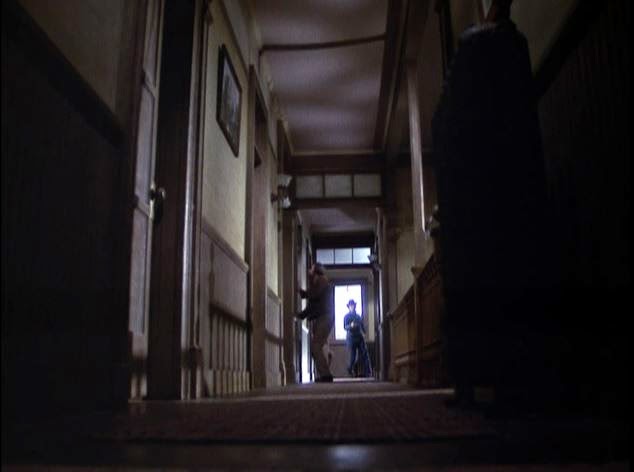
This is where we came in: Detective Daniels has Wilson show him to the Abandoned Plantation, and the body of Papa Benjamin... but the Plantation really is abandoned... spiderwebs fill the place, sticking to Wilson’s face as he leads the Detective and other policemen back to the room where he killed Papa Benjamin. All of the furniture is gone. And in that back room? No corpse. “I killed him, I tell you! Right here in this room!” They take him away...
New York City: Jerry visits Wilson in the mental ward. He’s getting better, and will soon be released.
When Wilson is released, he feels fine. Gained back weight. He goes to Jerry’s Office where he bumps into Judy. They’ve booked the band... on the island. Is Wilson up to this? Sure, that Voodoo stuff is fake. Superstition. He’s over it...
The Island: Wilson and Judy and the Band (minus Staats of course) play to a packed house. Wilson has never felt better. The crowd loves them. Then someone requests Voodoo Rhapsody. A moment... will Wilson play it? Of course! That whole voodoo thing was just superstition! The band starts playing, the crowd is loving it, then right as they get to the end... Wilson DROPS DEAD ON STAGE!
On the corner of the stage, a voodoo doll.

Review: This is the first of many THRILLER episodes that are based on a story by Cornell Woolrich (REAR WINDOW) and I wonder why it took them so long. Woolrich was a prolific pulp writer who turned out hundreds of thriller stories, many of which have been put on screen. Woolrich wrote all kinds of things for the pulp mags, from Noirs to Thrillers to Hardboiled to Crime Fiction to Police Procedurals to Supernatural stories to "Whiz Bangs" (sort of screwball crime fiction) and is one of the three fathers of modern Noir fiction (along with Horace McCoy and James M. Cain). His “Black Series” is one of the reasons why “noir” is noir, and when Truffaut did his pair of Hitchcock homages he picked a pair of novels by Woolrich, THE BRIDE WORE BLACK and WALTZ INTO DARKNESS. Hitchcock only made one film based on a Woolrich story (REAR WINDOW), which is surprising, but directed several short stories for his TV show and one for a *rival* TV show (FOUR O'CLOCK - a real nail-biter of a story about a husband who plots his wife's murder... then gets caught in his own trap and realizes *he* will die at 4 O'clock along with her!). Years ago I was up for a gig to adapt a great Woolrich story about an arson investigator who ends up prime suspect in a series of huge fires and must find the real arsonist... but all of the clues lead directly to him. Funny thing: I already had a treatment written, because this was one of my dream projects. Not funny thing: this was for a TV movie and they could not afford to have any buildings burn down... making a film about arson impossible. Hey, there are so many Woolrich stories out there, eventually I’ll get my chance.

But what about *this* story? This is an okay episode, and Ted Post does some great work with having Staats just vanish into the darkness and that scene where the spiderwebs cling to Wilson’s face make you go Yech! But in mainstreaming the story I think they took some of the punch out. The problem is, this story is all about mood. It’s a set up/punchline story that has not just been expanded to an hour (when it might have made a nice half hour show) they also start with the punchline: the episode opens with us knowing that voodoo is real. That’s actually the way the short story begins as well. But the short story is a metaphor for heroin addiction, and is about a New Orleans Jazz Band rather than a Ballroom Orchestra, and Staats doesn’t just vanish into the darkness, he comes back as a human skeleton... wasted away by his addiction to Voodoo. And Staats *dies* in the short story, as an early warning to Wilson (Bloch in the short story) of what will happen to him if he continues along this road. But in Noir when the protagonist sees that he or she is on the wrong path, that doesn’t stop them... they are addicted to the woman or the drug or the whatever else plays that “spider woman” role in the story. Because the Voodoo As Drug thing is muted, the focus ends up on that “twist end” which really isn’t a twist. Also, some of the suspense in the short story isn’t transferred to the screen: when Wilson follows Staats to the old Plantation is filled with tension and once they get to the Plantation there is all kind of suspense built up around the Wilson character being caught (in the story he creates a fake chicken foot to get him through the front gate, and suspense is built around him being discovered as an impostor). One of the things that’s great about Woolrich stories is the suspense, and that wasn’t really exploited in this episode... check out next week’s episode, though.
John Ireland is an odd choice, but gives a good performance. The wife character and the romance thing was an invention for the TV episode, probably as a way to externalize what the protagonist was going through... but it ends up adding a soapy element to the story. In REAR WINDOW the love interest was also an addition, but there it was done brilliantly: they made it thematic. Here it was just an additional character, and no effort was made to make Judy into a believer/non believer to take us deeper into the story.
The episode is still entertaining, and they do a great job of creating an island off the coast of Haiti on the backlot. But this isn’t the best episode of THRILLER based on a Cornell Woolrich story.
Bill