Friday, April 25, 2025

Fridays With Hitchcock: HITCH 20: ARTHUR (s3e4)

This is a great new documentary series called HITCH 20 that I am a "guest expert" on. The series looks at the 20 TV episodes directed by Hitchcock and here is the fourth episode of the third season, which looks at point of view and breaking the fourth wall in Hitchcock's work and in ARTHUR...

Not the great Dudley Moore movie nor the terrible remake, but an episode of ALFRED HITCHCOCK PRESENTS directed by Hitchcock and starring that fellow who was the MANCHURIAN CANDIDATE...


Once again I am in front of Universal Studios where this episode of HITCHCOCK PRESENTS was shot... and yes, they brought hundreds of live chickens and some chicken wranglers onto the lot and into the soundstage (this episode was shot indoors with some awesome background paintings making it look as if were out on a farm in the middle of the UK somewhere). Check out the shot where the police are searching - that’s an indoor set!

The episode focuses on breaking the fourth wall, but underneath that is something pretty common in film - the use of Voice Over Narration to get us into the head of a potentially unsympathetic character. If a character may be difficult to identify with, one of the techniques often used is to allow us to see the world through their eyes by giving them a running commentary - usually funny and amusing and entertaining. Adding an extra layer of story. So in a movie like DOUBLE INDEMNITY where our protagonist is a murderer, it helps to know their motivations and understand them... and it also helps that Walter Neff is amusing so that the narration is entertaining. The example I often use is another film from the same director, SUNSET BLVD, where protagonist and narration Joe Gillis is not just a screenwriter, his narration is filled with amazingly witty lines. You could remove the narration and the film still works perfectly, but it is so much better with that added layer of entertainment... plus it turns Gillis and Neff (and Arthur) into our friends and confidants. They are telling us their secret thoughts.


As I said in the episode, having Arthur talk directly into the camera also turns this into an odd satire on cooking shows, which were popular at the time. We watch Arthur prepare some meals, his presentation is beautiful, and he’s charismatic. Because cooking shows were inexpensive to produce in studios (still are) there were a bunch of them at the time, and the narration is just part of that.

But the narration doesn’t let the writer off the hook for telling the story visually - we see the dishes in the sink, the disk as the ashtray, the broken cup... and the audience wants to kill her, too. She has disrupted his orderly life. The narration might get us closer to Arthur, but all of those images, plus Helen herself, make us fully understand the chaos she has brought to Arthur’s life.

The actress who plays Helen, Hazel Court, may look familiar to you because she was a regular in all of those Corman Poe horror flicks we looked at last year during Halloween. THE RAVEN, MASQUE OF THE RED DEATH, and PREMATURE BURIAL among others. This episode even feels a bit like a Poe story. A UK actress who came to Hollywood and played all kinds of roles in lower budget movies and TV. I love her in this role - she manages to be irritating when doing minor things.


One of the fun things is the noise the chicken makes in the opening scene of the film is the same noise that Helen makes when Arthur strangles her. You can decide whether it’s the chicken or Helen’s strangulation sounds.

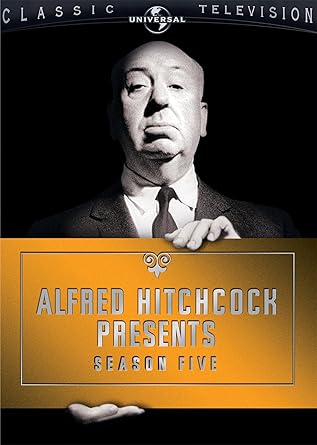
Which brings up strangulation - interesting, because that was the murder method in Hitchcock’s ROPE as well, and in both we side with the killers who then play a game of cat & mouse with an authority figure who is also a very close friend. In ROPE it’s their professor played by Jimmy Stewart, and here it’s the local constable played by Patrick MacNee who is his best friend. This is one of two episodes directed by Hitchcock that MacNee was in, what is that? 10% of the 20 episodes Hitchcock directed? The other episode is next up on HITCH 20, I think (this episode is Season 5 Episode 1 and that episode is Season 5 Episode 2). But the relationship between Arthur and the Constable is interesting because they are both close friends and on opposite sides of the law. There’s a great conversation about being alone, and therefor in control of your life. This gets to the core of what the story is about, aside from running your wife through an industrial strength grinder.

Hitchcock often experimented with giving the audience a walk on the wild side by telling the story from the “villain”s point of view. ROPE and PSYCHO and this episode put us in the shoes of the badguys and show us the world through their eyes, and make us worry that they will be caught be the authorities. And just for the trivia side of things, the female lead in PSYCHO, Janet Leigh, was the female lead in THE MANCHURIAN CANDIDATE which starred Lawrence Harvey... the star of this episode ARTHUR. Everything is connected!

- Bill

Now to plug my Hitchcock books...

HITCHCOCK: MASTERING SUSPENSE


LEARN SUSPENSE FROM THE MASTER!

Alfred Hitchcock, who directed 52 movies, was known as the “Master Of Suspense”; but what exactly is suspense and how can *we* master it? How does suspense work? How can *we* create “Hitchcockian” suspense scenes in our screenplays, novels, stories and films?

This book uses seventeen of Hitchcock’s films to show the difference between suspense and surprise, how to use “focus objects” to create suspense, the 20 iconic suspense scenes and situations, how plot twists work, using secrets for suspense, how to use Dread (the cousin of suspense) in horror stories, and dozens of other amazing storytelling lessons. From classics like “Strangers On A Train” and “The Birds” and “Vertigo” and “To Catch A Thief” to older films from the British period like “The 39 Steps” and “The Man Who Knew Too Much” to his hits from the silent era like “The Lodger” (about Jack The Ripper), we’ll look at all of the techniques to create suspense!

Films Included: NOTORIOUS, SABOTAGE, STRANGERS ON A TRAIN, THE 39 STEPS, REBECCA, TO CATCH A THIEF, FRENZY, FOREIGN CORRESPONDENT, THE LODGER, THE BIRDS, TORN CURTAIN, SABOTEUR, VERTIGO, THE MAN WHO KNEW TOO MUCH (1934), THE MAN WHO KNEW TOO MUCH (1955), SUSPICION, and NUMBER SEVENTEEN. 17 Great Films!

Only 125,000 words!

Accidentally still at the May Price of $3.99

Click here for more info!

OTHER COUNTRIES:

UK Folks Click Here.

German Folks Click Here.

French Folks Click Here.

Espania Folks Click Here.

Canadian Folks Click Here.


- Bill

Of course, my first book on Hitchcock...


HITCHCOCK: EXPERIMENTS IN TERROR


Click here for more info!

HITCHCOCK DID IT FIRST!

We all know that Alfred Hitchcock was the Master Of Suspense, but did you know he was the most *experimental* filmmaker in history?

Contained Thrillers like “Buried”? Serial Protagonists like “Place Beyond The Pines”? Multiple Connecting Stories like “Pulp Fiction”? Same Story Multiple Times like “Run, Lola, Run”? This book focuses on 18 of Hitchcock’s 53 films with wild cinema and story experiments which paved the way for modern films. Almost one hundred different experiments that you may think are recent cinema or story inventions... but some date back to Hitchcock’s *silent* films! We’ll examine these experiments and how they work. Great for film makers, screenwriters, film fans, producers and directors.

Films Examined: “Rear Window”, “Psycho”, “Family Plot”, “Topaz”, “Rope”, “The Wrong Man”, “Easy Virtue”, “Lifeboat”, “Bon Voyage”, “Aventure Malgache”, “Elstree Calling”, “Dial M for Murder”, “Stage Fright”, “Champagne”, “Spellbound”, “I Confess”, and “The Trouble with Harry”, with glances at “Vertigo” and several others.

Professional screenwriter William C. Martell takes you into the world of The Master Of Suspense and shows you the daring experiments that changed cinema. Over 77,000 words.

UK Folks Click Here.

German Folks Click Here.

French Folks Click Here.

Espania Folks Click Here.

Canadian Folks Click Here.

Bill

Friday, April 11, 2025

Fridays With Hitchcock:
HITCH 20: POISON (s3e2)

This is a great new documentary series called HITCH 20 that I am a "guest expert" on. The series looks at the 20 TV episodes directed by Hitchcock and here is the second episode of the third season, which looks at the terror of the unseen in Hitchcock's work.


Notes on the episode:

First off: How cool is the Poking The Tiger graphic? That totally made my day!

Many things get cut for time, so let’s talk about them here...

1) Once again, sorry for the sound issues - I think that’s why so little of my comments end up in this episode.

2) Though this story takes place somewhere in the tropics it was shot on the Revue Lot in Studio City (now CBS Radford) on a soundstage. The next three episodes covered were shot when the show had moved a couple of miles down the street at Universal, so that’s where I’ll be for those episodes.

3) This story by Roald Dahl is probably best known as a famous radio drama from Escape Radio Theater starring Jack Webb and William Conrad - that show’s most famous episode. Because this story deals with the unseen, radio is a perfect medium for it... our imaginations are already primed because we have to imagine everything else... so when you add that poisonous snake we can easily imagine the worst. Here is a page with a link to that episode: ESCAPE RADIO THEATER - POISON.

4) Hey, speaking of the unseen and that clip from JAWS - one of the cool things about this episode is that it deals with *dread*, which is a cousin to suspense. I think I talk a little more about that at the end of the episode. Dread is the “fuel” for horror because it’s roots are in “fear of the unknown” - we know that something terrible may happen but we don’t know when that will happen: it’s the Hitchcock bomb under the table and ticking clock... with no clock. When we can’t see the threat and we don’t known when or where it will strike, this creates unease in the audience and fear. Though people often credit the mechanical shark breakdown with the success of JAWS (because without the shark they had to depend on dread) I’m fairly sure that Spielberg is a smart enough filmmaker to know how dread works and had probably seen CREATURE FROM THE BLACK LAGOON (from the same studio as JAWS) and knew that it’s more effective *not* to show the monster before the attack to create dread... which is fear of the unknown, and often unseen.

By the way - even in a monster movie you eventually must show the monster (as this episode eventually shows us the snake) because the audience needs to know that it actually exists. Seeing is believing. Watch JAWS again and note how the *fin* is in almost every scene just before the shark attack. Just because the shark is below the surface and can not be seen before the attack doesn’t mean that it doesn’t exist - you still need to show it, so that the audience will know it. The monster is there - in the shadows - and eventually you must show it when it attacks!

The technique of dread may be an element of horror movies, but it can be used in any genre. One of the Trailer Tuesdays in rotation is on the noir film GUN CRAZY which uses dread in it’s final scene - where our protagonist couple are trying to escape from the police and end up huddled together in a foggy swamp with the *sounds* of the police and their barking bloodhounds all around them. Because we can not see these threats, they create dread. It’s not suspense - a known threat (ticking clock or something we can see) but dread which deals with fear of the *unknown* and/or *unseen*.

This episode of HITCHCOCK PRESENTS uses elements from other genres - like dread from horror movies and the heist genre. I think that’s important for filmmakers to remember - just because your story is in one genre doesn’t mean you can’t use the tools and techniques of other genres. You want to use every tool and technique to make the best possible movie... so know the techniques and how they work!

5) As I said in the episode - whether it’s suspense or dread, you need to poke the tiger and remind the audience that the threat is there, so they don’t forget. You may think, “of course they won’t forget, that’s what the story is about!” but suspense (and dread) will *dissipate* if you don’t keep reminding the audience... and when something is unseen you have to keep those tiger pokes coming. The character’s coughing is a great way to poke the tiger - think of how often something like a sneeze is used in comedy films to do the same thing. Come up with a list of “pokes” to keep your suspense bubbling! “The chloroform will be very cold, but don’t move!” Coughing, sweating, his buddy poking and prodding, the chloroform, the tube, and everything else that can keep the suspense in the forefront of the audience’s mind! Keep poking that tiger!

6) In Hitchcock’s explanation of how suspense works, he talks about the bomb under the table that we know will go off at a specific time and the clock on the wall counting down the minutes... and the two people at the table talking about something innocuous like *baseball scores*. That last part is often forgotten or misunderstood by filmmakers and screenwriters... and of course, development folks. You not only don’t want any conversation that will distract from the suspense, you also want conversation that is *pointless* - if someone is saying something important or interesting or with purpose then the audience will understand why they aren’t focusing on the bomb under the table (or whatever the suspense generator is). That dissipates the suspense because there is other important information in the scene. So suspense *increases* if the conversation is meaningless... like that wrong number when phoning for the doctor in POISON. Not just the wrong number, but *talking about it* afterwards instead of getting right back to dialing that phone and getting help. Frustration is an element of suspense - “Don’t just stand there, do something! Do something!” One of the notes I’ve gotten in suspense scenes from clueless Development Execs deals with dialogue like those baseball score conversations... they just don’t understand the basics of how suspense works! You *want* that wrong number and then the silly conversation about making the mistake before dialing it again - that ramps up the suspense!

7) The Heist Genre element that I mention in the show: Heist movies usually have a scene where the plan is discussed step-by-step, and this episode uses that technique with the doctor’s plan to knock out the snake. He explains exactly what he is going to do, so that the audience can *anticipate* each step and its effect before it happens. Suspense is the *anticipation* of a known action... so the audience is now able to anticipate the outcome of each step in the plan... and wonder if things will go wrong. If they don’t know what is going to happen, there is no suspense - just things happening. Because we know what is *supposed to happen* in a heist scene, when something doesn’t happen as planned the audience worries that it will cause larger problems. Here, each step in the plan to knock out that poisonous snake has the ability to go wrong and cause larger problems (well, the guy will be bitten and die - that’s a pretty big problem), so as each step is meticulously done and small problems occur, the audience is on the edge of their seats worried that even small deviations in the plan may have fatal consequences.

8) Love the ironic twist ending!

Next episode of HITCH 20 I’ll be a couple of miles down the street at Universal Studios, where the show moved to after this season.

- Bill

Of course, I have my own book on Hitchcock...


HITCHCOCK: EXPERIMENTS IN TERROR


Click here for more info!

HITCHCOCK DID IT FIRST!

We all know that Alfred Hitchcock was the Master Of Suspense, but did you know he was the most *experimental* filmmaker in history?

Contained Thrillers like “Buried”? Serial Protagonists like “Place Beyond The Pines”? Multiple Connecting Stories like “Pulp Fiction”? Same Story Multiple Times like “Run, Lola, Run”? This book focuses on 18 of Hitchcock’s 53 films with wild cinema and story experiments which paved the way for modern films. Almost one hundred different experiments that you may think are recent cinema or story inventions... but some date back to Hitchcock’s *silent* films! We’ll examine these experiments and how they work. Great for film makers, screenwriters, film fans, producers and directors.

Films Examined: “Rear Window”, “Psycho”, “Family Plot”, “Topaz”, “Rope”, “The Wrong Man”, “Easy Virtue”, “Lifeboat”, “Bon Voyage”, “Aventure Malgache”, “Elstree Calling”, “Dial M for Murder”, “Stage Fright”, “Champagne”, “Spellbound”, “I Confess”, and “The Trouble with Harry”, with glances at “Vertigo” and several others.

Professional screenwriter William C. Martell takes you into the world of The Master Of Suspense and shows you the daring experiments that changed cinema. Over 77,000 words.

UK Folks Click Here.

German Folks Click Here.

French Folks Click Here.

Espania Folks Click Here.

Canadian Folks Click Here.

Bill

Friday, April 04, 2025

Fridays With Hitchcock:
HITCH 20: Dip In The Pool (s3e1)

This is a great new documentary series called HITCH 20 that I am a "guest expert" on. The series looks at the 20 TV episodes directed by Hitchcock and here is the first episode of the third season, which looks at the importance of shot selection in Hitchcock's work on screen.


Notes On The Episode:

Many things get cut for time, so let’s talk about them here...

1) First off - sorry for the bad sound! My friend who was scheduled to shoot my episodes this season landed a studio gig and couldn’t shoot the first two episodes, so I called another friend who does sound on movies (thinking that the sound is more important than the picture, right?) and ask him to do me a favor... He shows up completely unprepared, with no headset - so he has no idea what any of this sounds like until it’s too late to do anything about it. Weird, because I have a pair of cheap headphones in my camera bag (with my cheap camera). So the first two episodes this year will have iffy sound quality in my segments. He did save my ass by helping out, so maybe beggers can't be choosers. But the sound sucks. Now on to the episode itself...

2) This story hits the ground running when it comes to characters - the Wife appreciates things that are internal and emotional (experiencing all of these wonderful places on vacation) and the Husband is completely external. This opening discussion does a great job of defining their differences as they discuss their vacation plans. I love her line, “That’s the whole trouble with you, William. If you can’t drink it, wear it, or ride in it you think it has no value.” Finding a great jab like that which both sums up the character and is the kind of witty put down that makes the audience laugh is a great two-fer. That’s not an OTN line of dialogue because it’s *mean*. The Wife has put up with a bunch of his crap in this conversation and she gets the last word (sort of).

3) Is that line the trigger for the Husband’s bet? This gets into the “tennis plotting” thing in my SECRETS OF ACTION SCREENWRITING - every action causes an equal and opposite reaction, and the characters knock the tennis ball of plot back and forth between them. The Husband triggers the Wife’s comment, her comment triggers his wish to prove himself (he’s very insecure), and it goes back and forth until we reach the end.


4) Leading The Audience. This is a big part of playing the audience like a musical instrument, though it has to do with the story elements rather that the shots (actually, in harmony with the shots). As writers our job is to Always Be Leading. We know this isn’t the best marriage in the world, then the Husband bribes the Steward for a vial of pills. He takes the vial of pills with him when he mixes his Wife’s drink. What does this lead the audience to believe? What does the audience expect to happen next? By leading the audience to jump to a conclusion, what *actually* happens becomes unexpected. Hey, this is HITCHCOCK PRESENTS, people poison each other on this show! So the audience jumps to the conclusion that the pill vial may be poison and the Husband will put some poison in his Wife’s drink and kill her... But the “twist” is that they are seasick pills and the Husband just doesn’t want his Wife to see his weakness - he’s seasick and needs to take a pill to keep from vomiting. The great thing about this is that it isn’t just leading the audience to jump to that poisoning scenario (adding a bit of excitement in this opening scene) it’s also all about *character* - the Husband not wanting to appear weak. Remember, he’s all about appearances, about the external.

The other nice little bit of Leading The Audience is the word “Pool”. Just as the Husband is lead to believe that this “pool” might involve swimming, so does the audience at first. The great thing about words with multiple meanings is that they can lead to confusion, and confusion creates realistic dialogue (we look at that technique in the Dialogue Blue Book). Always be looking for words with multiple meanings to use in dialogue, then lead the audience to think one meaning is being used when it is actually another meaning. That creates unpredictable dialogue which seems real. The odd thing about leading the audience is that the more a writer *plans* the more the result seems *unplanned*. If a conversation is about the “Ship’s Pool” the audience will jump to the conclusion that it is the swimming pool on the ship, instead of a *betting* pool on the ship.

5) Last but totally not least - this episode has a busted twist. The twist comes out of the blue and makes no sense at all! This lead me to re-read the Roald Dahl short story again to see where the episode went wrong. The answer: casting.


In the short story, the two women passengers are also Aged Mother and Middle Aged Daughter... but the “witness” was the Aged Mother who is slyly established as suffering from dementia, so the Daughter doesn’t believe her. Somehow in casting these roles were reversed and a middle aged actress was cast in the “Aged Mother” role and an elderly actress cast in the “Middle Aged Daughter” role. I know that sounds confusing, but the results are that the twist end where the Mother is not believed because she has dementia is flipped so that the Daughter is disbelieved by her Mother. Why? Never set up! Makes no sense at all! So the twist end is more of a WTF? moment than a twist.

How they could have fixed this: The earlier scene where the Husband and the (witness) Daughter character bump into each other in the passageway should have given her dialogue with double meanings. One meaning should have seemed innocuous and the other clearly showing that the character is delusional. Just off the top of my head, the word “unbalanced” can deal with rocking boats and sanity. That’s the obvious choice, with a little thought I could probably come up with the more clever version... but it just shows you how easy this problem was to solve (yet it didn’t get solved). Even if the script was written with the intention of the “witness” character being that Aged Mother, you still want to do all that you can at the script stage to make the story work. As writers we have no control over casting, so I always write for the worst possible casting choice instead of the best possible casting choice - just in case. You don’t want to depend on everything going right, because there are so many variables in making a film that something is always going to go wrong. Often many things! So you want the screenplay to be the very best that it can be and not depend on the competency of others. I’m sure the casting choice on this episode made sense at the time (I’m guessing that the younger woman seemed like a potential love interest in that earlier scene so they swapped the roles of Mother and Daughter... not realizing that would bust the twist ending). A plot twist is revealing what has always been true, so in earlier scenes that trust must be present. There is a Leading The Audience element to this - we want to lead the audience to *not* see that truth earlier in the story, even though it is there. Something like dialogue with two meanings or actions which can be understood in two different ways or a clever diversion so that we are too busy looking at A when the obvious trust is B are things that can help a twist. The HITCHCOCK PRESENTS show was famous for it’s twist endings, so this is something that they should have under control.

I think the next episode up is POISON, based on a famous short story that was adapted into a famous ESCAPE RADIO THEATER episode.

- Bill

Of course, I have my own book on Hitchcock...


HITCHCOCK: EXPERIMENTS IN TERROR


Click here for more info!

HITCHCOCK DID IT FIRST!

We all know that Alfred Hitchcock was the Master Of Suspense, but did you know he was the most *experimental* filmmaker in history?

Contained Thrillers like “Buried”? Serial Protagonists like “Place Beyond The Pines”? Multiple Connecting Stories like “Pulp Fiction”? Same Story Multiple Times like “Run, Lola, Run”? This book focuses on 18 of Hitchcock’s 53 films with wild cinema and story experiments which paved the way for modern films. Almost one hundred different experiments that you may think are recent cinema or story inventions... but some date back to Hitchcock’s *silent* films! We’ll examine these experiments and how they work. Great for film makers, screenwriters, film fans, producers and directors.

Films Examined: “Rear Window”, “Psycho”, “Family Plot”, “Topaz”, “Rope”, “The Wrong Man”, “Easy Virtue”, “Lifeboat”, “Bon Voyage”, “Aventure Malgache”, “Elstree Calling”, “Dial M for Murder”, “Stage Fright”, “Champagne”, “Spellbound”, “I Confess”, and “The Trouble with Harry”, with glances at “Vertigo” and several others.

Professional screenwriter William C. Martell takes you into the world of The Master Of Suspense and shows you the daring experiments that changed cinema. Over 77,000 words.

UK Folks Click Here.

German Folks Click Here.

French Folks Click Here.

Espania Folks Click Here.

Canadian Folks Click Here.

Bill